

You saw “rls” in a text, a TikTok comment, or a group chat, and now you’re stuck. Is it slang? Is it medical?
Is it some tech term your coworker dropped in a meeting? The truth is, RLS is one of those short forms that changes meaning depending on where you spot it.
This guide breaks down every common meaning of RLS — from casual texting slang to Restless Legs Syndrome to Row-Level Security in software — so you never have to guess again.
RLS Meaning In Text — Primary Definition
In everyday texting and social media, RLS most often stands for “Real Life Stuff” or “Real-Life Situation.”
People use it as a quick way to explain they’re dealing with something offline — work, family, errands, or just life getting in the way.
It shows up when someone can’t reply fast, cancels plans, or explains a gap in conversation. A typical message looks like this: “sorry I went quiet, dealing with rls rn.”
The term is casual, low-key, and doesn’t require oversharing. That’s part of why it stuck around — it lets people explain themselves without going into detail.
Other Common Meanings (Secondary)
RLS isn’t a one-definition acronym. Depending on the platform or audience, it can shift entirely. Here are the meanings you’ll run into most:
- Restless Legs Syndrome — a medical condition, common in health forums and doctor conversations.
- Relationships — used in some casual chats to reference dating or romantic topics.
- Row-Level Security — a data-access control term used in databases and business software.
- Real Live Stream — occasionally used in streaming or gaming communities for an ongoing broadcast.
- Return Link Service — a satellite distress-beacon confirmation signal, mostly used in maritime and aviation safety tech.
Context is everything. A message from a friend probably means “real life stuff.” A comment on a health forum probably means the medical condition.
What Does RLS Mean In Text — Origin & History

RLS traces back to early internet culture, when forums and instant messengers needed a fast way to separate online conversation from offline life.
Typing on early phone keyboards was slow, so short forms like RLS, IRL, and BRB became everyday habits.
As texting apps and social platforms grew, RLS carried over naturally. It became a staple in DMs, captions, and group chats because it’s short, flexible, and doesn’t demand explanation.
Over the past few years, the abbreviation has picked up extra meanings as different online communities adopted it for their own purposes — health forums for the medical condition, dating apps for relationship talk, and tech spaces for row-level security. One shorthand, several lives.
How People Use “rls” Online — Examples & Context
Seeing RLS in real conversations makes the meaning click faster than any definition alone. Here’s how it typically plays out:
- WhatsApp/iMessage: “Sorry I disappeared, rls got hectic this week.”
- TikTok comments: “when rls hits harder than the algorithm 😭”
- Discord/Slack: “can’t make the call today, dealing with some rls.”
- Instagram captions: “back to rls after a great weekend.”
- Dating app bios: “rls only, no drama.”
Notice that tone, punctuation, and emojis shape how the message feels, even though the abbreviation itself stays neutral. A crying-laughing emoji signals humor. A period and no emoji usually signals it’s genuine.
Related Slang & Alternatives — Quick Reference Table
| Abbreviation | Meaning | Typical Use Case |
| RLS | Real Life Stuff / Real-Life Situation | Explaining offline distractions |
| IRL | In Real Life | Contrasting online vs. offline identity |
| BRB | Be Right Back | Short pause in a live chat |
| TTYL | Talk To You Later | Ending a conversation temporarily |
| SMH | Shaking My Head | Expressing disbelief or disappointment |
| DM | Direct Message | Referring to a private message |
| OTG | On The Go | Being busy or out and about |
Popular Phrases Similar To rls
If RLS feels too vague or you want to switch it up, several phrases carry the same meaning:
- “Life stuff got in the way.”
- “Dealing with some things offline.”
- “Caught up with the real world today.”
- “Had a lot on my plate.”
- “Went through some things IRL.”
These work well in more formal or professional messages where RLS itself might read as too casual.
Top Mistakes When Using rls
A few slip-ups happen often enough that they’re worth flagging:
- Using it in formal emails or work messages. RLS reads as casual slang, so it can feel unprofessional in a work thread.
- Assuming the medical meaning applies everywhere. In a texting context, jumping to “Restless Legs Syndrome” usually causes confusion.
- Overusing it as a vague excuse. Repeating RLS without any follow-up can come across as evasive rather than honest.
- Ignoring platform norms. What works in a Discord server might not land the same way in a LinkedIn comment.
- Mixing it with unrelated acronyms. Pairing RLS with too many other short forms in one message can make texts hard to read.
Trending Contexts For rls Online
RLS shows up most in a handful of recurring situations:
- Late-night social media threads where people share offline confessions.
- Group chats catching up after a period of inactivity.
- Captions meant to feel authentic rather than overly curated.
- Dating app bios signaling a preference for low-drama connections.
- Gaming and streaming chats explaining a pause in activity.
It remains a niche shorthand rather than a universal term — common in casual spaces, but not something everyone recognizes on sight.
Creative Ways To Use rls In Conversation
Want to use RLS without sounding repetitive? Try mixing it into different tones:
- Playful: “rls said no more scrolling today 🙃”
- Honest: “rls has been a lot lately, needed a break from my phone.”
- Quick update: “ghosted the group chat for a sec, rls > wifi.”
- Light apology: “my bad, rls pulled me away from replying.”
Small tweaks in phrasing keep it feeling natural instead of copy-pasted.
How To Reply When Someone Says “rls”

A good reply usually acknowledges the person without pushing for details they didn’t offer. A few options:
- “No worries, hope everything’s okay!”
- “Totally get it, rls always finds a way.”
- “Take your time, chat whenever you’re free.”
- “Hope rls settles down for you soon.”
If the tone feels heavier than casual, a simple check-in like “everything alright?” shows you’re paying attention without prying.
Can rls Be Used Professionally?
Generally, no — not directly. RLS is casual internet shorthand, and using it in a client email or formal report can come across as unclear or unprofessional. Swap it for plain language instead, such as “personal matters” or “unforeseen circumstances.”
The one exception is the tech meaning. Row-Level Security is a legitimate, professional term used in database administration, business intelligence tools, and data governance conversations. In that context, RLS is entirely appropriate in formal settings.
Rls meaning slang
As slang, RLS is shorthand for “real life stuff” or “real-life situation.” It’s used to explain being busy, distracted, or offline without going into specifics.
Rls meaning relationship
In some casual and dating contexts, RLS is used to reference relationships or romantic situations, especially in bios or DMs. The intended meaning usually becomes clear from the surrounding conversation.
Rls meaning tiktok
On TikTok, RLS typically appears in captions or comments related to everyday stress, offline responsibilities, or a break from posting. It’s often paired with humor or relatable memes rather than serious explanations.
Rls meaning in chat
In live chats — Discord, Slack, or group messages — RLS usually explains a delay in responding or participating. It signals that something outside the app needs attention right now.
Restless Leg Syndrome: The New Cure

There isn’t a single cure for Restless Legs Syndrome (RLS), and claims of a definitive “new cure” should be treated with caution.
What has genuinely improved is the range of treatment options, which now allow most people to manage symptoms effectively.
Recent approaches focus on combining lifestyle changes with targeted medication, plus better screening for underlying causes like iron deficiency.
For many people, correcting an iron deficiency alone leads to major symptom relief. Anyone considering a new treatment should talk to a doctor rather than relying on unverified online claims.
Restless Leg Syndrome Treatment
Treatment usually starts with the basics before moving to medication. A doctor typically works through this in stages:
- Lifestyle adjustments — regular exercise, consistent sleep schedules, and cutting back on caffeine or alcohol.
- Addressing underlying causes — checking iron levels, kidney function, and any medications that might worsen symptoms.
- Medication — options may include dopamine agonists, alpha-2-delta calcium channel ligands, or iron supplements when levels are low.
- Ongoing monitoring — since RLS can change over time, treatment plans are often adjusted as symptoms evolve.
There’s no one-size-fits-all treatment, so what works well for one person may not work for another.
RLS Symptoms
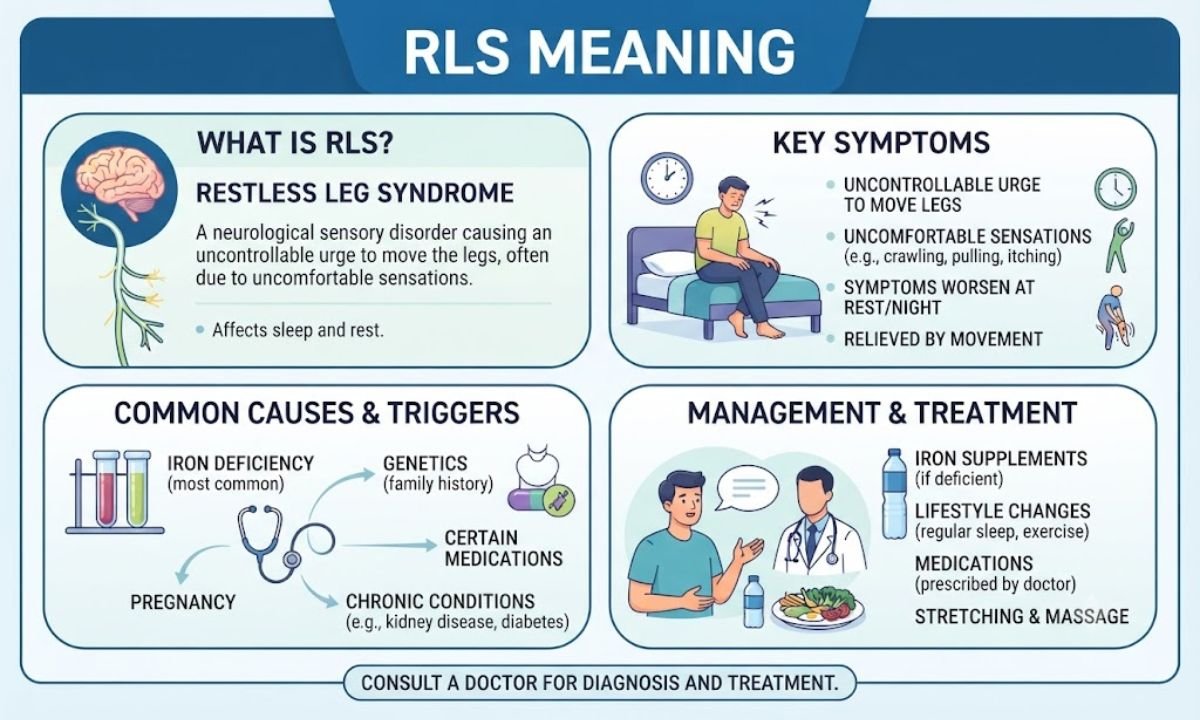
Restless Legs Syndrome causes an uncomfortable, hard-to-describe urge to move the legs. Common symptoms include:
- A crawling, tingling, or aching sensation deep in the legs.
- An urge to move that gets stronger when sitting or lying still.
- Symptoms that worsen in the evening or at night.
- Temporary relief with movement, like walking or stretching.
- Sleep disruption caused by the constant urge to shift position.
Symptoms range from mild and occasional to severe enough to interfere with daily life and sleep quality.
How To Stop Restless Legs Immediately
For quick, short-term relief, people often try:
- Walking or stretching the legs for a few minutes.
- Massaging the calves and thighs.
- Applying a warm or cold compress.
- Taking a warm bath before bed.
- Standing up and shifting position rather than staying still.
These steps ease symptoms in the moment, but they don’t address the underlying cause. Anyone with frequent or severe symptoms should still talk to a healthcare provider.
Is Restless Leg Syndrome Dangerous
RLS itself is not considered dangerous or life-threatening. However, it can significantly disrupt sleep, and long-term sleep loss is linked to fatigue, mood changes, and reduced quality of life.
In some cases, RLS is a sign of an underlying condition, like iron deficiency or kidney disease, which is why Persistent symptoms are worth discussing with a doctor rather than ignoring.
RLS Causes
The exact cause of Restless Legs Syndrome isn’t fully understood, but several factors are commonly linked to it:
- Genetics — RLS often runs in families, especially when symptoms start early in life.
- Iron deficiency — low iron levels in the brain are strongly associated with RLS symptoms.
- Chronic conditions — kidney disease, diabetes, and peripheral neuropathy are frequently connected.
- Pregnancy — especially in the third trimester, though symptoms usually resolve after delivery.
- Medications — certain antihistamines, antidepressants, and anti-nausea drugs can trigger or worsen symptoms.
Because causes vary so widely, a proper diagnosis matters more than guessing at home remedies.
Restless Leg Syndrome Diagnosis
There’s no single lab test for RLS. Instead, doctors typically diagnose it based on a set of criteria, including:
- An urge to move the legs, usually with uncomfortable sensations.
- Symptoms that start or worsen during rest.
- Relief from symptoms with movement.
- Symptoms that are worse in the evening or at night.
Blood tests, especially for iron levels, are often ordered to rule out or confirm underlying causes. In some cases, a sleep study helps assess how RLS is affecting sleep quality.
Conclusion
RLS is one short abbreviation with a surprisingly long list of meanings. In texting, it’s almost always “real life stuff.”
In a doctor’s office, it points to a real medical condition affecting the legs and sleep. In tech and data teams, it refers to row-level security controls.
Context is the key to reading it correctly every time. Once you know where to look — the platform, the person, and the conversation — RLS stops being confusing and starts being simple.
Frequently Asked Questions
What does RLS stand for in medical terms?
In medical terms, RLS stands for Restless Legs Syndrome, a condition that causes uncomfortable sensations and an urge to move the legs, especially at rest or at night.
What does RLS mean?
RLS most commonly means “Real Life Stuff” in texting, Restless Legs Syndrome in medical contexts, and Row-Level Security in technology and data settings. The correct meaning depends on where you see it.
Can you explain the meaning of RLS in technology products?
In technology, RLS usually refers to Row-Level Security, a feature that restricts which rows of data a user can view or edit based on their role or identity, commonly used in databases and business intelligence tools.
What are the common symptoms of restless legs syndrome?
Common symptoms include an uncomfortable crawling or tingling feeling in the legs, an urge to move them, symptoms that worsen at rest or at night, and temporary relief through movement.
What is the RLS feature in popular streaming services?
RLS isn’t a standard consumer feature in mainstream streaming apps. The term is more commonly tied to Row-Level Security in the backend data systems some platforms use, or to “Real Live Stream” as informal slang in streaming chat communities.
What causes RLS?
Restless Legs Syndrome is linked to genetics, iron deficiency, pregnancy, certain chronic conditions like kidney disease, and some medications, though the exact cause isn’t always identified.
How do companies use RLS in data security?
Companies use Row-Level Security to control which specific rows of a database each user can access, ensuring people only see data relevant to their role, department, or permissions.
Where can I find RLS options for cloud software?
Row-Level Security settings are typically found in the admin or security section of cloud data platforms and business intelligence tools, such as Power BI, Snowflake, and similar database services.
What are the main treatment options for RLS?
Main treatment options include lifestyle changes, correcting iron deficiency, and medications such as dopamine agonists or alpha-2-delta calcium channel ligands, depending on symptom severity.

I am a dedicated author with 6+ years of experience writing and researching content for name meaning websites. My expertise includes American names, baby names, surnames, name origins, and cultural significance. I focus on creating accurate, well researched, and easy to read articles using trusted sources. My goal is to help readers discover the history, meaning, and uniqueness behind every name with reliable and engaging content.