
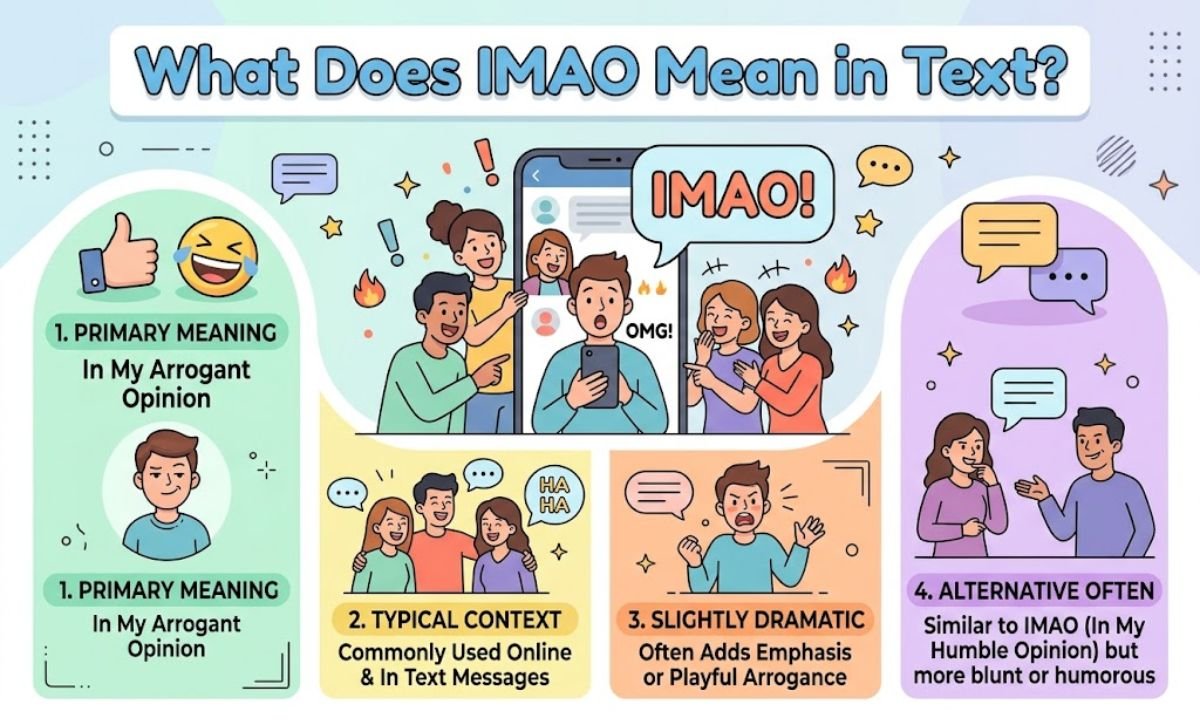

Scrolling through a group chat, you spot a reply that just says “imao” and nothing else. No context, no punctuation, just four letters sitting there like a punchline you’re not in on.
If you paused to Google it, you’re not alone — this acronym trips up more people than most internet slang because it looks so close to a term you already know.
IMAO stands for “in my arrogant opinion,” a sarcastic cousin of the more familiar IMHO. But in everyday texting, it’s just as often a typo for LMAO, which changes the meaning completely.
This guide breaks down where IMAO came from, how people actually use it today, and how to tell which meaning someone intended.
What Is IMAO? Full Explanation
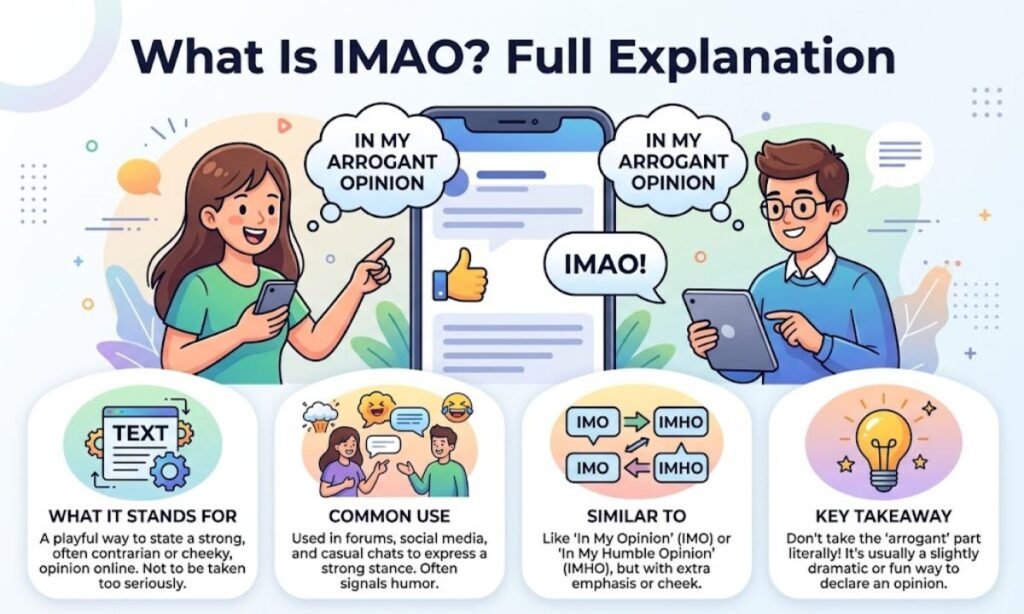
At its core, IMAO is short for “in my arrogant opinion.” It’s a play on IMHO, or “in my humble opinion,” swapping humility for exaggerated confidence. People use it to soften a blunt or opinionated statement by poking fun at their own certainty.
The tone is almost always self-aware. Someone typing IMAO isn’t usually claiming real arrogance — they’re signaling that what follows is a strong take, delivered with a wink. It works the same way sarcasm does in speech: the words say one thing, but the intent is lighter.
Here’s the twist that makes IMAO confusing: in modern texting, it’s frequently a simple typo for LMAO (“laughing my ass off”).
On many keyboards and fonts, a lowercase L can look almost identical to a capital I, so “lmao” becomes “imao” without anyone noticing. This means the acronym now carries two live meanings depending on context.
- Formal internet-slang definition: In my arrogant opinion
- Common casual usage: An accidental (or intentional) stand-in for LMAO
Both readings are valid today, which is exactly why context matters more than the letters themselves.
Linguists who study internet slang point out that acronyms like IMAO survive because they’re efficient. A single word replaces a full phrase, letting a conversation keep its speed without losing the emotional flavor behind it.
That efficiency is also why the meaning can drift over time — once enough people start using a term one way, that usage becomes just as “correct” as the original.
It also helps to remember that IMAO isn’t tied to any single platform. It shows up in texts, comment sections, forums, and DMs alike, which is part of why its meaning has stretched to cover more than one situation over the years.
How IMAO Became Popular Online
IMAO isn’t a recent invention — it actually predates most modern internet slang by decades. Language researchers trace early use of the acronym back to a 1989 Usenet discussion about the band the Grateful Dead, where a poster used it to flag a deliberately opinionated take and then explained what it meant so people would stop asking.
From there, IMAO spread slowly through online forums and newsgroups throughout the 1990s, mostly in debates and arguments where someone wanted to sound confident without sounding preachy.
It never reached the mainstream popularity of IMHO, partly because admitting arrogance isn’t something most people want to do mid-argument.
The acronym found new life once texting and social media took over casual communication. As typing speed became more important than spelling accuracy, IMAO picked up its second identity as a typo-driven stand-in for LMAO.
Today, that accidental usage is arguably more common than the original sarcastic meaning, especially among younger texters who may not know the original phrase at all.
Social media accelerated that shift even further. Comment threads move quickly, and a fast reply typed on a phone keyboard is far more prone to letter mix-ups than a carefully composed forum post from the 1990s.
As a result, IMAO gradually became one of those rare acronyms that carries meaningful history on one hand and a very modern, accidental identity on the other.
When Should You Use IMAO?
IMAO fits best in casual, low-stakes conversations where a little sarcasm is welcome. Think group chats, social media comments, or texts between friends who already share an easy, joking tone.
It’s a useful tool when you want to give an opinion that might sound harsh on its own, but softened by the acknowledgment that you know you’re being a bit much. Use it when:
- You’re stating a strong opinion and want to signal you’re aware it’s biased.
- The conversation already has a playful, teasing energy.
- You want to react to something funny and mean LMAO instead.
- You’re texting someone who already understands internet slang and won’t need a translation.
Avoid IMAO in professional emails, formal messages, or any conversation where tone could easily be misread. Because the acronym carries two possible meanings, using it with someone unfamiliar with slang can create more confusion than clarity.
It also helps to think about your audience before hitting send. A close friend who texts you daily will pick up on the joke instantly, while a new coworker or an older relative might take the “Arrogant” wording at face value.
When in doubt, a plain sentence gets the point across just as well without any risk of the message landing the wrong way.
Real-World Examples of IMAO Usage
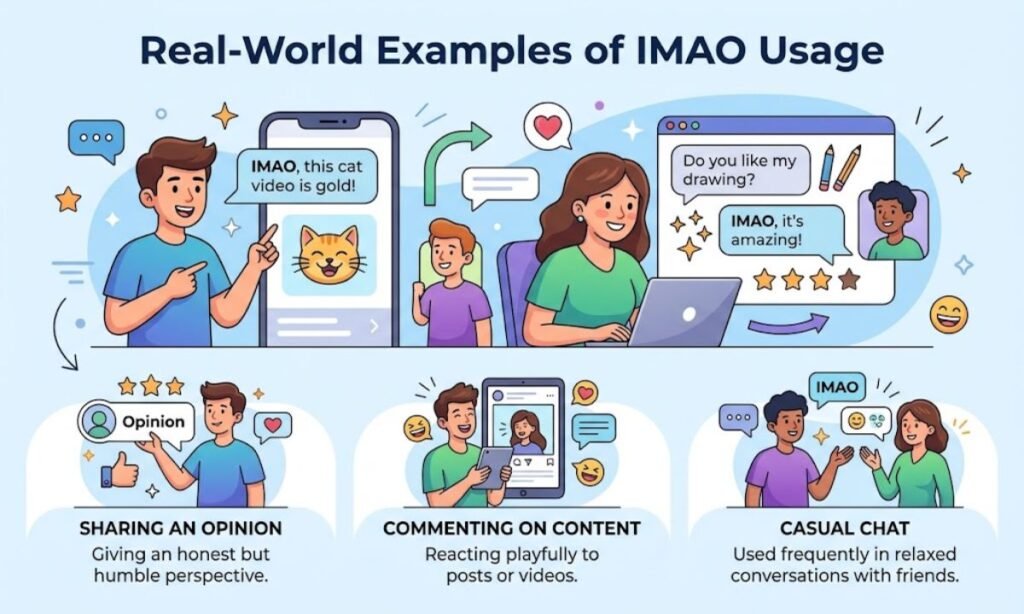
Seeing IMAO in context makes both meanings much easier to spot. Below are common ways it shows up in real conversations.
As “in my arrogant opinion”:
- “IMAO, pineapple absolutely belongs on pizza.”
- “That movie was mediocre at best, IMAO.”
- “IMAO, everyone overthinks this way too much.”
As a typo or stand-in for LMAO:
- “He tripped over his own shoelace imao.”
- “Imao I can’t believe you actually said that out loud.”
- “Wait that’s so random imao.”
Notice how the second group reads more naturally as a reaction to something funny, while the first group reads like a stated opinion. That difference in sentence structure is often the clearest clue to which meaning is intended.
Punctuation and placement matter too. When IMAO opens a sentence and is followed by a complete thought, it’s usually functioning as an opinion marker.
When it’s dropped at the end of a message, almost like an afterthought, it’s far more likely standing in for laughter. Reading the full message before replying — rather than reacting to the acronym alone — is the simplest way to avoid misreading someone’s tone.
Common Mistakes and Misconceptions About IMAO
A lot of confusion around IMAO comes from assuming it only has one correct meaning. In reality, both common interpretations are widely used, and neither is “wrong” — context decides which one applies.
Here are a few misconceptions worth clearing up:
- Misconception: IMAO always means the same as LMAO. It doesn’t. The original, dictionary-recognized meaning is “in my arrogant opinion,” even though the typo usage is now extremely common.
- Misconception: IMAO is always meant to be taken literally. Even in its “arrogant opinion” sense, it’s typically playful, not a genuine claim of superiority.
- Misconception: Only older internet users use the “arrogant opinion” meaning. While it originated decades ago, it still shows up in debates, forums, and comment sections today.
- Misconception: Using IMAO is rude. The tone is closer to self-deprecating humor than actual arrogance, so most readers take it as a joke rather than an insult.
- Misconception: IMAO and IMFAO mean the same thing. IMFAO is a separate, more explicit variation that intensifies the “opinion” meaning with stronger language, and it isn’t interchangeable with the milder IMAO.
Another common mix-up happens when people assume the acronym is brand new internet slang made for texting. In reality, IMAO predates smartphones entirely, and its original meaning has simply picked up a second life thanks to a typing quirk.
Knowing that history helps explain why two very different definitions can both be technically “correct” today.
IMAO vs Similar Internet Abbreviations
IMAO belongs to a small family of opinion-and-reaction acronyms that often get mixed up because they look alike or serve similar purposes. Here’s a quick side-by-side comparison.
| Acronym | Full Meaning | Typical Tone | Common Use Case |
| IMAO | In my arrogant opinion | Sarcastic, confident | Stating a strong opinion with self-aware humor |
| IMHO | In my humble opinion | Polite, modest | Softening a suggestion or opinion |
| LMAO | Laughing my ass off | Amused, casual | Reacting to something funny |
| LOL | Laughing out loud | Light, friendly | General amusement or acknowledgment |
IMAO vs IMHO
IMHO and IMAO share the same sentence structure but opposite attitudes. IMHO signals modesty, often used before giving advice or a gentle opinion, while IMAO deliberately drops the humility for comedic effect.
If someone wants to sound approachable, they reach for IMHO; if they want to sound cheekily overconfident, IMAO is the better fit.
IMAO vs LMAO
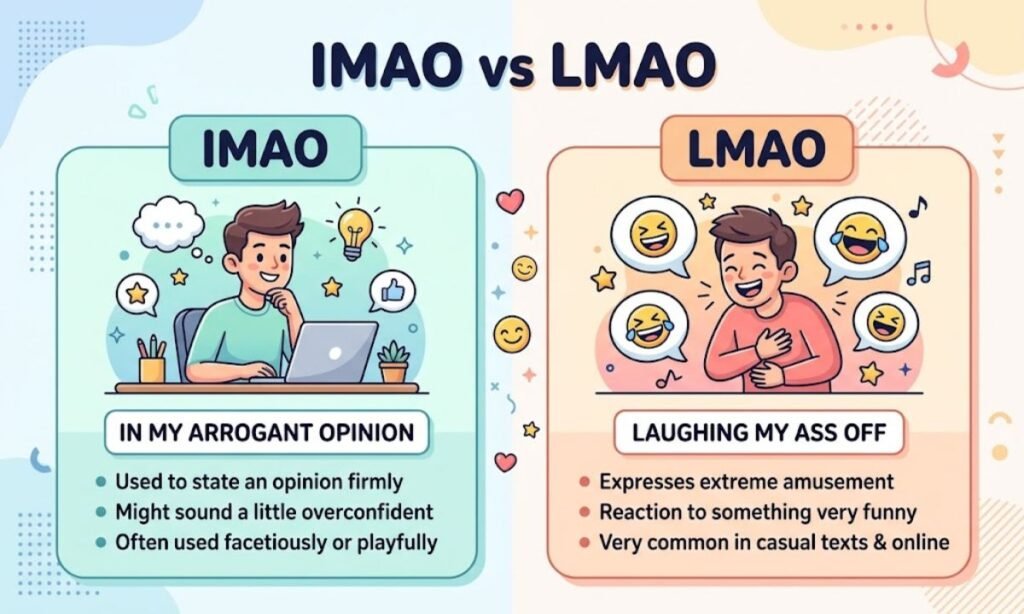
This is where most real-world confusion happens. LMAO is purely a reaction to something funny, with no opinion attached at all.
IMAO, in its typo form, gets used the exact same way — but in its original form, it’s making a statement rather than just laughing. Sentence context is the only reliable way to tell them apart.
IMAO vs LOL
LOL is the mildest and most universal laughter acronym, used almost reflexively in casual texting.
IMAO carries more personality, either through sarcasm (arrogant opinion) or through the more intense reaction implied by LMAO. LOL rarely causes confusion the way IMAO does, since it doesn’t double as an opinion marker.
Why Internet Slang Matters in Modern Communication
Acronyms like IMAO exist because digital conversation moves fast, and tone is hard to convey through text alone. Slang fills that gap, letting people signal sarcasm, humor, or emphasis without writing out a full sentence every time.
Understanding these terms isn’t just about keeping up with trends — it helps prevent real misunderstandings. A message meant as a joke can land as an insult if the reader doesn’t recognize the acronym’s intended tone, and vice versa.
As texting, DMs, and comment sections continue to replace face-to-face conversation for a huge share of daily communication, knowing the difference between something like IMAO and IMHO becomes a genuinely useful literacy skill, not just internet trivia.
This kind of shorthand also shapes how people express personality online. Choosing IMAO over a plain “I think” adds humor and self-awareness to a message that might otherwise sound flat or overly serious.
In that sense, slang isn’t just a shortcut — it’s part of how tone and character come through in text-based conversation, where facial expressions and vocal inflection simply aren’t available.
IMAO Meaning Across Texts, Social Media, and Everyday Slang
The meaning of IMAO shifts slightly depending on where and how it’s used. Here’s a quick breakdown across common platforms and contexts.
- In text messages and text speak: IMAO almost always functions as either a sarcastic opinion marker or a fast-typed version of LMAO, depending on whether it’s followed by a statement or a reaction.
- On TikTok: Comment sections lean heavily toward the LMAO reading, since IMAO usually appears reacting to a funny video rather than stating an opinion.
- On Snapchat and Instagram: Because these platforms favor quick, informal replies, IMAO is typically shorthand for laughter rather than a genuine opinion statement.
- In Gen Z slang: Younger users tend to use IMAO interchangeably with LMAO far more often than the original “arrogant opinion” meaning, which many haven’t encountered at all.
- From a boy or a girl: The meaning of IMAO doesn’t change based on who’s typing it — tone comes from the sentence around it, not the sender’s gender.
- In gaming chat: IMAO shows up in the middle of fast-paced conversation, usually reacting to a funny in-game moment, which again points to the LMAO interpretation.
- As a stand-in for “laugh”: When IMAO is used right after something amusing happens, treat it as laughter first and an opinion marker second.
Reading the sentence that surrounds IMAO is still the best way to know which meaning someone means, no matter which app the conversation is happening on.
It’s also worth noting how quickly this kind of slang can spread once it catches on in one corner of the internet.
A term that starts in gaming chat or a niche forum can show up on TikTok within weeks, then filter into everyday texting soon after.
IMAO’s journey from a 1989 newsgroup post to a modern typo for LMAO is a good example of just how far — and how differently — a single acronym can travel.
Conclusion
IMAO carries two lives in modern texting, and both are valid depending on the moment. Sometimes it’s a sarcastic nod to “in my arrogant opinion,” and other times it’s just a quick typo for LMAO. Either way, the sentence around it usually gives away the intended meaning.
Next time IMAO shows up in a chat, take a second to read the tone before responding. Getting comfortable with acronyms like this one makes digital conversations smoother, funnier, and a lot less confusing.
Frequently Asked Questions
What does “imao” mean in text messaging?
IMAO most often means “in my arrogant opinion,” but it’s also a common typo for LMAO, so the meaning depends on the sentence it appears in.
How do different chat apps interpret the acronym “imao”?
No app assigns it an official meaning — it’s read the same everywhere, though platforms with fast, reaction-based comments (like TikTok or Snapchat) lean toward the LMAO interpretation.
How is Imao typically used in digital conversations?
It’s typically used to either state a bold opinion with self-aware sarcasm or to react to something funny, similar to LMAO.
Can I find “imao” meaning in popular texting dictionaries online?
Yes, IMAO appears in most major slang and acronym dictionaries, where it’s defined as “in my arrogant opinion.”
What is the difference between “imao” and similar acronyms in texting?
Unlike IMHO (humble opinion) or LMAO (pure laughter), IMAO can function as either an opinion marker or a laughter reaction, making it the most context-dependent of the group.
Is Imao considered appropriate for all text situations?
No — it works well in casual, friendly conversations but should be avoided in formal or professional messages where its double meaning could cause confusion.

I am a dedicated author with 6+ years of experience writing and researching content for name meaning websites. My expertise includes American names, baby names, surnames, name origins, and cultural significance. I focus on creating accurate, well researched, and easy to read articles using trusted sources. My goal is to help readers discover the history, meaning, and uniqueness behind every name with reliable and engaging content.