
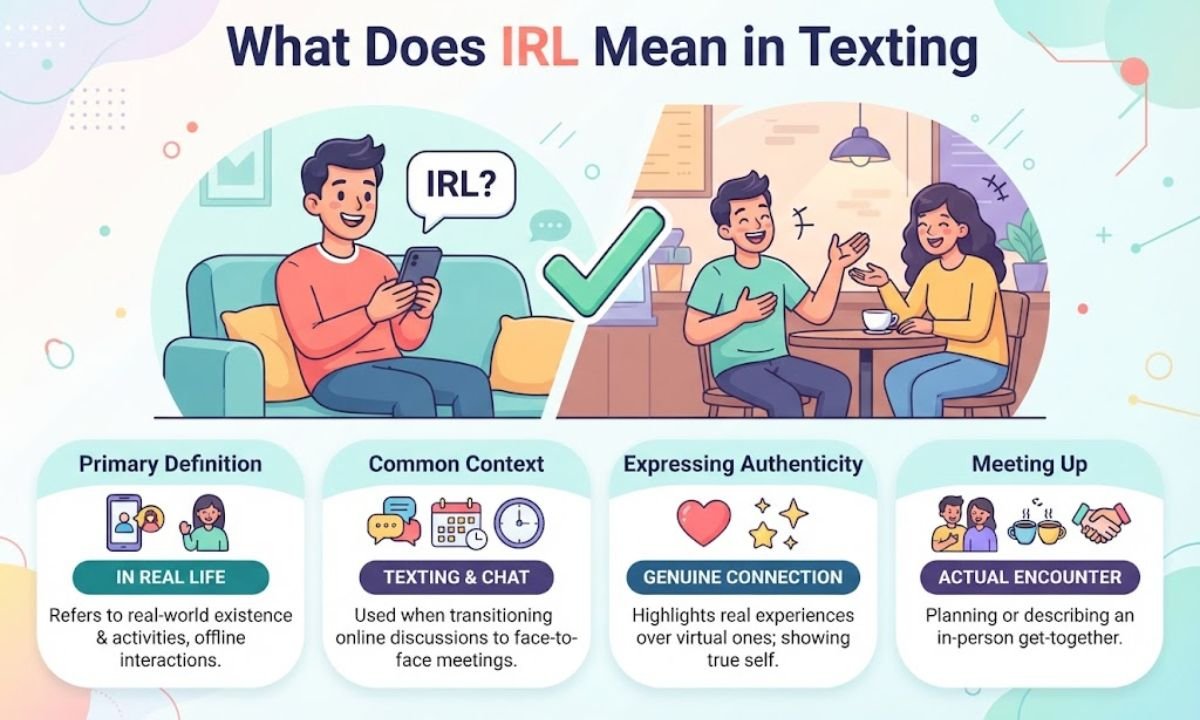

If you have ever seen a friend text “let’s hang out IRL” and paused to figure out what that meant, you are not alone.
IRL is one of the most common abbreviations in modern texting, and it shows up everywhere from group chats to Instagram captions to livestream titles.
This guide breaks down what IRL means, where it came from, how it feels emotionally, and exactly how (and when) to use it correctly, so you never get caught guessing again.
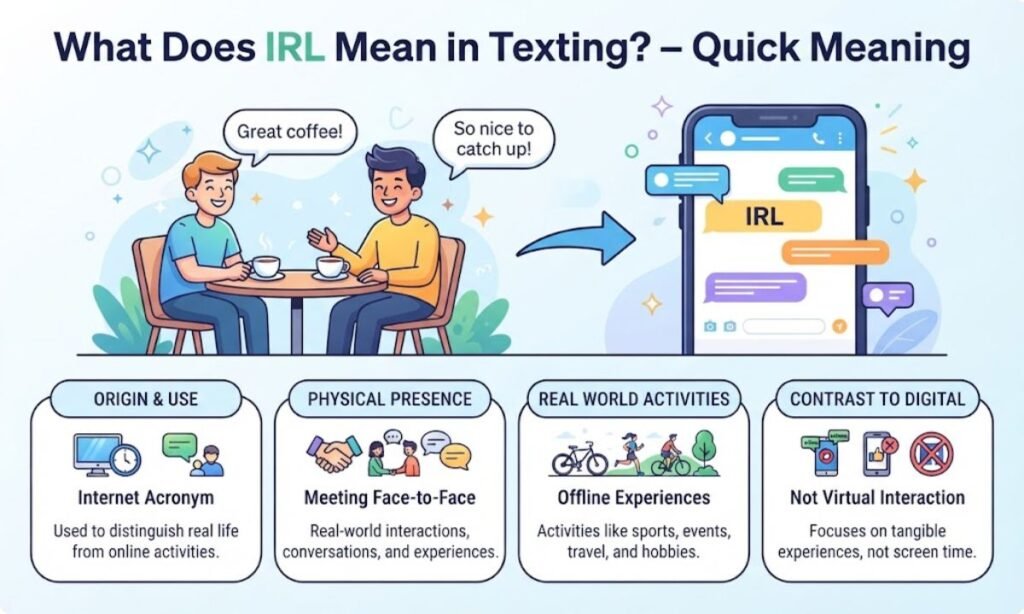
What Does IRL Mean in Texting? – Quick Meaning
Simple Definition
IRL stands for “In Real Life.” It is used to separate something happening in the physical, offline world from something happening online or through a screen. When someone says “IRL,” they are pointing to real-world experience rather than a digital one.
People use IRL as a quick way to draw a line between two versions of life: the one lived through apps, chats, and social feeds, and the one lived face-to-face.
It is short, easy to type, and instantly understood by most texters today. Because it takes only three letters to type, IRL has become a natural part of fast, casual conversation, appearing in texts, comments, captions, and even spoken conversation among younger generations.
Examples
Here are a few quick examples of IRL in action:
- “She’s so funny online, but she’s even funnier IRL.”
- “We met on a dating app and finally hung out IRL last weekend.”
- “I don’t post much, but my IRL life is pretty exciting.”
- “This group chat is fun, but let’s actually meet up IRL soon.”
- “He seems shy in his videos, but he’s way more talkative IRL.”
- “I have so many IRL responsibilities this week, I can barely go online.”
In each case, IRL simply flags the “real world” side of a comparison, whether that comparison is about personality, plans, or everyday life.
Origin & Background
Where Did IRL Come From?
IRL traces back to early internet forums and chat rooms in the 1990s, long before smartphones existed.
Back then, people who met online through message boards, Usenet groups, or early chat clients needed a simple way to talk about life outside the screen.
“In real life” got shortened to IRL, and the habit stuck. It joined a small but growing vocabulary of internet shorthand, alongside terms like BRB and LOL, that let early internet users communicate faster in text-only environments.
Influence of Internet Culture
As gaming communities, forums, and early messaging platforms grew, IRL became part of everyday internet slang.
Gamers used it to separate their in-game identity, such as a username or avatar, from their actual personality and daily life.
Forum users used it to talk about meetups with people they had only known through typed conversation. Over time, the term spread far beyond niche internet circles and became a normal part of casual digital vocabulary for millions of people.
Social Media’s Role
When platforms like Facebook, Instagram, and Twitter took off, IRL moved from niche slang into mainstream vocabulary.
Hashtags like #IRL and captions comparing online photos to real-life moments made the term instantly recognizable to a much wider audience, including people who never used early internet forums.
Influencers and everyday users alike began posting “me online vs me IRL” content, which helped cement the phrase as a shared cultural reference point rather than just insider slang.
How Its Meaning Has Evolved
Originally, IRL simply meant “not online.” Today, its meaning has stretched a little further. People use it to describe authenticity, contrast a curated online persona with a truer offline self, or simply confirm plans to meet in person.
The core idea, physical reality versus digital interaction, has stayed the same even as the usage has broadened to cover relationships, jobs, emotions, and entire lifestyles that exist beyond the screen.
Real-Life Conversations
WhatsApp Conversation
Sara: We’ve been talking for weeks now. Ayesha: I know! We should finally meet IRL. Sara: Yes! Coffee this weekend? Ayesha: Perfect, I’ll text you the address.
Here, IRL simply confirms that the plan is to meet in person, not just keep chatting online. It signals a shift from a purely digital friendship toward something more concrete.
Instagram DM Conversation
Zoya: Loved your last reel, you seem so confident on camera. Hana: Haha thank you, I’m way more awkward IRL though. Zoya: No way, I doubt that! Hana: You’ll see when we finally hang out.
In this DM exchange, IRL contrasts a polished on-camera personality with a more genuine, everyday version of the same person, a comparison that comes up constantly in casual social media chats.
Emotional & Psychological Meaning
What Emotion Does IRL Express?
IRL often carries a subtle emotional undertone of authenticity or longing for something more real.
It can express excitement about finally meeting someone, relief at being “just yourself,” or a gentle admission that online life does not tell the full story. In many cases, the emotion behind IRL is a quiet desire for genuine connection beyond a screen.
Why Do People Use It?
People reach for IRL because it does a lot of communicating in three letters. It signals honesty, sets expectations for a real meetup, and acknowledges that online personas are often curated or edited.
It is efficient, familiar, and instantly understood across most texting apps, which makes it a convenient shortcut compared to spelling out “in real life” every time.
What Does It Reveal About Modern Communication?
The popularity of IRL reveals something bigger about how people communicate today: most relationships now start or grow partly online, so a specific word for “offline” became necessary.
IRL exists because the line between digital and physical interaction genuinely needed a name, and its widespread use shows just how much daily life now happens across both spaces at once.
A Personal-Style Scenario
Imagine texting a college friend you have not seen in months. You have liked each other’s posts and replied to a few stories, but nothing more.
When you finally text “we need to catch up IRL,” it signals a shift, from passive online contact to intentional, real-world connection, and often carries a small spark of genuine excitement about seeing someone again.
Usage in Different Contexts
Social Media
On social media, IRL usually appears in captions or comments comparing an online image to everyday life, such as “me on Instagram vs me IRL,” or in posts documenting a real-world meetup with online friends.
Friends and Relationships
Among friends, IRL is used casually to plan hangouts, describe someone’s real personality, or joke about how different a person is once you actually spend time with them outside of texting and social apps.
Work and Professional Settings
IRL occasionally shows up in casual internal chats, like Slack messages between coworkers, but it stays informal. It is rarely, if ever, appropriate in emails, reports, or any formal work communication where clarity and professionalism matter most.
Casual vs Serious Tone
IRL almost always carries a casual, conversational tone. It is not used in serious or formal statements, and forcing it into a serious context, like a condolence message or legal note, can feel out of place or even flippant.
When NOT to Use It
Professional and Formal Communication
Avoid IRL in resumes, cover letters, client emails, or any formal business writing. It reads as too casual and can make communication seem unprofessional or careless, especially with clients or senior colleagues.
When the Audience May Not Understand
Not everyone, especially older relatives or people less familiar with internet slang, knows what IRL means. In mixed-age conversations, it is safer to spell out “in real life” to avoid confusion and keep the message clear for everyone involved.
Sensitive Conversations
During serious or emotional discussions, such as talking about grief, illness, or a difficult personal situation, using slang like IRL can feel dismissive of the moment’s weight, even if that is not the intention behind it.
Cultural Sensitivity
In some cultures and languages, English internet slang does not translate directly. Using IRL with an international audience unfamiliar with the term may cause unnecessary confusion or make a message harder to understand than it needs to be.
Common Misunderstandings
People Think IRL Means “Really”
Some newer texters mistakenly assume IRL means “really.” While the words look similar in a fast-scrolling chat, IRL specifically refers to real life, not emphasis or agreement, so mixing the two up can genuinely change the meaning of a sentence.
Confusing Online and Offline Relationships
People sometimes assume an “IRL friend” and an “online friend” cannot overlap. In reality, many relationships that start online eventually become IRL friendships once people meet in person, so the two categories often blend together over time.
Assuming It Only Refers to People
IRL is not limited to describing people. It can also describe events, jobs, problems, or experiences that happen in the physical world, not just personalities or friendships, which is a detail many casual users overlook.
Tone Confusion
Because IRL is casual, some readers misread it as sarcastic or dismissive when it is actually meant sincerely, especially in text form where tone is harder to detect without facial expressions or vocal cues.
Literal vs Figurative Meaning
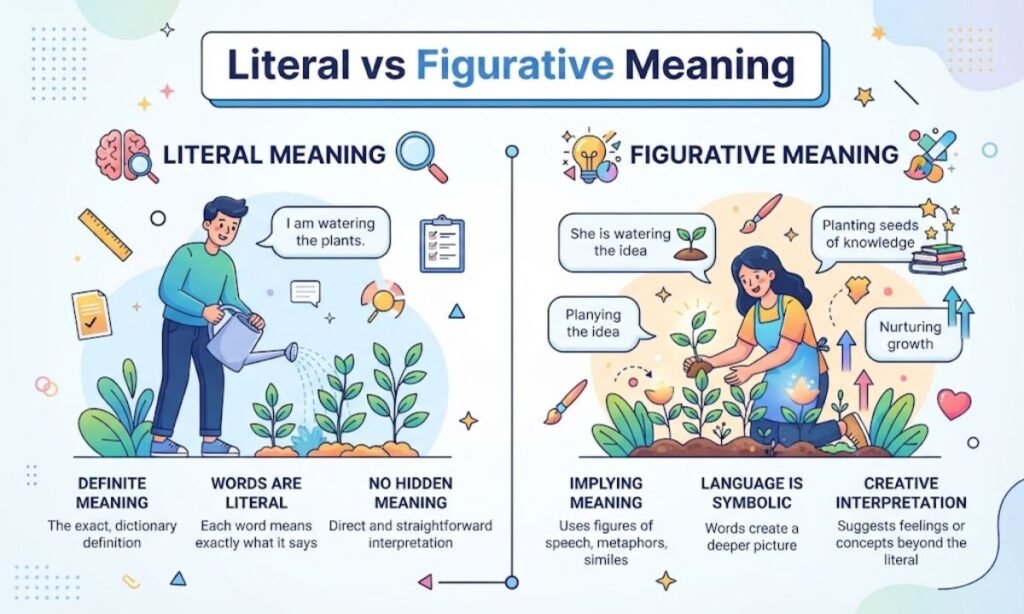
IRL is almost always literal, referring to actual physical reality, rather than a figurative or exaggerated expression, which sometimes trips up newer internet users who are still learning how internet abbreviations typically function.
Comparison Table
| Term | Meaning | Typical Use |
| IRL | In Real Life | Offline, physical-world reference |
| RL | Real Life | Shorter, more casual version of IRL |
| Online | Digital/virtual space | Contrasted against IRL |
| Offline | Not connected to the internet | Often used interchangeably with IRL |
| BRB | Be Right Back | Temporary online absence, unrelated to IRL’s meaning |
| AFK | Away From Keyboard | Similar offline signal, mostly used in gaming |
Key Insight
The key insight from this comparison is that IRL is not just another chat abbreviation; it is a conceptual marker that separates two distinct experiences, online and offline, in a single, quick term.
Unlike abbreviations that simply save time (like BRB), IRL carries a small amount of meaning about authenticity and physical presence that other shorthand terms do not.
Variations and Related Types of IRL
IRL Friend
An “IRL friend” is someone you know and interact with in person, as opposed to a friend you have only ever spoken to through a screen, and the term is often used to clarify which kind of friendship someone is describing.
Meet IRL
“Meet IRL” simply means arranging to see someone face-to-face after getting to know them online, a phrase commonly used when finalizing plans after weeks or months of digital conversation.
IRL Event
An “IRL event” is a real, physical gathering, like a concert, meetup, or party, as opposed to a virtual or livestreamed one, and the phrase helps distinguish attendance options clearly.
IRL Relationship
An “IRL relationship” refers to a romantic or platonic connection that exists (or has moved) beyond texting and social media into in-person interaction, often marking an important relationship milestone.
IRL Job
An “IRL job” describes traditional, real-world employment, often used humorously to contrast with online side hustles, content creation, or freelance internet work.
IRL Problems
“IRL problems” are real-world struggles, like bills, deadlines, or family issues, as opposed to drama that happens purely online, and the phrase is often used to put things in perspective.
IRL Personality
Someone’s “IRL personality” is how they actually behave and speak in person, which can differ from their online tone, persona, or writing style in noticeable ways.
IRL Experience
An “IRL experience” refers to something lived firsthand in the physical world, rather than something watched, read, or simulated online, and the phrase emphasizes direct, personal involvement.
IRL Best Friend
An “IRL best friend” is a closest companion you regularly spend time with in person, not just someone you talk to online, and the distinction matters to many people describing their closest relationships.
IRL Meetup
An “IRL meetup” is a planned, in-person gathering of people who typically connect online, common in gaming, fan, and hobby communities where members often live far apart.
How to Respond When Someone Uses IRL
Casual Replies
- “Yeah, let’s finally do it!”
- “For sure, IRL hangout is overdue.”
- “Sounds good, just tell me when.”
Funny Replies
- “Wait, you have an IRL life? Since when?”
- “IRL me is way more chaotic, fair warning.”
- “Careful, IRL me talks way too much.”
Mature Replies
- “I’d genuinely enjoy catching up in person.”
- “That sounds good, let’s set a real date.”
- “I’ve been hoping we’d finally meet up too.”
Respectful Replies
- “Thanks for suggesting that, I’d love to.”
- “I appreciate you wanting to meet up properly.”
- “That means a lot, let’s plan something soon.”
Supportive Responses
- “I’m glad you’re comfortable meeting IRL now.”
- “Take your time, IRL meetups can feel nerve-wracking at first.”
- “Whenever you’re ready, I’m happy to meet up.”
Regional & Cultural Usage
Western Culture
In the US, UK, and other English-speaking regions, IRL is fully mainstream slang used across age groups, though most heavily by younger texters, and it appears comfortably in both casual speech and writing.
Asian Culture
In many Asian countries, IRL is often used alongside local slang in bilingual texting, especially among urban, internet-savvy youth active on global platforms like Instagram, Discord, and Twitter.
Middle Eastern Culture
Across the Middle East, IRL frequently appears in English-Arabic mixed conversations online, particularly among younger, socially connected internet users who blend English internet slang into everyday chats.
Global Internet Usage
Because IRL originated in English-language internet spaces, it has spread globally alongside platforms like Instagram, Discord, and Twitter, becoming one of the most universally recognized internet abbreviations across different languages and regions.
Generational Differences
Gen Z
Gen Z uses IRL constantly and casually, often blending it naturally into everyday speech, not just text, to the point where it barely registers as slang anymore.
Millennials
Millennials, who witnessed IRL’s early internet origins, use it comfortably but slightly less frequently than Gen Z, often reserving it for texting rather than spoken conversation.
Older Generations
Older generations are less likely to use IRL unprompted and may need the term explained the first few times they encounter it in a message or online post.
Is It Safe for Kids?
Understanding the Context
IRL itself is a harmless, neutral abbreviation with no inappropriate meaning, making it generally safe for children and teens to use in everyday texting without any cause for concern.
Context Still Matters
While the term is safe, parents should stay aware of who their kids are planning to meet “IRL,” since the phrase often relates to arranging in-person meetups that deserve normal safety precautions, just as any real-world plan with a stranger would.
What Does IRL Mean in Texting From a Girl
General Meaning
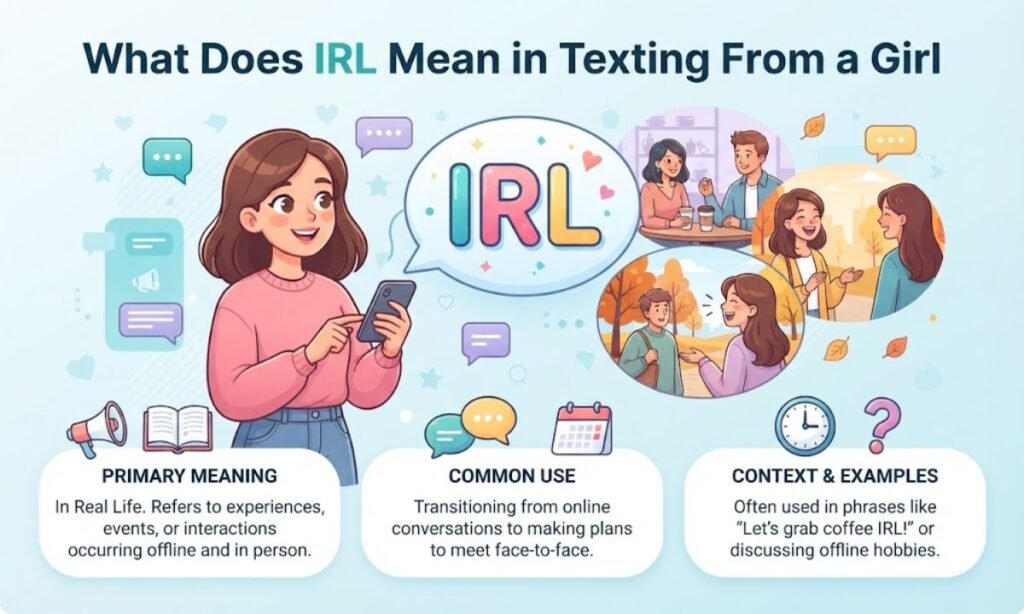
When a girl uses IRL in texting, it carries the exact same core meaning as anyone else: something happening in real life rather than online, with no gender-specific twist to the definition.
Common Context
It often shows up when she is comparing her online posts to her everyday personality, or suggesting an in-person hangout after chatting for a while through DMs or group chats.
Reading the Tone
Context matters more than gender here. A girl texting “let’s meet IRL” is almost always simply proposing a real-life meetup, not sending a hidden or romantic signal on its own, unless the rest of the conversation clearly suggests otherwise.
Irl Meaning in Chat From a Boy
General Meaning
When a boy uses IRL in chat, it means the same thing: real life, as opposed to the online conversation happening in that moment, with the meaning staying consistent regardless of who types it.
Common Context
It frequently appears when he wants to shift a purely digital conversation toward an actual meetup, or describe how he acts outside of texting compared to how he seems online.
Reading the Tone
As with any texter, the meaning depends on the surrounding conversation rather than who sent it; IRL itself carries no gender-specific undertone, so context always matters more than the sender.
IRL Meaning in Love
Romantic Context
In romantic conversations, IRL often refers to meeting a match from a dating app or online conversation in person for the first time, marking an important step in a developing relationship.
Signaling Commitment
Suggesting an IRL date can signal genuine interest, since it moves a relationship from purely digital messaging toward real-world connection, often after weeks of texting or video calls.
Common Phrases
Phrases like “I really want to see you IRL” or “our IRL chemistry” describe how a couple’s connection feels once they are physically together, rather than just talking through a screen.
IRL Meaning in Live Stream
Streaming Context
On platforms like Twitch and YouTube, “IRL” is a specific content category showing a streamer’s everyday, real-world life rather than gaming or produced content, often labeled directly in the stream title.
What IRL Streams Show
IRL streams often feature streamers walking, traveling, cooking, or simply going about daily routines while broadcasting live to viewers who enjoy watching unscripted, everyday moments.
Why It’s Popular
Viewers enjoy IRL streams because they feel more personal and authentic compared to scripted or gameplay-focused content, giving audiences a closer look at a creator’s real personality.
Irl Meaning in Email
Formality Concerns
IRL is rarely appropriate in email, which tends to be more formal than texting or direct messaging, even in casual workplace culture where slang might otherwise be common.
When It Might Appear
It occasionally shows up in very informal emails between close coworkers or friends, usually about planning an in-person hangout rather than discussing work matters.
Better Alternatives
In professional emails, it is safer to write “in person” or “in real life” fully instead of using the abbreviation IRL, which keeps the message clear and appropriately formal.
What Does IRL Mean in School
Everyday Usage
Students commonly use IRL in text messages and group chats to talk about meeting up after class or comparing online personas to how someone actually acts at school.
Classroom Context
Teachers introducing digital literacy or internet slang sometimes reference IRL as an easy, real-world example of common texting abbreviations that students already understand.
Social Dynamics
Among classmates, IRL often distinguishes between someone’s social media presence and how they actually act during school hours, which can sometimes differ quite a bit.
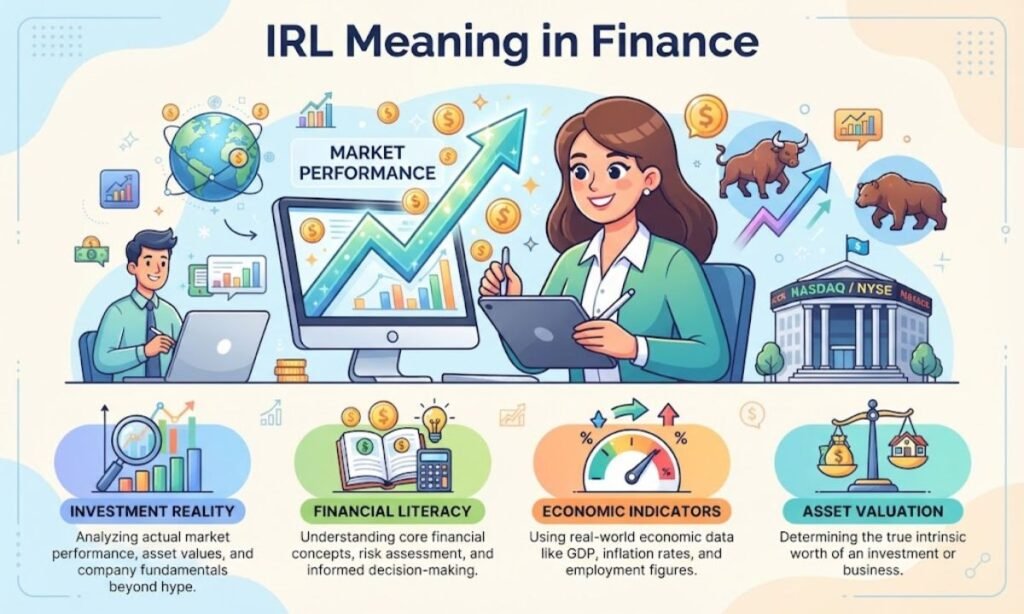
IRL Meaning in Finance
Uncommon but Present Usage
IRL is not standard finance terminology, but it occasionally appears in casual finance discussions to contrast online trading activity or app-based portfolios with real-world financial decisions.
Example Usage
Someone might say, “my portfolio looks great online, but IRL I’m still budgeting carefully,” to highlight a gap between numbers on a screen and everyday financial reality.
Key Takeaway
In finance conversations, IRL simply keeps its standard meaning, real life, rather than taking on any specialized financial definition, even when used in money-related chats.
Conclusion
IRL is a small abbreviation that carries a big idea: the difference between our online lives and our real, physical experiences. Whether it shows up in a WhatsApp message, an Instagram caption, or a livestream title, IRL almost always means the same simple thing, real life.
Understanding when to use it, and when to spell things out instead, helps you communicate clearly across every kind of conversation, casual or formal, online or off. The next time you see IRL in a text, you will know exactly what it means and how to respond with confidence.
Frequently Asked Questions
What does IRL stand for in texting slang?
IRL stands for “In Real Life,” used to describe something happening offline rather than online.
What does I R L stand for in text messages?
It stands for the same phrase, “In Real Life,” regardless of spacing or capitalization used.
How do popular messaging apps define IRL?
Most messaging apps don’t formally define slang, but IRL is universally understood across WhatsApp, Instagram, and similar platforms as “in real life.”
How is IRL used in online conversations and forums?
In forums, IRL typically separates online usernames or personas from a person’s actual, offline identity or activities.
What is the meaning of IRL in social media conversations?
On social media, IRL usually contrasts a curated online post or persona with someone’s genuine, everyday life.
Examples of common text messages using the term IRL?
Common examples include “let’s meet IRL,” “she’s funnier IRL,” and “my IRL life is different from my feed.”
How do major texting platforms use the term IRL?
Texting platforms don’t build in special features for IRL; users simply type it naturally as casual slang within normal conversations.
What are the social implications of meeting someone IRL from online?
Meeting someone IRL often marks a relationship becoming more serious, trusted, or real compared to purely online contact.
Can I use IRL in professional messaging apps?
It’s best avoided in professional messaging, since IRL reads as casual slang unsuitable for formal workplace communication.
When did the acronym IRL become popular in digital communication?
IRL became popular in the 1990s through early internet forums and chat rooms, later spreading widely with social media in the 2000s and 2010s.

I am a dedicated author with 6+ years of experience writing and researching content for name meaning websites. My expertise includes American names, baby names, surnames, name origins, and cultural significance. I focus on creating accurate, well researched, and easy to read articles using trusted sources. My goal is to help readers discover the history, meaning, and uniqueness behind every name with reliable and engaging content.