
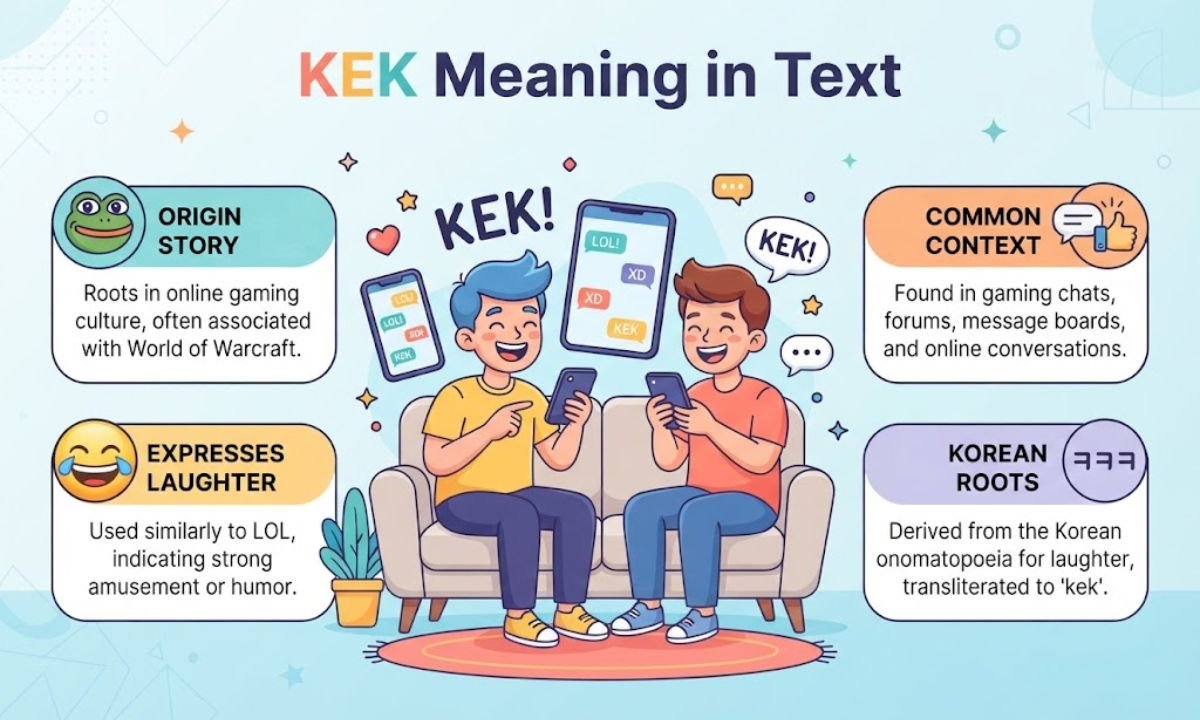

If you’ve been scrolling through Discord, Twitch, or a group chat and spotted the word “kek” flying around, you’re not alone in wondering what it actually means.
It looks like a typo for “kek,” sounds like a cough, and yet somehow it’s everywhere in gaming and internet culture. This guide breaks down exactly what KEK means in text, where it came from, how people use it today, and when you probably shouldn’t type it at all.
What Does KEK Mean in Text?
In plain terms, KEK is internet slang used to express laughter, similar to “lol,” “lmao,” or “haha.” When someone texts you “kek,” they’re almost always reacting to something they found funny, ironic, or absurd.
What makes KEK different from a typical laughing acronym is its backstory. It didn’t start as letters standing for a phrase — it started as a glitch, a translation quirk, and a piece of gaming history that slowly leaked into mainstream text conversations.
That history is exactly why “kek” can feel like an inside joke even when it’s used casually.
Because it sits at the intersection of gaming slang, Korean internet culture, and meme history, KEK carries more nuance than a simple “lol.” Understanding where it came from makes it much easier to read the tone behind it whenever it shows up in your notifications.
Today you’ll see it in:
- Gaming chats (Discord, Twitch, World of Warcraft)
- Text messages between friends who game or follow meme culture
- Comment sections on Reddit, Instagram, and TikTok
- Meme captions and reaction posts
KEK Meaning in Text – Quick Meaning
Here’s the short version, if you just need the quick answer before diving deeper.
| Term | Meaning | Tone |
| KEK | Laughter, amusement | Ironic, gaming-flavored, sometimes edgy |
| Kek | Same as above, lowercase/casual | Playful |
| KEKW | Intense laughter | Exaggerated, meme-heavy |
In short: KEK = “haha” with a gamer accent.
What Does It Mean When Someone Texts You “KEK”?
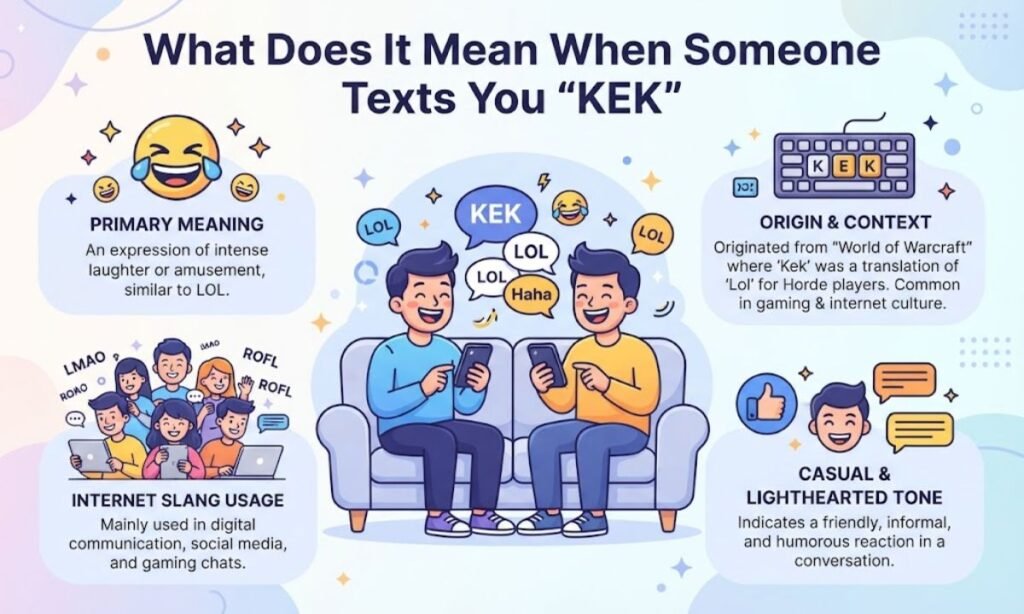
If a friend texts you “kek” after you send a joke, meme, or funny story, they’re telling you it made them laugh. It’s not an insult on its own, and it’s not a coded message — it’s simply a stylized way of laughing in text form.
Context still matters, though. The same word can come across as:
- Genuine amusement (“kek, that’s actually hilarious”)
- Dry, ironic laughter (“kek… sure”)
- Light teasing between friends who share gaming or meme culture
Origin & Background of KEK
To really understand KEK, you have to go back to gaming servers and language filters from the early 2000s. The term wasn’t invented on purpose — it emerged from a workaround.
World of Warcraft and “KEK”
The most widely cited origin of KEK comes from Blizzard’s massively multiplayer game World of Warcraft. In the game, players belong to one of two opposing factions — the Alliance or the Horde and the two sides aren’t supposed to be able to communicate directly through in-game chat.
To keep that separation intact, Blizzard applied a language filter. When a Horde player typed “lol” in the public chat channel, Alliance players didn’t see “lol” at all — they saw the word “kek” instead, as if it had been translated into the fictional Orcish language. The reverse also worked, depending on which side was chatting.
Because “lol” is one of the most frequently typed phrases in any online game, “kek” quickly became something Alliance players saw constantly, and it stuck. Even players who never spoke Orcish in-game picked it up simply from repetition.
Players soon started typing “kek” on purpose, even when talking to teammates on their own side, purely because it had become a recognizable, funny piece of shorthand.
What began as a one-way translation quirk turned into a badge of gaming familiarity that outlived the specific mechanic that created it.
Korean “Kekeke” Connection
The story doesn’t stop with World of Warcraft, though. Many language and slang researchers trace the deeper roots of “kek” back to Korean internet culture, specifically to Blizzard’s earlier game StarCraft.
In Korean, laughter is often written as a repeated consonant sound, ㅋㅋㅋ (pronounced like a clipped “k” sound), which is the rough equivalent of typing “hahaha” in English. When Korean StarCraft players typed this out using a Latin keyboard, it was often rendered as “kekeke.”
Because StarCraft had a massive competitive scene in South Korea, “kekeke” was extremely common in match chats and streams.
When Blizzard built World of Warcraft’s cross-faction chat filter, the “kek” translation for “lol” likely wasn’t random — it echoed a laughing sound gamers had already been seeing for years.
From Gaming to Wider Internet Culture
From there, KEK spread the way most gaming slang does: through forums, screenshots, and shared jokes. Gaming communities on sites like 4chan and Reddit picked it up as a substitute for “lol,” and it slowly became less about World of Warcraft specifically and more about internet humor in general.
Over time, KEK picked up extra baggage beyond simple laughter. It became associated with a satirical, meme-based “deity” nicknamed the “Cult of Kek,” loosely tied to imagery of Pepe the Frog and an ancient Egyptian god also named Kek.
That connection is part of why the word can carry a slightly edgier or more polarizing tone in certain corners of the internet, even though most everyday uses are completely lighthearted.
Real-Life Conversations Using KEK
Seeing KEK used in context makes it much easier to understand than any dictionary definition. Here’s what it typically looks like in everyday chats, across a few different apps and relationship types.
WhatsApp Conversation
Sam: just tripped over my own dog in front of the delivery guy Riya: KEK 😂 tell me you’re okay Sam: barely
Instagram DMs
Jordan: sent you that video, watch till the end Alex: kekekeke the ending got me Jordan: told you
Discord Gaming Chat
PlayerOne: got outplayed by a level 3 character PlayerTwo: kek that’s actually embarrassing PlayerOne: don’t remind me
Text Between Friends
Mia: my cat knocked my coffee into my laptop Dee: kek why is it always the laptop Mia: universe hates me
In each case, “kek” is doing the same job “lol” or “haha” would do — it just carries a bit more gamer or meme-culture flavor. Notice, too, that none of these examples require the sender or receiver to be an avid gamer; the word has spread far enough that it now functions as general-purpose internet laughter, even outside dedicated gaming spaces.
Emotional & Psychological Meaning of KEK
Slang isn’t just about the literal meaning of a word — it also signals identity, tone, and relationship dynamics between the people using it.
It Can Signal Internet-Culture Familiarity
Using “kek” instead of “lol” often subtly signals that someone spends time in gaming or meme-heavy online spaces. It’s a small marker of shared culture, similar to how using a specific inside joke shows you’re part of a particular group.
Friends who game together will often default to “kek” without even thinking about it, simply because it’s become their normal way of reacting.
KEK Can Sound More Ironic Than “Haha”
Because of its gaming and forum roots, KEK often reads as slightly more detached or ironic than a warm “haha.” It can imply “that’s funny in a dry, absurd way” rather than genuine belly-laugh amusement.
This dry undertone is part of why some people specifically reach for “kek” instead of a warmer laugh reaction when something is funny in a slightly cringe or awkward way.
It Can Be Playful Teasing
Among close friends, “kek” is frequently used to gently tease someone after they’ve embarrassed themselves or said something ridiculous. It’s rarely meant to be cruel — more often it’s affectionate mockery, the texting equivalent of a friendly eye-roll paired with a laugh.
A Personal-Style Scenario
Imagine you send a friend a photo of a cooking disaster. A reply of “kek, what did you even do” reads as amused disbelief, not judgment. The word softens the tease while still acknowledging how funny the situation is.
KEK Meaning in Different Contexts
KEK doesn’t mean exactly the same thing everywhere it appears. The platform and audience shift its tone.
KEK in Text Messages
In one-on-one texting, KEK usually functions as a casual laugh reaction, often between friends who are already familiar with gaming or meme slang. It rarely needs explanation between people who already share that context.
KEK on Discord
Discord is arguably where KEK feels most at home. It’s used constantly in gaming servers, meme channels, and voice-chat follow-ups as a quick laughter reaction, sometimes stacked several times in a row for emphasis (“kek kek kek”).
KEK in Gaming
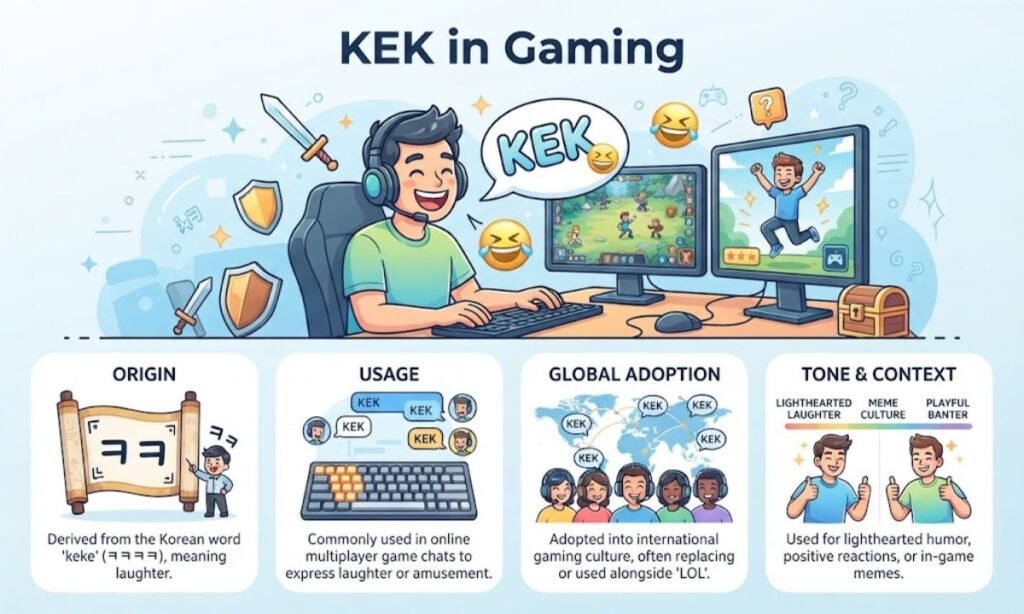
Inside multiplayer games, especially World of Warcraft and other titles with active chat communities, KEK is often typed in real time to react to funny plays, deaths, or in-game chaos. It’s fast to type mid-match, which is part of why it’s stayed popular for decades.
KEK on Instagram
On Instagram, particularly in comments and DMs, KEK tends to appear as a reaction to memes, funny reels, or ridiculous captions, often alongside laughing or skull emojis for extra emphasis.
KEK on TikTok
In TikTok comment sections, KEK often shows up stretched out (“kekekeke”) as an exaggerated laugh reaction to a video punchline or unexpected twist, functioning much like a string of “hahaha” would in a more traditional comment.
When NOT to Use KEK
Even though KEK is common online, there are situations where it can land badly or simply confuse the person reading it.
Professional Communication
Avoid using KEK in work emails, client messages, or professional Slack channels. It reads as slang most colleagues won’t recognize, and given its more controversial associations in some communities, it can create an unnecessary awkward impression.
Academic Writing
KEK has no place in essays, reports, or academic writing. Even informal academic discussion boards are better served by plain language or a standard “lol.”
When the Audience May Not Understand It
If you’re texting a parent, grandparent, or someone outside gaming and meme culture, KEK will likely just look like a typo. In those cases, stick to something universally understood.
Sensitive Conversations
Because KEK can carry ironic or dismissive undertones, avoid using it in serious or emotionally heavy conversations where it might read as flippant.
Common Misunderstandings About KEK
A few myths about KEK circulate online, so it’s worth clearing them up.
KEK Is Not an Acronym for a Standard Phrase
Unlike “lol” (laugh out loud) or “brb” (be right back), KEK isn’t short for a specific phrase. It emerged from a chat filter and a laughter sound, not from initials.
KEK Doesn’t Always Mean Sarcasm
While KEK can carry an ironic tone, it’s frequently used with completely genuine amusement, especially among gamers and younger internet users.
KEK Isn’t Automatically an Insult
On its own, “kek” is not an insult in English internet slang — it’s simply a laugh reaction. (Note: in German slang, “Kek” is used very differently, closer to calling someone a loser or idiot — more on that below.)
KEK Can Have Controversial Associations
Because of its link to satirical “Cult of Kek” imagery and some politically charged online communities after 2016, KEK can occasionally carry unwanted baggage depending on where and how it’s used. Most casual, everyday uses are unrelated to this history, but it’s worth being aware of.
KEK vs. Similar Internet Slang
KEK sits alongside a whole family of laughter-based slang. Here’s how it compares.
| Term | Origin | Typical Tone | Common Platforms |
| LOL | “Laugh out loud” acronym | Casual, universal | Everywhere |
| LMAO | “Laughing my a** off” acronym | Exaggerated, emphatic | Social media, texting |
| KEK | Gaming chat filter / Korean “kekeke” | Ironic, gaming-based | Discord, Twitch, forums |
| KEKW | KEK + Twitch “W” emote culture | Over-the-top, meme laughter | Twitch, Discord |
| Haha/Hehe | Literal representation of laughing | Warm, genuine | Texting, everyday chat |
Key Insight
The biggest difference isn’t really meaning — nearly all of these terms signal laughter. The difference is cultural context. LOL feels neutral and universal, while KEK signals gaming or meme-culture fluency, and often a slightly drier sense of humor.
Variations and Types of KEK
KEK has spawned several stylistic variations over the years, each with a slightly different flavor.
1. kek
The lowercase, casual version — used the same way as a quick “lol.”
2. KEK
All-caps KEK often adds emphasis, as if shouting the laugh.
3. Kekeke
A stretched-out version mimicking the original Korean “kekeke” laughter pattern, used for bigger laughs.
4. KEKW
A Twitch-specific variation combining “kek” with the platform’s “W” emote culture, used for a laughing-face emote representing intense laughter.
5. Top Kek
An exaggerated way of saying something is extremely funny — “top-tier kek.”
6. “kek lol”
A hybrid used half-jokingly, layering two laugh terms together for extra emphasis.
7. Emoji-Paired Kek
“Kek 😂” or “kek 💀” combine the word with laughing or “I’m dead” emojis for added tone.
8. Text-Speak Kek
Casual shorthand like “kk” or “kekk” used quickly in fast-paced chats without much thought.
9. Sarcastic Kek
A flat, single “kek” used to indicate dry, unimpressed amusement rather than genuine laughter.
10. Gaming Kek
Typed in real time during matches to react to a funny kill, death, or in-game blunder.
How to Respond When Someone Says KEK
Not sure how to reply when someone drops a “kek” in your chat? Here are a few directions you can take.
Casual Replies
- “kek fr”
- “lol same”
- “haha yeah”
Funny Replies
- “glad my suffering amuses you”
- “kekw you’re not wrong”
- “i’m cackling too ngl”
Mature Replies
- “haha true, that was funny”
- “yeah I laughed way too hard at that”
Respectful Replies
If you don’t use gaming slang yourself, it’s completely fine to simply respond with a normal laugh reaction like “lol” or “haha” — there’s no obligation to match someone’s slang.
Regional & Cultural Usage of KEK
KEK isn’t used identically everywhere. Its popularity and tone shift depending on region and community.
Western Gaming Culture
In North America and Europe, KEK is closely tied to PC gaming communities, especially World of Warcraft, Twitch, and Discord servers, where it has remained a steady piece of shorthand for over a decade.
Korean Internet Culture
In Korea, laughter is more commonly represented with ㅋㅋㅋ directly rather than the Romanized “kek,” though the sound and meaning behind both are closely related, since “kek” was originally a Latin-alphabet approximation of that same laugh.
Asian Gaming Communities
Outside Korea, some Asian gaming communities have picked up “kek” through shared exposure to Western streaming and Discord culture, often alongside local laughter slang like “wkwkwk” or “233” used in other regions.
Middle Eastern Gaming Communities
In Middle Eastern gaming Discords and forums, “kek” appears frequently as borrowed internet slang, typically used the same way as in Western gaming spaces, especially among younger players active on international servers.
Global Internet Culture
Because gaming and streaming culture is global, KEK has spread far beyond its original Korean and World of Warcraft roots into general meme vocabulary worldwide, appearing in comment sections in dozens of languages.
Gen Z vs. Millennials
Millennials who grew up gaming in the 2000s are more likely to know KEK’s World of Warcraft origins firsthand, while many Gen Z users encounter it purely through memes, Twitch emotes, and Discord culture without knowing the backstory — for them, it’s simply another laugh reaction alongside “💀” or “no because.”
Is KEK Safe for Kids?
On its own, “kek” is simply a laughter term and isn’t inherently harmful. However, parents should be aware of a few things:
- KEK is closely tied to gaming and meme communities where content maturity varies widely.
- The word’s association with the satirical “Cult of Kek” and certain politically charged online spaces means kids may encounter more loaded content while searching for its meaning.
- As with most internet slang, context and the platform where a child encounters it matter more than the word itself.
If a child uses “kek” casually with friends the same way they’d use “lol,” it’s generally harmless. It’s worth keeping an eye on the broader online spaces where they picked it up.
Kek meaning in text in english
In English texting, “kek” simply means laughter functionally identical to “lol” or “haha,” just with a gaming-culture flavor attached. It works as a standalone reaction or as part of a longer message, and doesn’t require any special punctuation or formatting to make sense.
Kek meaning 4chan
On 4chan, “kek” has long been used as a laughter reaction, and the platform is also where much of the satirical “Cult of Kek” meme mythology developed and spread throughout the 2000s and 2010s. Because of the site’s mixed reputation, the term picked up extra cultural baggage there that it doesn’t necessarily carry elsewhere.
KEKW meaning
KEKW is a Twitch emote showing an exaggerated laughing face based on a photo of Spanish comedian Juan Joya Borja — paired with the word “kek” to represent intense, over-the-top laughter during a stream or chat. It’s one of the most-used emotes on the platform.
Kek meaning German
In German slang, “Kek” is used very differently from English it’s a casual, sometimes affectionate way of calling someone a “loser,” “idiot,” or “dummy,” depending on tone. Whether it lands as an insult or a joke depends heavily on the relationship between the speakers and how it’s said out loud.
Kek Urban Dictionary
Urban Dictionary entries for “kek” generally describe it as an alternative to “lol,” rooted in World of Warcraft and gaming culture, while also noting its more controversial internet associations. As with most crowd-sourced slang dictionaries, definitions vary in tone and quality from entry to entry.
Kek meaning crypto
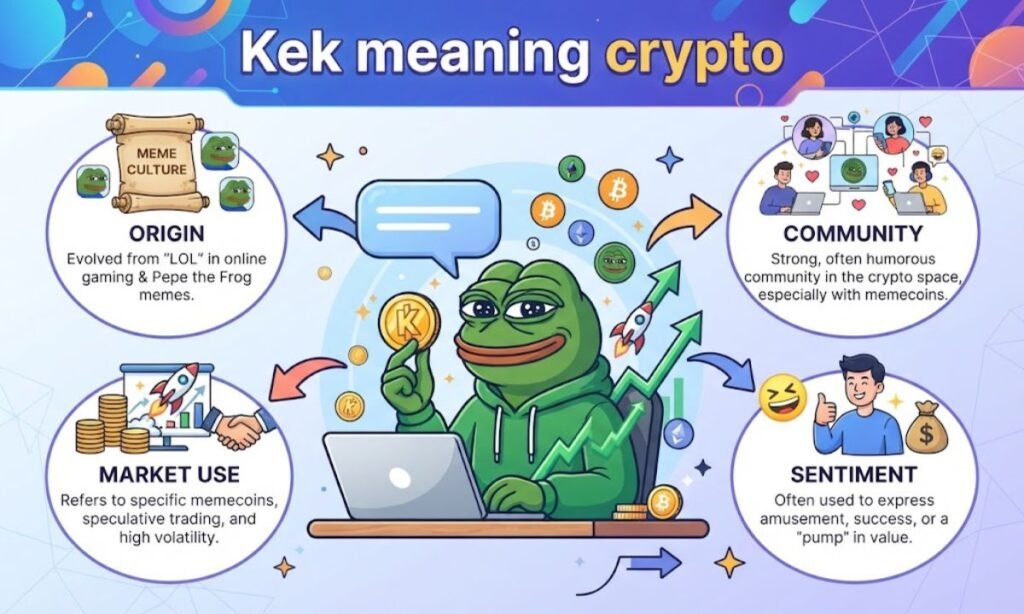
In crypto spaces, “KEK” (or KEKE) refers to meme-coin projects inspired by the Cult of Kek internet mythology — these are separate, community-driven tokens unrelated to the everyday slang meaning of laughter.
They typically trade on decentralized exchanges and lean heavily on meme branding rather than underlying utility.
KEK meaning Twitch
On Twitch, “kek” and its exaggerated form “KEKW” are used constantly in stream chats as quick laughter reactions to funny moments, fails, or jokes, often appearing dozens of times in a row during a particularly funny clip or moment.
Conclusion
At its core, KEK is just another way of laughing online but its journey from a World of Warcraft chat filter to a global piece of internet slang makes it more interesting than your average acronym.
Whether you’re texting a friend, chatting on Discord, or scrolling through Twitch, knowing what KEK means (and when to use it) helps you read the tone of a conversation correctly.
It also helps to remember that context shapes meaning here more than almost any other piece of slang.
The same three letters can be a warm inside joke between friends, a dry ironic reaction on a forum, or a reference to a meme-coin project and reading the platform and relationship correctly is the real key to using it well.
Use it with people who’ll recognize it, skip it in professional settings, and you’ll never be confused by a stray “kek” again.
Frequently Asked Questions
What does kek mean in online gaming chats?
It’s used as a laughter reaction, similar to “lol,” and traces back to World of Warcraft’s cross-faction chat filter.
What does “kek” signify in online messaging?
It signals amusement or laughter, often with a gaming or meme-culture tone rather than a completely neutral one.
Where can I find merchandise with kek-themed designs?
Kek and meme-related merchandise can occasionally be found on print-on-demand sites and fan marketplaces, though availability varies and quality should be checked carefully.
How do popular social media platforms interpret the term kek?
Most platforms treat it as informal laughter slang, though moderation policies may flag it depending on surrounding context tied to its more controversial associations.
How is “kek” typically used in gaming communities?
It’s typed in real time to react to funny plays, deaths, or chat moments, much like “lol” would be used elsewhere.
Are there any apps that use kek as part of their branding?
Some niche gaming, meme, or crypto-related apps and projects have used “Kek” in their branding, drawing on its internet-culture recognition.
Is “kek” considered offensive in some contexts?
It can be, depending on the community and the surrounding conversation, mainly due to its ties to certain politically charged online spaces — though everyday casual use is rarely intended that way.
Can I buy kek-related emojis or stickers for messaging apps?
Yes, meme and gaming-themed sticker packs featuring “kek” or KEKW-style laughing faces are available on several sticker and emoji marketplaces.
What’s the difference between “lol” and “kek” in text?
Both mean laughter, but “lol” is neutral and universal, while “kek” carries gaming and meme-culture roots and a slightly more ironic tone.

I am a dedicated author with 6+ years of experience writing and researching content for name meaning websites. My expertise includes American names, baby names, surnames, name origins, and cultural significance. I focus on creating accurate, well researched, and easy to read articles using trusted sources. My goal is to help readers discover the history, meaning, and uniqueness behind every name with reliable and engaging content.