
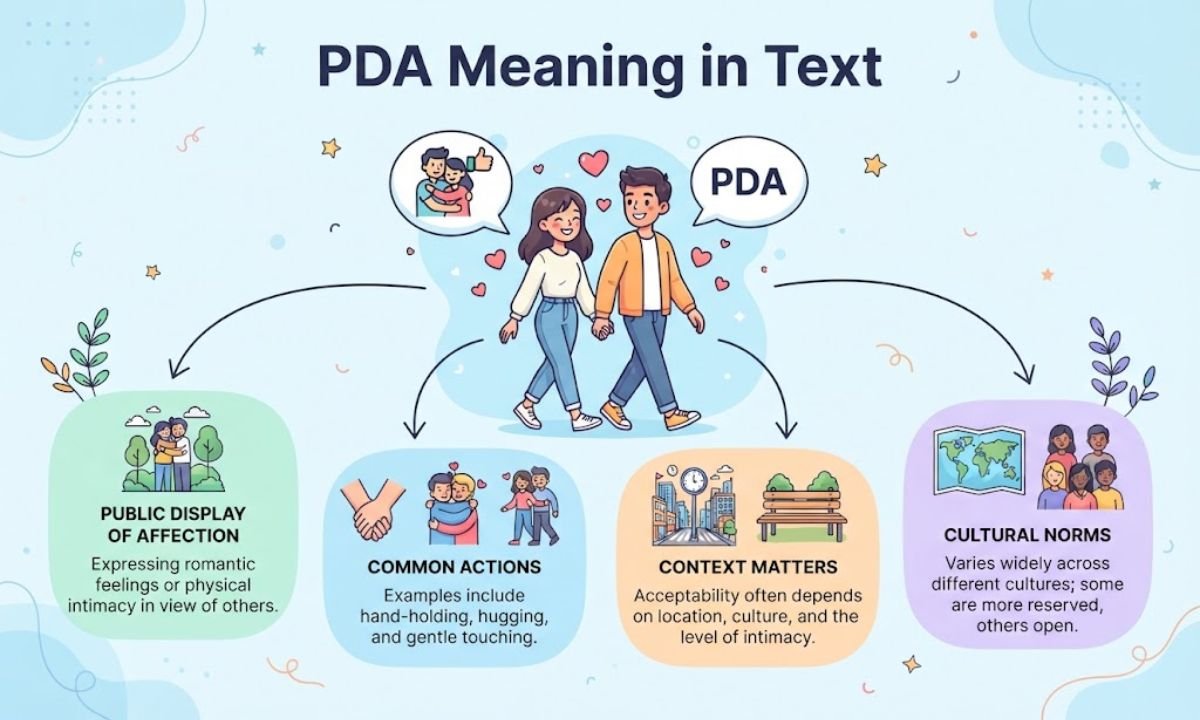

You’re scrolling through a chat and someone writes, “Okay, that was too much PDA.” Or a friend texts, “No PDA at the wedding, please.” So what does it actually mean? In texting and social media slang, PDA means “public display of affection.” It covers anything from holding hands to a long kiss in a crowded place, and today it also covers loved-up posts online.
But the acronym has a few other meanings depending on where you spot it. This guide walks through each one, with real examples, replies you can copy, and clear advice on when to use it and when to skip it.
Whether you’re a parent decoding your teen’s messages, a student reading school rules, or just someone who wants to stay up to date with slang, you’ll find a simple answer here. Everything is explained in plain language, so you can understand PDA quickly and use it with confidence.
PDA Meaning in Text – Quick Meaning
What Does PDA Mean?
In a text message, PDA almost always stands for public display of affection. It describes any visible sign of romantic or close affection shown where other people can see it.
Simple Definition
PDA is a short way of saying “affection shown in public.” The behavior can be physical, such as hugging, or digital, such as posting couple photos.
Common Examples in Text
- “They were all over each other. So much PDA.”
- “I’m not really a PDA person.”
- “Can we keep the PDA to a minimum at dinner?”
- “Their PDA on Instagram is next level.”
How It’s Usually Used
People use PDA as a noun (“that was a lot of PDA”) or as a label for a habit (“she’s big on PDA”). It leans casual, shows up mostly between friends and couples, and usually carries a light, teasing tone.
You’ll also see it in short requests and reactions, like “PDA alert!” when a couple starts getting cozy, or “not a fan of PDA” when someone wants to set a personal limit. Notice that the acronym rarely needs an explanation among people who chat online often. That’s exactly why it has stuck around.
Origin & Background
Where the Term Came From
“Public display of affection” was already common in everyday English long before phones existed. It appeared in school rules, etiquette columns, and family conversations about what was and wasn’t appropriate in public.
Cultural Influence
Movies, teen shows, and pop music made the phrase familiar. Once schools began printing “no PDA” in their dress and conduct policies, nearly every teenager learned the acronym.
Social Media Changed Everything
Texting rewards short words, so “public display of affection” quickly shrank to three letters. Then platforms like Instagram and TikTok gave couples a stage. Suddenly a couple’s anniversary post counted as PDA too.
How the Meaning Evolved
The core meaning barely changed. What changed is the range: PDA moved from the park bench to the comment section. Today it can mean a kiss, a caption, or a “happy birthday, my love” story posted for everyone to see.
It also became more playful. Older generations often used the phrase as a gentle warning about manners. Younger users turned it into a joke, a reaction, and sometimes even a compliment. The words stayed the same, but the attitude around them relaxed.
Real-Life Conversations
WhatsApp Conversation
Mia: Are you coming to Sara’s engagement party? Zain: Yes, but they’ll probably be full PDA all night 😅 Mia: Let them. It’s their night.
Instagram DM Conversation
Lena: Saw your story with Jake. The PDA is cute, not gonna lie. Chloe: Haha, he insisted on the couple selfie. Lena: Worth it. You two look happy.
TikTok Comments
“They said no PDA but look at the last ten seconds 😭” “This is the cutest PDA I’ve seen all week.” “Why is PDA so awkward to watch but I can’t look away?”
Text Message Conversation
Ali: Meeting your parents Sunday. Any rules? Nora: Just no PDA, my dad will faint. Ali: Understood. Handshake only.
Emotional & Psychological Meaning
What Emotion Does PDA Express?
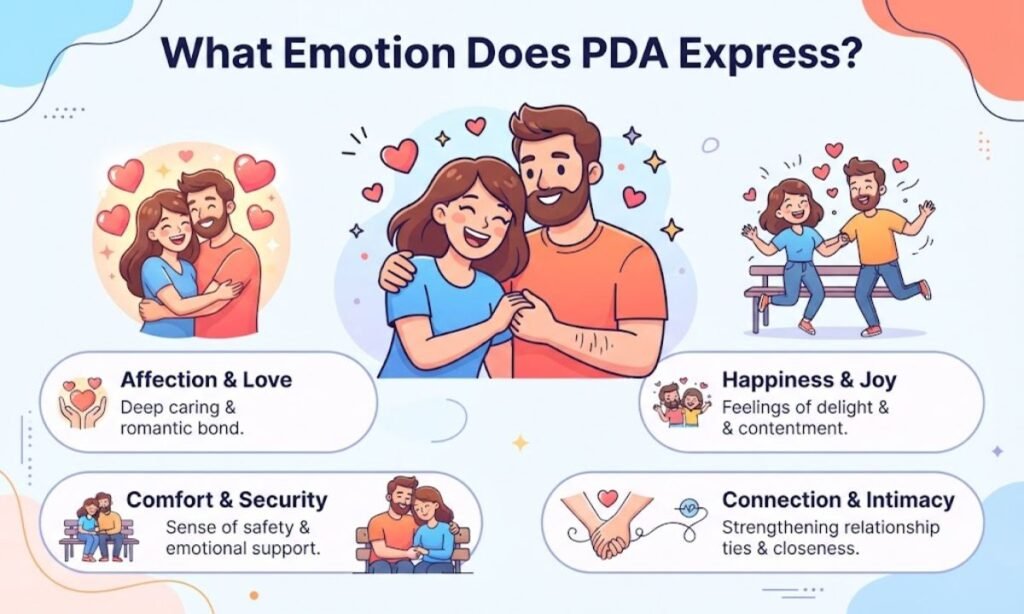
Mostly warmth and closeness. But the emotion behind the word depends on the speaker. A couple may use it proudly, while a bystander may use it to show discomfort or to tease.
Why People Use PDA
- To describe affection without going into detail
- To joke about an awkward moment
- To set boundaries (“I’m not a PDA person”)
- To celebrate a relationship openly
What It Reveals About Modern Communication
We compress feelings into tiny labels. Instead of explaining that a couple’s behavior felt intimate for a public place, one short acronym carries the whole idea. It saves time, and everyone in the chat understands the mood at once.
It also shows how much we rely on shared context. Two people can exchange three words and a laughing emoji and fully understand each other. That shortcut is convenient, but it works best when both sides know the meaning. If one person is unsure, a quick clarification prevents confusion.
A Realistic Scenario
Sam and Priya are at a friend’s birthday dinner. Priya keeps leaning on Sam’s shoulder and holding his hand under the table. Later Sam texts a friend: “Priya’s cute but the PDA at dinner made me shy.” He isn’t complaining. He’s just being honest, using a word both of them know.
Usage in Different Contexts
Social Media
On TikTok, Snapchat, and Instagram, PDA appears in captions, comments, and reactions. It can be positive (“goals”) or teasing (“get a room”).
Friends & Relationships
Among close friends, PDA is a joke-friendly word. Between partners, it can be a real conversation topic: how much affection feels comfortable in front of others.
Work & Professional Settings
In office chat, PDA rarely appears, and when it does, it’s usually in a policy discussion. Colleagues keep affection private, so mentioning it casually can sound out of place.
Casual vs Serious Tone
| Tone | Example | What It Signals |
| Casual | “Too much PDA lol” | Light teasing |
| Neutral | “We should limit PDA here.” | A simple request |
| Serious | “PDA isn’t allowed on campus.” | A rule or policy |
When NOT to Use It
Formal Situations
Skip the acronym in official emails, applications, or reports. Write “public display of affection” in full if you truly need the phrase.
The same goes for messages to teachers, managers, or anyone you don’t know well. Clear, complete wording sounds more professional and avoids any chance of the reader guessing wrong.
Sensitive Cultural Environments
In communities where public affection is a delicate topic, joking about it can offend. Read the room before you type.
During Serious Conflict
If you’re arguing with a partner about how much affection they show, “you’re doing too much PDA” can sound dismissive. Use clear, kind sentences instead.
Situations That Cause Misunderstanding
Because PDA has several meanings, avoid it when the other person might think of a device or a medical term. Add context so nobody gets confused.
For example, “Bring your PDA tomorrow” could mean a handheld device to an IT team and something completely different to a group of friends. One extra word, such as “handheld” or “affection,” fixes it.
Common Misunderstandings
People Think PDA Always Means Kissing
Not true. Holding hands, a side hug, or a comment on a partner’s photo can all count. Kissing is only the most obvious example.
Tone Gets Misread Online
Text has no facial expressions. “That’s a lot of PDA” might be playful or critical. An emoji or a follow-up sentence removes the doubt.
Literal vs Figurative Meaning
Literally, PDA is a public act. Figuratively, people use it for anything that feels over the top, such as a very gushy post. Both uses are common in chats.
A helpful rule: if the sentence is about a place and a physical action, it’s probably literal. If it’s about a post, a caption, or an exaggerated mood, it’s probably figurative.
Comparison Table
| Meaning | Full Form | Where You’ll See It | Example |
| Slang | Public Display of Affection | Texts, social media | “No PDA at school.” |
| Technology | Personal Digital Assistant | Tech articles, retro gadget talk | “My old PDA still works.” |
| Health | Patent Ductus Arteriosus | Medical settings | A heart condition in newborns |
| Neurodiversity | Pathological Demand Avoidance | Parenting and autism discussions | “PDA profile” |
Key Insight
Context decides everything. In a chat about couples, PDA means affection. In a chat about gadgets, it’s a handheld device. In a health discussion, it’s something else entirely.
Variations / Types
Physical PDA
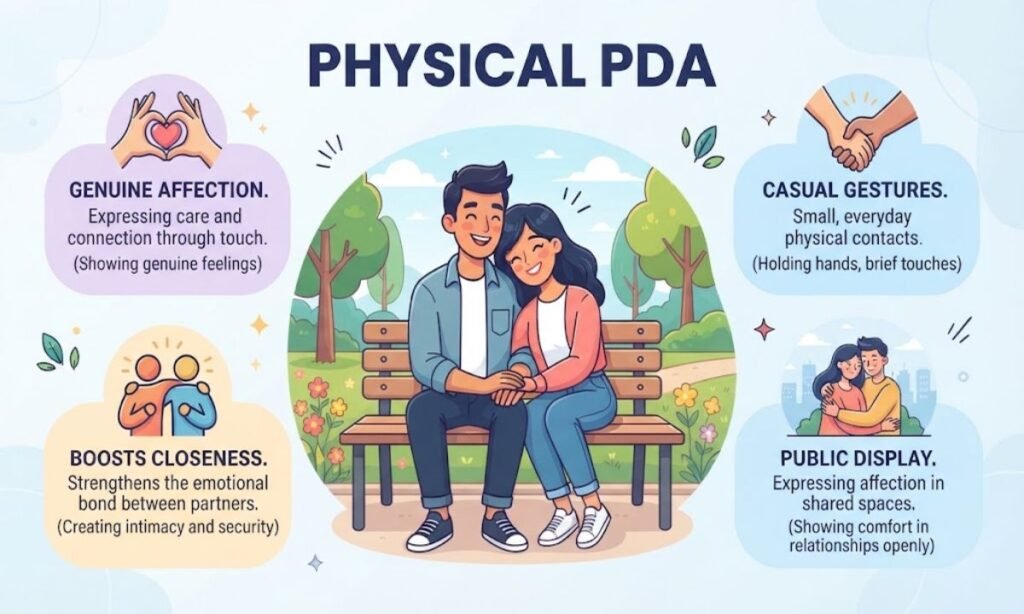
Hugging, kissing, holding hands, sitting close, or leaning on a partner in public.
Digital PDA
Loving captions, couple photos, tagging a partner, and public comments like “love you.”
Mild PDA
Small, quiet gestures such as a brief hand hold or a light shoulder touch. Most people barely notice.
Extreme PDA
Long, intense displays in crowded places. This is the kind that makes onlookers uncomfortable.
Cute PDA
Sweet, harmless moments, like sharing an umbrella or a gentle forehead kiss.
Cringe PDA
Affection that feels staged or oversharing. The internet’s favorite target for jokes.
Celebrity PDA
Famous couples on red carpets or in paparazzi shots. Fans often discuss it heavily online.
Social Media PDA
Anniversary posts, love stories, and public “I love you” messages. Simple, but very visible.
Accidental PDA
An unplanned moment, like a quick hug at the airport, that others happen to witness.
Performative PDA
Affection shown mainly for an audience. The gesture may be more about being seen than feeling close.
How to Respond When Someone Uses It
Casual Replies
- “Haha, fair.”
- “Yeah, they were really into it.”
- “Right? Very lovey.”
Funny Replies
- “Someone hand them a room key.”
- “PDA level: movie trailer.”
- “I looked away. Twice.”
Mature Replies
- “Some people are more comfortable with affection than others.”
- “It’s fine in moderation. Just depends on the place.”
Respectful Replies
- “Thanks for telling me. I’ll keep it lower next time.”
- “I hear you. Let’s find a balance we both like.”
Regional & Cultural Usage
Western Culture
Public affection is generally accepted, though schools and workplaces often set limits. PDA is discussed casually and often with humor.
Asian Culture
Attitudes vary widely by country and family. In many places, quieter forms of affection are more common, so PDA jokes may carry a stronger note of embarrassment.
Middle Eastern Culture
Public affection is often more restricted by social and legal norms. Be careful when joking about it, especially in mixed or unfamiliar groups.
Global Internet Usage
Online, the term travels easily. English-speaking teens and young adults around the world understand it, even if local customs differ.
Generational Differences
Gen Z
Gen Z uses PDA playfully, often in TikTok comments and group chats. They’re comfortable with digital PDA and talk about boundaries openly.
Millennials
Millennials tend to use it in a slightly more traditional sense, tied to public behavior and etiquette, though they use it on social media too.
Is It Safe for Kids?
Understanding the Context Matters
The word itself is harmless. It’s a common term in school rules and family conversations. What matters is the context. Parents can explain it simply: “PDA means showing affection in public, and different places have different rules about it.” If a child sees it in a chat, a short and honest talk is usually enough.
PDA meaning in school
What It Means on Campus
At school, PDA refers to hugging, kissing, or cuddling that staff consider inappropriate for the setting. Many schools list it in the student handbook.
Typical School Rules
- Quick hugs are often fine
- Kissing and lingering contact are usually not allowed
- Consequences may range from a warning to a parent meeting
How Students Use It in Chat
Students say things like “no PDA in the hallway” or “the teacher caught them doing PDA.” It’s usually gossip or a joke, not a serious accusation.
No PDA meaning in relationship
Why Some Couples Say “No PDA”
“No PDA” means “let’s keep affection private.” One partner may feel shy, or the setting may call for a more reserved approach.
How to Talk About It Kindly
Try: “I love being close, but I feel more comfortable when we save it for later.” That message keeps the boundary clear without hurting anyone.
Finding a Middle Ground
Couples can agree on small gestures, like holding hands, while skipping bigger ones. Comfort levels are personal and change over time.
Neither preference is wrong. Some people grew up in families where affection was open, while others learned to keep it private. Talking about it early avoids hurt feelings later.
Pda meaning in corporate
PDA at the Workplace
Most companies expect romantic affection to stay out of the office. Even a hug between coworkers who are dating can raise eyebrows.
Tone in Work Chats
Colleagues rarely use the acronym in messages. When they do, it’s often in reference to conduct policies or office etiquette.
Other Corporate Meanings
Corporate teams may also see PDA as a tech term for a handheld device, or as part of an internal acronym. Context always helps.
PDA abbreviation meaning
Common Full Forms
| Abbreviation | Meaning |
| PDA | Public Display of Affection |
| PDA | Personal Digital Assistant |
| PDA | Patent Ductus Arteriosus |
| PDA | Pathological Demand Avoidance |
Personal Digital Assistant
Before smartphones, a PDA was a small handheld computer used for calendars, contacts, and notes. Palm and similar brands made these devices popular in the late 1990s. Smartphones largely replaced them, but the term still appears in tech history and some industrial settings.
Medical Use
In medicine, PDA can refer to a heart condition in newborns. It is unrelated to texting slang, so context matters.
PDA meaning autism
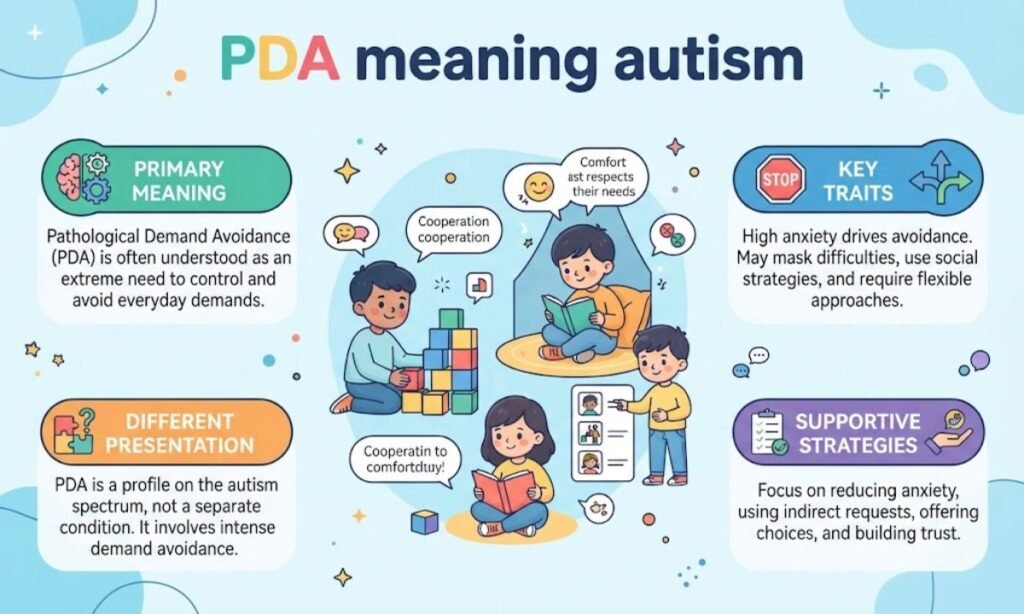
What Pathological Demand Avoidance Is
In autism conversations, PDA is a term for a profile marked by intense resistance to everyday demands. Experts describe it as being rooted in anxiety and a need for control.
Not a Formal Diagnosis
The PDA profile is not an official diagnosis in the major diagnostic manuals, though it is discussed by many families and professionals. Some prefer the phrase “persistent drive for autonomy.”
Where You May See It in Text
Parenting forums and support groups often use “PDA” in this sense. If you see it there, it has nothing to do with affection. For medical or developmental concerns, please talk to a qualified professional.
This is a good reminder of why context matters so much. A post in an autism support group and a comment under a couple’s photo can use the same three letters and have nothing in common.
Conclusion
PDA in text most often means public display of affection. It’s a simple, casual label for anything from a quick hug to a gushy online post. Its tone depends on who’s speaking and where.
Remember that the same three letters can point to a handheld device, a heart condition, or an autism profile. When in doubt, check the context or ask.
Use it lightly, respect people’s comfort levels, and skip it in formal writing. Do that, and you’ll always be understood.
The next time you see PDA pop up in a chat, you’ll know what it means, how to reply, and when to add a little extra context. A small bit of clarity keeps every conversation friendly.
Frequently Asked Questions
What does PDA mean in text messaging slang?
It means “public display of affection,” such as kissing, hugging, or holding hands in public or posting couple content online.
What does PDA mean in text messages?
Usually the same: public display of affection. Depending on the chat, it can also mean personal digital assistant.
How to interpret PDA references in online chats?
Look at the topic. If people are discussing couples, it’s affection. If they’re discussing gadgets or health, it likely means something else.
Which companies manufacture popular PDA devices today?
Traditional consumer PDAs are mostly discontinued. Handheld business devices are now made by companies like Zebra, Honeywell, and Samsung.
What are the social rules for PDA in group texts?
Keep it light and avoid oversharing about others’ relationships. Don’t tag or post couples’ private moments without their okay.
How is PDA used in professional texting or chat apps?
Rarely. When it appears, it’s usually about workplace conduct or, occasionally, a handheld device. Write the full phrase to be safe.
How to address uncomfortable PDA in text conversations?
Be kind and direct: “I’m not comfortable with this much PDA. Can we keep it lower?” Avoid sarcasm.
Where can I buy a PDA device for business use?
Look at authorized retailers and business-tech suppliers for rugged handheld computers. Check the brand’s official site for current models.
What does PDA mean in a text?
It usually means public display of affection, like kissing or hugging in public.
What does PDA stand for on TikTok?
On TikTok, PDA stands for public display of affection, often used in comments about couples.
Is PDA a bad word?
No. PDA is a neutral term. It only sounds negative if someone uses it critically.

I am a dedicated author with 6+ years of experience writing and researching content for name meaning websites. My expertise includes American names, baby names, surnames, name origins, and cultural significance. I focus on creating accurate, well researched, and easy to read articles using trusted sources. My goal is to help readers discover the history, meaning, and uniqueness behind every name with reliable and engaging content.