
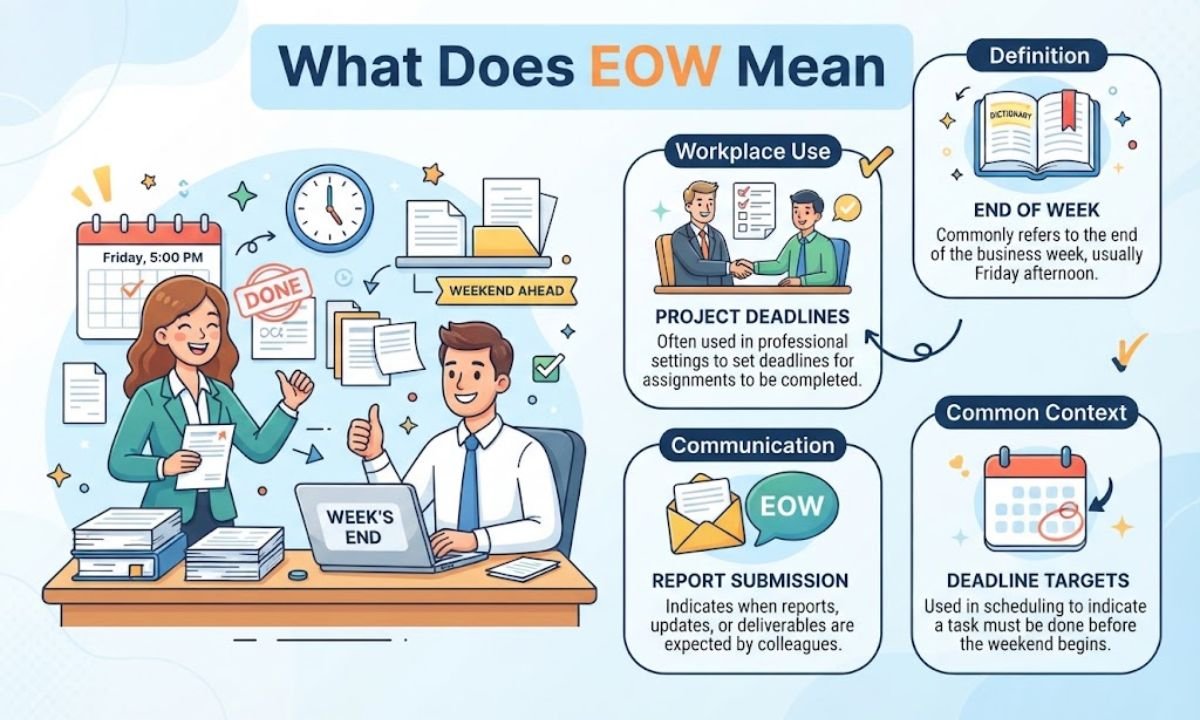

You just got an email that says, “Please send the draft by EOW.” Or maybe you saw three letters on a police memorial and wondered what they stood for. Either way, you want a straight answer.
EOW most commonly means “End of Week.” In police and military settings, it means “End of Watch.” In warranty and product paperwork, it can mean “End of Warranty.” Context decides which one applies.
This guide walks through every major meaning, shows real examples, and explains when the abbreviation is a good idea and when it is not. You will also find quick tables, plain-English definitions, and answers to the questions people search for most.
What Is the Full Form of EOW?
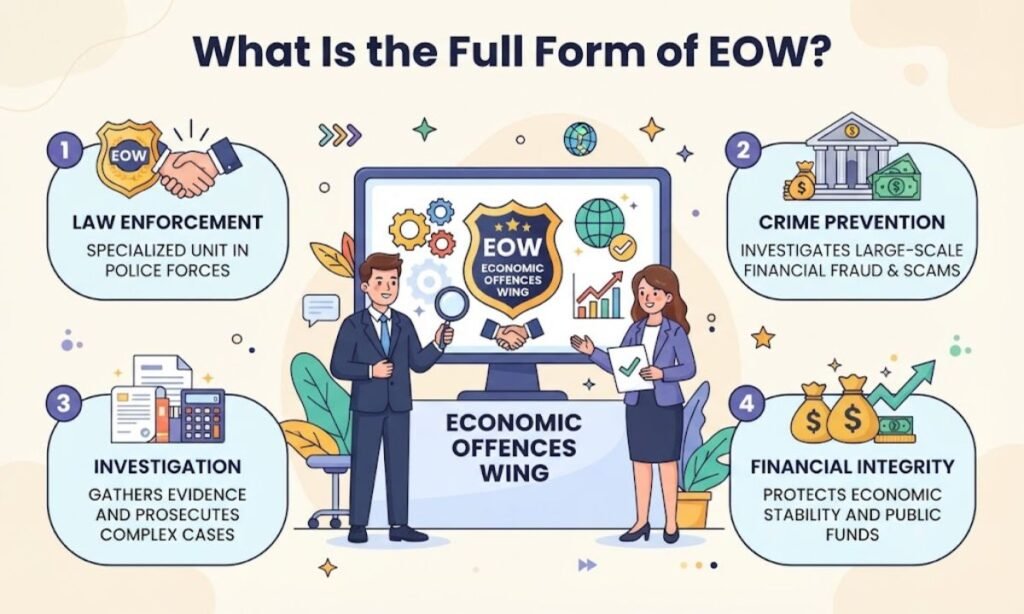
The full form of EOW depends on where you see it. Three expansions cover almost every situation you will run into. The table below gives the short version, and the sections that follow explain each one.
| Full Form | Where You See It | Typical Meaning |
| End of Week | Offices, emails, project tools | Deadline or wrap-up point, usually Friday |
| End of Watch | Police, fire, military | End of a shift, or the date an officer died on duty |
| End of Warranty | Product and service contracts | The date coverage stops |
1. End of Week
This is the everyday meaning. When a manager writes “EOW,” they mean the close of the working week, which for most teams is Friday afternoon.
A sentence like “I need the numbers by EOW” sets a deadline without naming a date. It is short, quick to type, and widely understood in offices that run on email and chat.
The catch is that “end of week” is a little fuzzy. Is it Friday at 5 p.m., or Sunday night? Most people mean Friday, but it is smart to confirm.
2. End of Watch
In law enforcement, a “watch” is a shift. End of Watch marks when that shift finishes. Officers log it in daily reports, and dispatchers use the phrase when an officer signs off for the day.
It also carries a heavier meaning. Memorial pages and tribute posts use “EOW” beside the date an officer was killed in the line of duty. In that setting, the letters are a mark of respect, not a scheduling note.
3. End of Warranty
In product manuals, service contracts, and IT asset lists, EOW can point to the date a warranty expires. After that date, repairs and replacements are no longer covered by the seller or maker.
This meaning is the least common of the three. You will mostly see it in spreadsheets used by procurement, IT, or facilities teams that track equipment lifespans.
How EOW Is Used in Business Communication
In business, EOW is a deadline shortcut. It sits in the same family as EOD (end of day) and COB (close of business). Managers use it in email, chat threads, task comments, and meeting notes.
Typical uses include:
- Deadlines: “Client feedback is due EOW.”
- Status updates: “I will share the final report by EOW.”
- Planning: “Let’s lock the schedule by EOW so we can start Monday.”
- Follow-ups: “Can you confirm by EOW whether the vendor is approved?”
Because it saves a few words, it feels efficient. That efficiency only works when everyone reads it the same way, which is why the next section matters.
Best Practice for Professional Use
A few habits keep EOW from causing trouble:
- Pair it with a day and time. Write “EOW (Friday, 5 p.m. ET)” instead of leaving it open.
- Name the time zone when your team spans regions.
- Use it with people who know it. Colleagues will get it. New clients might not.
- Do not stack it with other abbreviations. A sentence full of acronyms is hard to read.
- Expand it once in written project briefs, then use the short form.
These small steps turn a vague shorthand into a clear commitment.
What Does EOW Stand for Police?
In police use, EOW stands for End of Watch. It refers to the end of an officer’s tour of duty.
On a normal day, that simply means the shift is over and the officer signs off. Many departments record the time in logs, and radio traffic often marks the moment.
The phrase has a second, more solemn use. When an officer dies while serving, the department lists the date as their “End of Watch.” That date appears on plaques, memorial walls, funeral programs, and tribute pages.
So if you see EOW next to a badge number and a date, it almost certainly refers to this second meaning.
EOW Meaning Police
Put simply, EOW in police language means the point at which an officer’s duty ends. Think of it as the closing bracket on a shift.
Here is how the two uses differ:
- Routine use: the end of a scheduled shift, noted in logs or by radio.
- Memorial use: the date an officer died in the line of duty.
The second use is the one most people meet online. Tribute posts often read “EOW: June 4,” followed by the officer’s name and department. Reading it as “end of week” there would completely miss the point.
EOW Meaning
The short answer to “EOW meaning” is that it is an initialism with several valid expansions. End of Week leads the pack because so many people work in offices. End of Watch ranks second and is the standard in law enforcement and the military.
A few less common readings exist too. Some prescribers use it for “every other week” in medication schedules. In India, EOW also stands for the Economic Offences Wing of certain police units. Old English used ēow as a pronoun meaning “you.”
None of these are interchangeable. Look at who wrote it, where it appears, and what surrounds it. Those clues almost always settle the question in seconds.
What Does EOW Mean in Business?
In a business setting, EOW means the end of the work week. It tells you when something must be done, usually Friday afternoon.
Here are a few realistic examples:
- “Please submit expense reports by EOW.”
- “The design team will deliver mockups EOW.”
- “We need sign-off EOW to hit the launch date.”
Project teams like it because weekly cycles are common. Sprint reviews, weekly reports, and Friday check-ins all fit neatly around an end-of-week marker.
There is one soft spot: it is not a precise timestamp. If you receive an EOW deadline, a quick reply such as “Just to confirm, Friday at 5 p.m.?” removes doubt and shows good follow-through.
Eow definition
EOW (noun, abbreviation): an initialism whose meaning changes by setting.
- Business: end of week; the close of the working week, usually Friday.
- Law enforcement and military: end of watch; the end of a duty shift, or the date of an officer’s death in service.
- Contracts and assets: end of warranty; the date coverage expires.
- Medical shorthand (discouraged): every other week.
If you only need one line for a quick reference, use this: EOW usually means “end of week” in an office and “end of watch” in policing.
What does e.o.w. stand for
Written with periods, e.o.w. stands for the same things as EOW. The dots simply follow an older style of abbreviating, where each letter is punctuated.
Most modern writing drops the periods. You will see “EOW” in emails, chat apps, and calendars far more often than “e.o.w.”
Meaning is unaffected by punctuation. So e.o.w. means end of week in a corporate message, and end of watch in a police report. The clues are still in the surrounding text, the sender, and the setting.
Eow stand for
When people ask what EOW stands for, they usually want a single answer. The most useful reply is a ranked one:
- End of Week (most common overall)
- End of Watch (most common in public safety)
- End of Warranty (common in asset tracking)
Beyond these, you might spot niche uses inside specific companies or agencies. For example, a logistics firm might use it for “end of wave” in a warehouse. If a message seems to make no sense, ask the sender. A five-second question beats a wrong guess.
Eow acronym
Strictly speaking, EOW is an initialism rather than an acronym. An acronym is pronounced as a word, like NASA. An initialism is read letter by letter, like FBI. People say “E-O-W,” so it is an initialism.
In everyday talk, though, almost everyone calls it an acronym, and search engines treat the two as the same thing. That is why “EOW acronym” is such a common search.
The practical point is this: it is spoken as three separate letters, and typed in capitals. Writing “eow” in lowercase is fine in casual chat but looks sloppy in a formal email.
Eow acronym meaning
The meaning of the EOW acronym shifts with its home turf.
| Setting | Meaning |
| Corporate email | End of week |
| Police report or memorial | End of watch |
| Equipment register | End of warranty |
| Indian police units | Economic Offences Wing |
| Prescription notes | Every other week |
A good rule is to check the source. A message from your manager points to end of week. A post on an officer’s memorial page points to end of watch. A purchase record points to end of warranty. Read the source first, then decide.
Whats eow mean
If someone texts or emails “whats eow mean,” here is the fast reply: it usually means “end of week.”
Say a coworker writes, “Need this EOW.” They want it finished by the close of the week, most likely Friday. If a friend types it in a casual chat, the meaning is normally the same, or it may hint at a plan for the end of the week, such as “let’s catch up EOW.”
Not sure? Reply with a clarifying line. Something like “Do you mean Friday afternoon?” works well. It keeps things polite and prevents missed deadlines.
What does eow mean in text
In text messages and chat apps, EOW normally means “end of week.” People use it to talk about plans, deadlines, and results that land near the weekend.
Examples:
- “Payday is EOW, finally.”
- “Can we meet EOW?”
- “I’ll send the photos EOW.”
In group chats about police, firefighters, or veterans, you might also see it as “end of watch.” The topic of the chat is your best clue.
One more tip: because texting is casual, people rarely say which day they mean. If timing matters, ask.
What does eow mean for police
For police, EOW means End of Watch. It marks when an officer’s shift or service period ends.
You will hear the phrase in two ways:
- Everyday: “Unit 12, end of watch.” That is a sign-off at the close of a tour.
- Honorary: “EOW: March 9, 2019.” This appears in tributes to fallen officers.
Many agencies and community groups keep memorial pages that list each officer’s name, rank, and End of Watch date. Families and coworkers often use the phrase in remembrance posts as well.
What Does EOW Stand For?
EOW stands for End of Week in most workplaces, End of Watch in law enforcement and the military, and End of Warranty in contract and asset records.
If you need a one-line answer for a quiz, a search snippet, or a quick reply, go with “End of Week.” It fits the widest range of real-life messages.
Where the answer changes is in public safety and product paperwork. There, the same three letters point to something very different. The setting, the sender, and the topic are your tie-breakers.
EOW Medical Abbreviation
In medicine, EOW is sometimes written to mean “every other week.” A prescriber might use it for a treatment that is given once every two weeks, such as certain injections.
Here is the problem: it looks a lot like other abbreviations. Patient-safety groups have long warned that shorthand like this can be misread, and they encourage writing “every other week” in full.
A practical rule for patients: if a prescription note says EOW, ask your pharmacist or doctor to spell it out. Never guess about dosing. Clear wording protects you, and it costs nothing to ask.
What’s EOW?
What’s EOW? It is a short form people use to save time. Most of the time it means the end of the week, and it signals a deadline or plan.
Think of it as the calendar version of “by tomorrow.” It gives the reader a target without naming the exact date. That is handy for busy teams and dangerous for unclear ones.
If you are the one writing it, add a day. If you are the one reading it, treat Friday afternoon as the safe assumption unless told otherwise.
What Does E.O.W. Mean?
E.O.W. carries the same set of meanings as EOW, with periods added between the letters. The punctuation is old-fashioned, but the message is unchanged.
- Office setting: end of week.
- Police and military setting: end of watch.
- Contract setting: end of warranty.
You are more likely to see the dotted version in older documents, formal letters, or printed forms. Chat apps, project boards, and modern email almost always drop the periods.
EOW Abbreviation
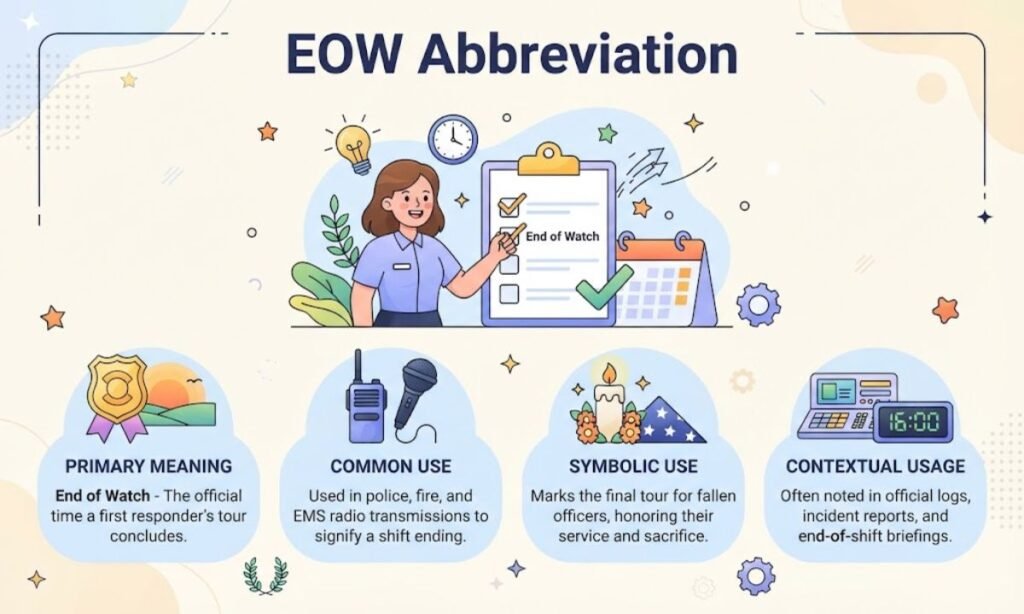
As an abbreviation, EOW belongs to the “end of” family used for time markers. These shortcuts help people set boundaries around work.
Here is the family at a glance:
- EOD: end of day
- EOB / COB: end of business / close of business
- EOW: end of week
- EOM: end of month
- EOY: end of year
Each one sets a finish line at a different scale. EOW sits in the middle, which makes it great for weekly reports, sprint wrap-ups, and Friday hand-offs.
What Does EOW Mean?
Here is the plain answer: EOW means end of week when someone is setting a deadline, and end of watch when someone is talking about police or military duty.
To pick the right one, ask two questions:
- Who is speaking? A manager, a colleague, an officer, a vendor?
- What is being discussed? A due date, a shift, a memorial, a product?
Those two clues solve about 95 percent of cases. For the rest, a quick question to the sender clears things up.
What Does EOW Stand For in Police?
In police work, EOW stands for End of Watch. A “watch” is simply a shift, so the phrase means the shift has ended.
Two situations show up most often:
- Signing off: An officer completes a tour of duty and reports out.
- Remembrance: A department marks the date an officer died while serving.
The second use is why the phrase feels so weighty. On memorial walls and tribute pages, the letters EOW sit beside a date and a name. Readers who see it there should think of it as a tribute, not a time stamp.
EOW Stands For
EOW stands for end of week, end of watch, and end of warranty. Every one of them marks a finish point.
That shared idea is useful. Whenever you see “EOW,” picture a line drawn under something: a week of work, a shift on duty, or a period of coverage. Once you know what is being closed out, the right meaning usually snaps into place.
For memory’s sake, remember it this way: Week for work, Watch for the badge, Warranty for the product.
EOW/EOH Meaning
You may spot EOW/EOH written as a pair. This usually signals two time boundaries: the end of the week and the end of the hour, or another “end of” marker paired with it.
EOH is not standardized. In some workplaces it means “end of hour,” and in others it may be a team-specific label. Because it is less common than EOD or EOW, it is best to expand it the first time.
When you see a slash between two abbreviations, treat it as a small warning sign. Ask what the sender means, or define both terms in your own reply so nobody loses track.
What Does EOW Mean?
Another way to see it: EOW is a signal that something finishes. What finishes depends on the world you are in.
| If you are reading… | EOW probably means… |
| A project update | End of week |
| A memorial post | End of watch |
| An IT asset list | End of warranty |
| A doctor’s note | Every other week (ask to confirm) |
If two rows seem possible, look for more clues, like a date, a badge number, or a product model. The extra detail almost always points the way.
Define EOW
Define EOW: an abbreviation used to mark the end of a period. In business it refers to the close of the working week. In law enforcement it refers to the end of a duty shift or the date a service member died in the line of duty.
For a dictionary-style entry, you could write it like this:
EOW (abbr.): 1. End of week. 2. End of watch. 3. End of warranty.
Short, accurate, and easy to remember. If your reader needs only one definition, lead with the business meaning and mention the police meaning right after.
What Is an EOW?
“What is an EOW?” sounds odd, since EOW is not a thing, it is a label. People use “an EOW” in a few ways:
- An EOW deadline: a due date at the end of the week.
- An EOW report: a summary produced at the end of the week.
- An EOW date: the end-of-watch date on a memorial.
In India, you may also hear “the EOW” about the Economic Offences Wing, a police unit that investigates large financial crimes. In that case, the article “the” is normal, since it names a department.
What Is EOW?
EOW is shorthand for a finish line. In an office, it is Friday. In policing, it is the close of a shift or a fallen officer’s final day. On a purchase record, it is the day coverage stops.
It is one of those tiny terms that becomes second nature after a few uses. People type it because it is fast. They keep using it because everyone around them seems to understand.
The trick is knowing whose “everyone” you are writing for. A team that shares a workplace can use it freely. A stranger may need the words spelled out.
What EOW Stands For
When people ask what EOW stands for, the best structured answer looks like this:
- Work context: End of Week.
- Police context: End of Watch.
- Warranty context: End of Warranty.
- Regional police context (India): Economic Offences Wing.
- Health context: Every Other Week.
Five answers may sound like a lot, but in real life you will rarely see more than one or two in the same place. Your daily environment narrows the field quickly.
Understanding the Difference: EOW, EOD, and COB
These three abbreviations all set deadlines, but the scale differs. Mix them up and you can end up with a task due four days too late.
| Abbreviation | Full Form | Usual Meaning | Example |
| EOD | End of Day | Late in the workday, often 5 p.m. | “Send it by EOD.” |
| COB | Close of Business | When the office closes for the day | “Reply by COB.” |
| EOW | End of Week | Friday afternoon, in most workplaces | “Finish by EOW.” |
A few points worth noting:
- EOD is a bit looser than COB. Some people treat EOD as midnight, others as 5 p.m.
- COB is tied to business hours, so it suggests a tighter cut-off.
- EOW covers a longer runway, but can be misread as Sunday night.
When precision matters, replace any of them with a date and time. “Friday, 3 p.m. GMT” leaves no room for doubt.
The Meaning of EOW in Law Enforcement
In law enforcement, End of Watch is part of the profession’s shared language. Officers work shifts, and each shift has a start and an end. The “watch” is the block of hours an officer is responsible for.
The phrase appears in a few places:
- Duty logs: the recorded end of a tour.
- Radio traffic: a sign-off at the close of a shift.
- Memorials: the date an officer died in the line of duty.
- Tributes and social posts: “Gone but never forgotten, EOW.”
Firefighters, corrections staff, and some military units follow similar customs. Because of that, the term carries a sense of duty and sacrifice that “end of week” never will.
Use of EOW in Chat and Messaging Apps
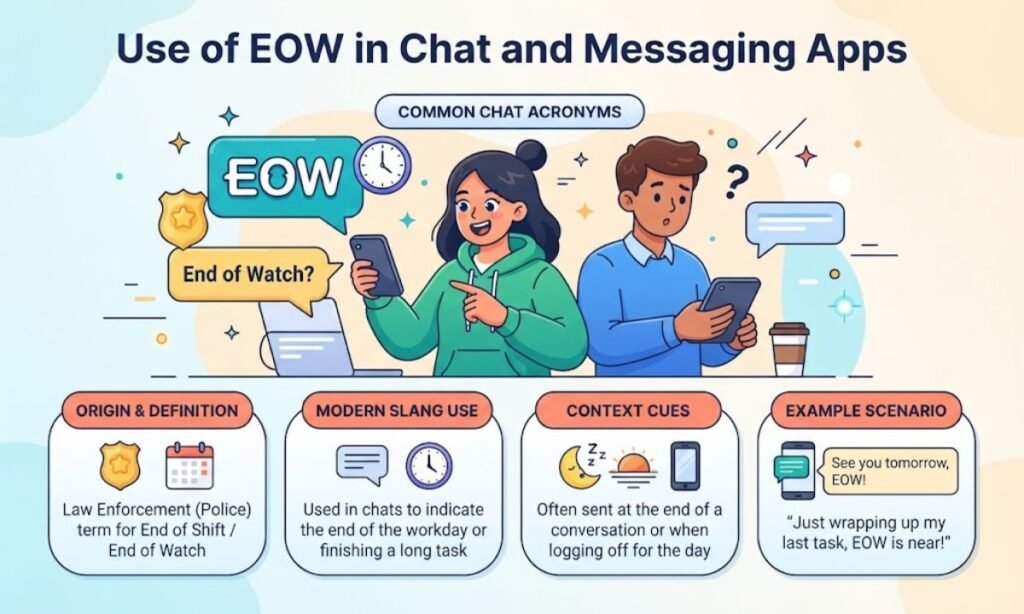
In Slack, Teams, WhatsApp, and similar apps, EOW fits right in with other quick shorthand. People use it because chat rewards speed.
Common patterns:
- Work chats: “Can you review the deck EOW?”
- Personal chats: “Let’s grab dinner EOW.”
- Community chats: a tribute using End of Watch.
Because chat is informal, senders often skip details. That is fine for low-stakes plans. For anything with real consequences, such as a client deadline, add a specific day.
If you get a message you do not understand, you are allowed to ask. Nobody minds a quick “EOW as in Friday?”
EOW Meaning in Hindi and Urdu
In Hindi, “end of week” translates to सप्ताह का अंत (saptaah ka ant) or, more casually, हफ़्ते का अंत (hafte ka ant). In Urdu, the equivalent is ہفتے کا اختتام (hafte ka ikhtitaam) or ہفتے کے آخر میں (hafte ke aakhir mein).
Many South Asian offices work in English and use “EOW” exactly as it appears in international workplaces. The abbreviation itself is not translated. It is simply understood in English-language emails.
A few things to keep in mind:
- In parts of South Asia, the work week may run Monday to Saturday, or end on Thursday in some regional settings. That shifts what “end of week” means.
- For police news in India, “EOW” often refers to the Economic Offences Wing, not a time marker.
- When writing to a mixed audience, spell out the day. “By Friday” is clearer than any abbreviation.
When You Should Avoid Using EOW
Abbreviations are handy, but they can create friction. There are times when spelling things out is the better choice, and the four cases below cover the main ones.
1. Communication With New Clients
A new client does not know your shorthand yet. Using EOW might make them feel left out, or worse, lead to a wrong assumption about the deadline.
Try this instead: “I will send the draft by Friday, May 16, at 5 p.m.” It reads as professional and warm at the same time. Once the relationship is established, you can relax into shorthand.
2. International Teams
Work weeks differ around the world. Some regions run Sunday to Thursday. Time zones add another layer. Your Friday evening may already be someone else’s Saturday.
For global teams, name the date and the time zone. “Wednesday, 4 p.m. CET” is unambiguous. “EOW” is not.
3. Formal Documents and Legal Agreements
Contracts, statements of work, and policies should avoid ambiguous terms. If a payment or delivery date matters legally, use an exact calendar date.
A vague “EOW” could become a dispute later. Was it Friday at noon or Sunday at midnight? A written date closes that loophole before it opens.
4. Sensitive Contexts
In messages about safety, health, or grief, shorthand can feel cold or lead to mistakes. This is particularly true for medical notes, where “every other week” should be written out in full.
It also applies to tributes. If you are honoring a fallen officer, write “End of Watch” fully. It is a small act of respect.
The Role of Abbreviations Like EOW in Modern Workplace Culture
Abbreviations are woven into how modern teams talk. They speed up messages, shape norms, and quietly signal who belongs to the group. EOW is a small example of a bigger trend: work communication is getting shorter and more frequent.
That trend comes with real upsides and a few risks. Here is how it plays out.
1. Encourages Concise Communication
Busy people scan messages. A short deadline marker helps them find what matters fast. “Due EOW” takes two words, and the reader knows what to do.
Concision also helps in chat, where long messages get skipped. Short, structured notes are more likely to be read and acted on.
2. Supports Agile Project Management
Agile teams work in short cycles, often one or two weeks. EOW lines up neatly with sprint boundaries, weekly reviews, and Friday demos.
In tools like Jira, Asana, and Trello, comments such as “will close by EOW” help everyone see what will land this cycle. It becomes a shared clock for the team.
3. Reflects Workplace Norms
Every workplace builds its own dialect. Some teams love EOD and EOW. Others insist on exact dates. Neither approach is wrong, but new hires pick up cues fast.
If you are new, listen first. Notice how your manager writes deadlines, and mirror that. It shows awareness without any awkward questions.
4. Balancing Clarity and Efficiency
Shorthand saves seconds, but confusion can cost hours. The sweet spot is to use abbreviations for routine, low-risk messages and spell things out when accuracy matters.
A good test: if a mistake would cause a missed deadline, a lost sale, or a legal problem, write the full date. If not, EOW is fine.
Why These Sections Help SEO
Readers arrive with different questions. One person wants the office meaning, another wants the police meaning, and someone else is checking a prescription. A clear structure lets each of them jump straight to the answer.
Short sections with plain headings also make it easier for search engines to match a specific question to a specific answer. That is good news for readers, because it means the most helpful part of a page can show up right when they need it.
For you as a writer, the takeaway is simple: answer one question per section, keep sentences short, and use tables and lists where they make comparisons easier to see.
Common Questions About EOW
A few questions come up again and again, especially from people who are new to the term or who work across teams and time zones. The four answers below cover the most frequent ones.
Does EOW always refer to Friday?
No. In most offices EOW means Friday, but it depends on the team’s work week. If your team works Sunday to Thursday, or Monday to Saturday, the “end” shifts accordingly.
Retail, hospitality, and healthcare teams often run seven-day schedules, so their “week” may end on a Sunday. When in doubt, confirm the day.
Does EOW include weekends?
Usually not. Most people treat EOW as the close of the working week, which means the deadline falls before the weekend starts. A task due EOW is meant to be done by Friday evening, not Sunday night.
Some managers do quietly expect weekend flexibility. If a request feels ambiguous, ask directly, so you protect both the deadline and your time off.
Is EOW formal?
EOW sits in the middle. It is fine in internal emails and team chats, and it is common in project tools. It is less suitable for formal letters, contracts, or first contact with a client.
If you want to sound polished, write “by the end of the week” or give a date. That keeps the tone professional without adding much length.
Can EOW be misunderstood?
Yes, and that is the main risk. It can be read as Friday afternoon, Friday midnight, or Sunday night. It can also be mistaken for “end of watch,” especially online.
The cure is simple: add a day and time, or expand the abbreviation the first time you use it.
Why Context Matters
Every meaning of EOW is correct in its own place and wrong outside it. Context is the difference between a sensible deadline and a confusing message.
Here are the clues worth checking, in order:
- The sender. A manager, an officer, a vendor, or a friend.
- The channel. Work email, memorial post, purchase record, or text.
- The topic. Deadlines, duty, or product coverage.
- The surrounding words. A date, a badge number, a model name.
When these clues disagree or seem thin, ask. A one-line question saves the time and stress of a wrong guess.
what does eow mean police
If you are asking what EOW means in police terms, the answer is End of Watch. It marks the end of an officer’s shift, and it is also used for the date an officer died in the line of duty.
Online, you will often find it in remembrance posts and memorial databases. If the post includes a name, department, and date, it is almost certainly this meaning.
what does eow mean in business
In business, EOW means end of week. Someone uses it to say a task, report, or decision should be done by the close of the working week.
For example, “please review the proposal by EOW” asks for a review before the weekend. If you need certainty, a quick confirmation of the day and time is worth the effort.
does eow mean end of week
Yes, in the vast majority of workplace messages, EOW does mean end of week. It is the most common reading by a wide margin.
The exceptions are in policing, where it means end of watch, and in contract paperwork, where it can mean end of warranty. If your message comes from a colleague about a deadline, end of week is the safe bet.
what does eow mean in healthcare
In healthcare, EOW is sometimes used as shorthand for every other week, especially in notes about how often a treatment is given. It can also appear in administrative contexts as “end of week,” such as in weekly staffing or reporting schedules.
Because dosing errors can be serious, many safety organizations recommend writing “every other week” in full. If you see EOW on a prescription or care plan, ask a pharmacist or clinician to confirm what it means. That advice is general, not personal medical guidance.
Eow meaning old english
In Old English, ēow (sometimes spelled eow) was a pronoun meaning “you,” used for more than one person in the accusative and dative forms. It is part of the language spoken in England before about 1150.
Reference works on historical language show this same spelling in older texts. It has nothing to do with the modern abbreviation, which is a separate use of the same letters.
You will only run into it in literature, linguistics, and genealogy. In modern emails, it is not relevant.
Eow meaning from a girl
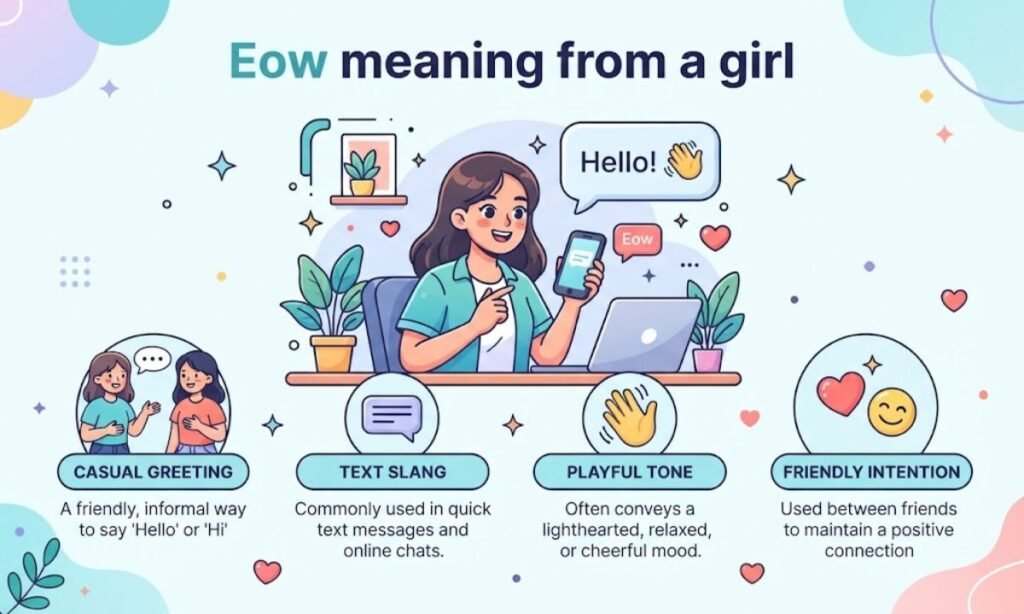
If a girl, or anyone, texts you “EOW,” it almost always means end of week. Someone might be talking about weekend plans, payday, or a deadline.
For example, “Can we hang out EOW?” is a suggestion to meet up around the end of the week. There is no hidden slang here, so you can take it at face value.
If the message seems unclear, ask which day they mean. A simple “Friday or Saturday?” gets you a straight answer and shows you are paying attention.
EOW meaning military
In the military, EOW commonly means End of Watch. It marks the close of a duty period on a ship, at a post, or in a unit’s log.
As in policing, it is also used to honor service members who died on duty. Memorial notes may list a “End of Watch” date beside a name.
Some units also use “end of week” for weekly reports and training schedules. Check the branch, the unit’s habits, and the topic of the message to decide which one applies.
Conclusion
EOW is a small abbreviation with a surprisingly wide reach. In offices, it means end of week, a handy way to mark a deadline. In policing and the military, it means end of watch, a phrase tied to duty and remembrance. On product records, it can mean end of warranty.
The key is context. Look at who is writing, where the message appears, and what it is about. If you are the one writing, add a day and time to keep things clear. If you are the one reading, do not hesitate to ask.
Use EOW with people who know it, spell it out with people who do not, and always treat the police meaning with respect. With those habits, you will never be caught off guard by three little letters again.
Frequently Asked Questions
What does EOW mean in workplace communications?
It means end of week, a deadline marker usually set for Friday afternoon. Add a specific day and time to avoid confusion.
What does EOW mean in a corporate email?
It tells the reader that something is due by the end of the working week. Confirm the exact time if the email does not give one.
How do popular project management tools define EOW?
Tools like Jira, Asana, and Trello do not define EOW themselves. Teams use it in comments and due dates to mean the end of the work week or sprint.
EOW meaning in email signatures from business software platforms?
Email signatures rarely use EOW. When it appears in an automated footer or status line, it normally means end of week, such as a weekly report cycle.
How is EOW used in financial reporting?
Finance teams use EOW to label weekly close-outs, balances, and reports. It marks the last business day of the reporting week.
What is the EOW deadline feature in task management software?
Some task tools let you set a due date at the end of the current week. It automatically picks the last working day, so you do not need to type a date.
What does EOW mean in text?
In text, EOW almost always means end of week. Someone is setting a plan or deadline near the weekend.
What does EOW stand for in police work?
It stands for End of Watch. It marks the end of a shift or the date an officer died on duty.
Does EOW mean end of week?
Yes, in most offices and chats. In law enforcement, it means end of watch instead.

I am a dedicated author with 6+ years of experience writing and researching content for name meaning websites. My expertise includes American names, baby names, surnames, name origins, and cultural significance. I focus on creating accurate, well researched, and easy to read articles using trusted sources. My goal is to help readers discover the history, meaning, and uniqueness behind every name with reliable and engaging content.