
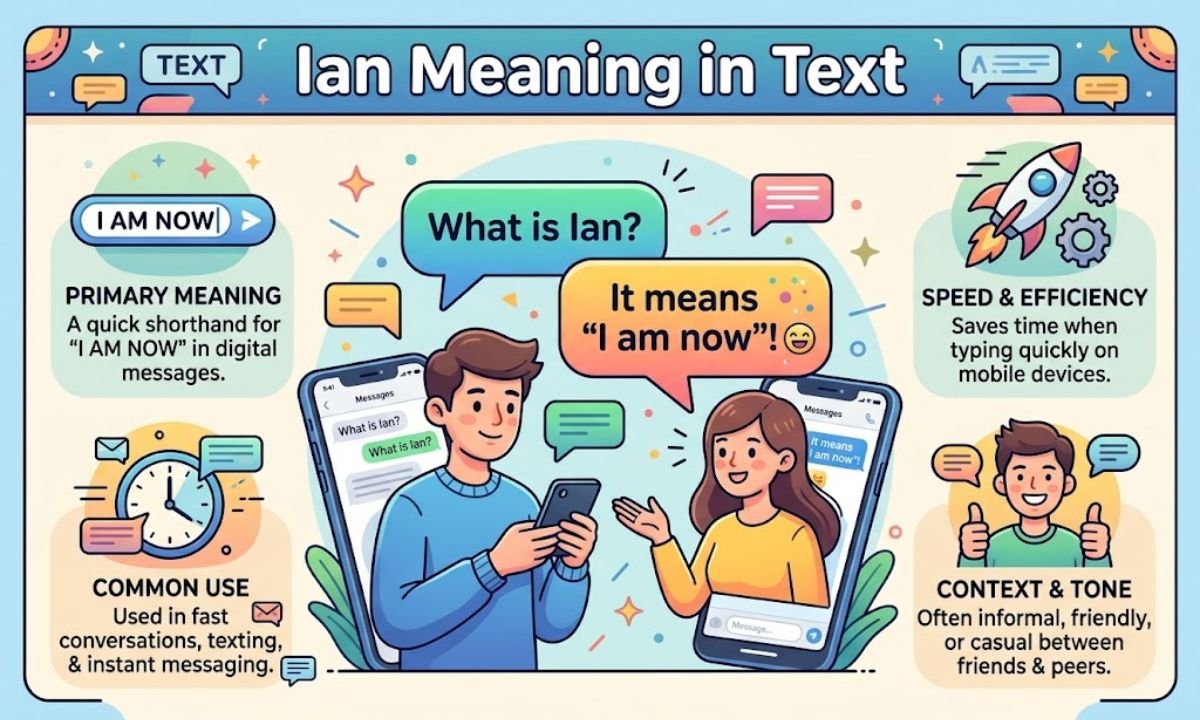

If you’ve seen “ian” in a chat and it clearly wasn’t a person’s name, it’s almost always a casual, sound-based spelling of “I ain’t” (sometimes read as “I am not”). The Ian meaning in text depends on the sentence around it, so context is what settles it.
This guide covers the slang meaning, how people use it on different apps, what it signals, and how to reply. It also separates the slang from the first name “Ian.”
Ian Meaning in Text – Quick Meaning
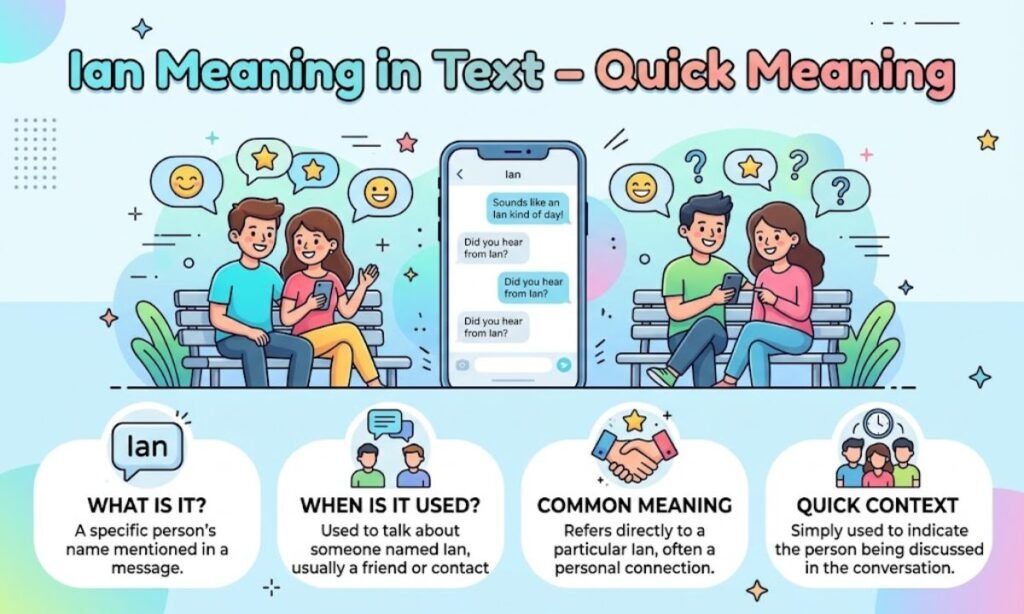
In text slang, “ian” is usually a lowercase, spoken-style spelling of “I ain’t.” You’ll see it before a verb or a word like “even,” “gonna” or “tryna.”
There’s no official dictionary entry for this slang use. Some sites list it as “I am not” instead, so the sense comes from the sentence, not from a fixed rule.
Simple Definition:
Ian (slang) = “I ain’t” or “I am not.” It’s a quick way to deny, refuse or push back on something in casual chat.
Quick Examples:
- “ian going tonight” → I ain’t going tonight
- “ian even mad lol” → I ain’t even mad, lol
- “ian gonna lie, that was funny” → I ain’t gonna lie, that was funny
- “ian tryna argue” → I ain’t trying to argue
Origin & Background
“Ain’t” is a long-standing informal contraction in spoken English. “Ian” looks like a spelling built from how “I ain’t” sounds when said fast.
I couldn’t find a documented first use or a reliable source that traces this exact spelling. Treat any confident “origin story” for it with caution.
A close relative is “ion,” which is widely listed as short for “I don’t.” Both follow the same habit of typing words the way they sound.
Real-Life Conversations (How People Actually Use It)
These are made-up examples that show typical patterns.
WhatsApp Chat
Sara: Are you coming to dinner? Ali: ian sure yet, let me check
Here it softens the answer. It means “I ain’t sure yet,” not a flat no.
Instagram DMs
Her: you liked my old post lol Him: ian even gonna deny it
It’s playful and slightly teasing, which is typical for DMs between people who know each other.
TikTok Comments
“ian never seen anyone do that 😭”
In comments, it adds attitude and exaggeration. The emoji tells you the tone is joking, not angry.
Text Message
Friend: Did you finish the assignment? You: ian started 😅
Short, honest and a little funny. It only works if the friend knows your texting style.
Emotional & Psychological Meaning
The words themselves are simple, but the tone can shift a lot. Emojis, punctuation and your history with the person do most of the work.
What it often signals:
- Casual confidence: “ian worried about it” sounds relaxed.
- Playful honesty: “ian gonna lie” usually comes before a real opinion.
- Mild defensiveness: “ian even do that” can mean the person feels accused.
- Comfort with you: people use slang with those they feel at ease with.
- Bluntness: “ian doing all that” can sound dismissive.
Usage in Different Contexts
1. Social Media
This is where “ian” fits best: captions, comments, replies and Stories. Short, spoken-style spellings are normal there.
2. Friends & Relationships
Between friends it feels natural. With a partner or crush it can sound teasing: “ian even like you like that 😏.” Without an emoji, though, a joke can land as cold.
3. Work or Professional Settings
Skip it. Write “I am not” or “I don’t” in work emails, client chats and anything formal.
4. Casual vs Serious Tone
It suits light moments. In a serious or emotional talk, full words come across as more careful and respectful.
Common Misunderstandings
1. Thinking “Ian” is always a name
Ian is a real first name, described by Dictionary.com as the Scottish form of John. If it’s capitalized and points to a person, it’s a name. If it sits before a verb, it’s likely slang.
2. Misreading the tone
Text has no voice. “ian talking to you” can be a joke or a brush-off. Check emojis, earlier messages and the person’s usual style.
3. Using it in the wrong setting
Slang in a formal message can look careless. Match the setting.
4. Confusing it with typos
It can look like a mistyped “in” or “I am.” If the message reads naturally as “I ain’t,” that’s the likely meaning. If it doesn’t fit, ask.
Comparison Table
| Term | Usual meaning | Where you’ll see it |
| ian (lowercase slang) | I ain’t / I am not | Casual chats, comments, DMs |
| ion | I don’t (also “in other news”) | Social media, texting |
| ain’t | Informal “am not / isn’t / don’t” | Spoken and informal written English |
| Ian (capitalized) | A male first name, Scottish form of John | Everywhere |
| een | Not established texting slang; mostly dialect or other-language words | Rare |
Key Insight:
The slang “ian” and “ion” both turn speech into spelling. Capitalization, grammar and context tell you whether you’re reading slang or a name.
Variations / Types of “Ian”
- ian (I ain’t): the main slang reading.
- ian (I am not): a reading some sites give, especially for short replies.
- ian even / ian gonna / ian tryna: natural combinations built from “I ain’t even,” “I ain’t gonna” and “I ain’t trying to.”
- Ian (name): a person’s name, usually capitalized.
- ion: a separate but similar slang form meaning “I don’t.”
How to Respond When Someone Uses “Ian”
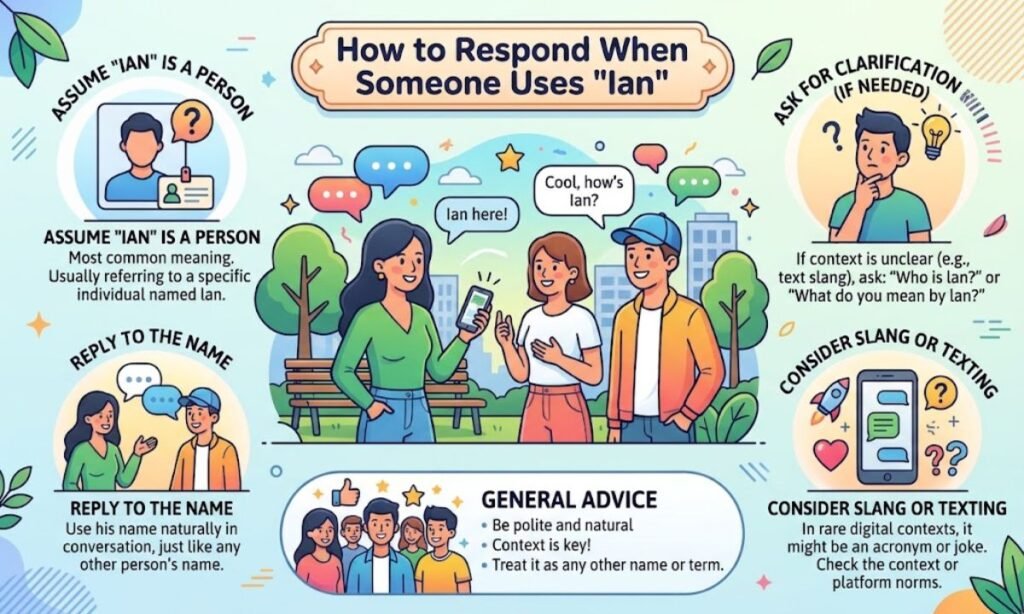
Reply to the meaning, not the spelling, and match their tone.
Casual Replies
- “Okay, no worries.”
- “Got it, let me know.”
- “Fair enough.”
Funny Replies
- “Ian either 😂”
- “Ian judging, but wow.”
- “Same, honestly.”
Mature / Confident Replies
- “Understood. I’m fine either way.”
- “Thanks for being straight with me.”
- “No problem. Tell me when you’re ready.”
Private / Respectful Replies
- “No pressure, we can talk later.”
- “Take your time. I’m here.”
- “I appreciate you telling me.”
Regional & Cultural Usage
I found no reliable data on how often “ian” is used in any region, so these notes are general.
Western Culture
In English-speaking countries, “ain’t” is familiar, so “ian” is easy to decode for people who use these apps.
Asian Culture
For English-as-a-second-language users, “ian” may look like a name or a typo at first. Learning it usually comes through social media.
Middle Eastern Culture
Younger English-speaking users may pick it up from short videos and chats. In formal or mixed-age groups, standard English is safer.
Global Internet Usage
The meaning stays the same wherever the app is used. If you’re unsure, a quick “wait, do you mean ‘I ain’t’?” settles it.
ian meaning in text slang
In slang, “ian” most often means “I ain’t.” Some sites read it as “I am not,” so check the sentence.
ian meaning in text snapchat
On Snapchat it works the same way: a quick, casual “I ain’t” in chats and snap captions. I couldn’t find an official Snapchat definition.
Ian meaning in text urban dictionary
Urban Dictionary entries are user-submitted, and I couldn’t verify a specific entry for this slang. Treat any entry there as one person’s definition, not a standard.
Ian meaning in text from girl
There’s no gender-specific meaning. It still means “I ain’t,” and her tone, emojis and past messages show whether it’s playful or serious.
What Does Ian mean on tiktok
On TikTok it’s used in comments and captions as casual “I ain’t.” Exaggeration and emojis usually show it’s a joke.
Ian meaning in text from a guy
It carries the same meaning from a guy: “I ain’t.” Read it alongside the rest of the message to judge whether he’s joking, teasing or being blunt.
Een meaning in text
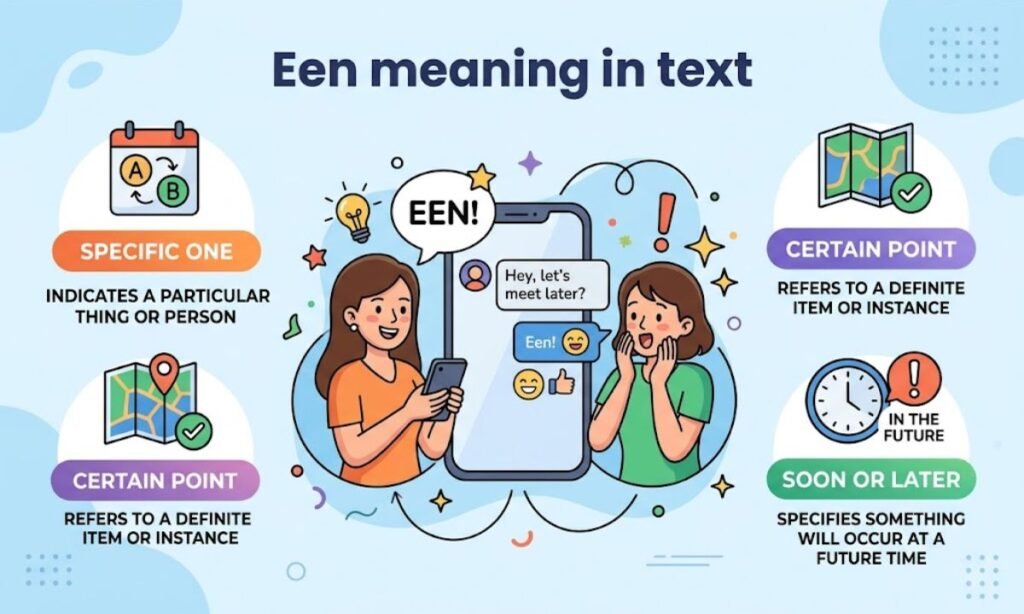
“Een” isn’t an established texting slang term. In English it’s mostly a dialect or poetic word, and in Dutch and Afrikaans it means “one,” so check the language and context.
Conclusion
In texts, “ian” is usually a casual spelling of “I ain’t,” while a capitalized Ian is simply a name. Look at the grammar, the tone and your relationship with the sender to be sure.
Use it with friends and on social media, and switch to “I am not” or “I don’t” anywhere formal.
Frequently Asked Questions
What does “ian” mean in text messaging slang?
It usually means “I ain’t,” and some sites read it as “I am not.” The surrounding sentence shows which fits.
What does the suffix -ian typically denote in English words?
It usually means “from, related to, or like,” as in “Italian,” or it marks a profession, as in “musician.” It comes from Latin -iānus.
Are there any brand names that use “ian” to appeal to younger audiences?
I couldn’t find verified examples of brands using “ian” this way. The suffix mostly appears in words for origin, belief and professions.
How do I know if “ian” is slang or a name?
If it’s capitalized and refers to a person, it’s a name. If it’s lowercase and sits before a verb or “even,” it’s likely slang.
Is “ian” the same as “ion”?
They’re similar but not identical. “Ion” is commonly listed as “I don’t,” while “ian” is usually “I ain’t.”
Should I use “ian” in a work message?
No. Use “I am not” or “I don’t” in professional writing.
How should I reply when someone texts “ian”?
Answer the meaning behind it and match their tone, whether that’s a casual “okay, no worries” or a friendly joke.
Why do people type “ian” instead of “I ain’t”?
It’s faster and mirrors how people speak, which gives chats a casual feel.

I am a dedicated author with 6+ years of experience writing and researching content for name meaning websites. My expertise includes American names, baby names, surnames, name origins, and cultural significance. I focus on creating accurate, well researched, and easy to read articles using trusted sources. My goal is to help readers discover the history, meaning, and uniqueness behind every name with reliable and engaging content.