
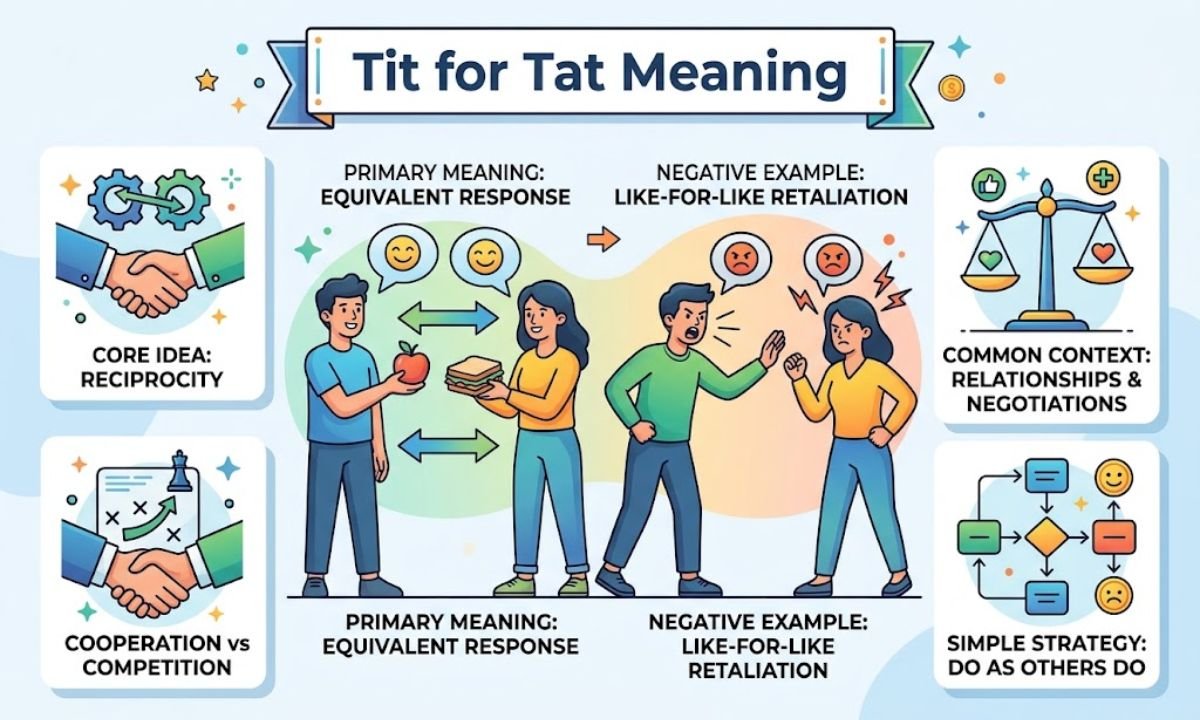

Tit for tat means giving back the same treatment you received. If someone hurts you, you hurt them back. If someone helps you, you help them in return. In everyday speech, though, people mostly use it for payback, like an insult answered with an insult.
You will hear this idiom in arguments, group chats, news headlines, trade stories and even pop music. This guide explains the tit for tat meaning, where the phrase came from, how people use it online and offline, and how to reply when someone says it to you.
Tit for Tat – Quick Meaning
Tit for tat is an English idiom that means an equal response to what someone did, usually something unkind or annoying.
- Simple definition: one action, one matching action back.
- Usual tone: negative or tense, but it can also be playful.
- Spelling: it is often hyphenated before a noun, as in “a tit-for-tat argument.”
- Example: “He ignored my message, so I ignored his. Tit for tat.”
The key idea is balance. The person using the phrase believes the reply is only fair, even when the other side disagrees.
Origin & Background of “Tit for Tat”
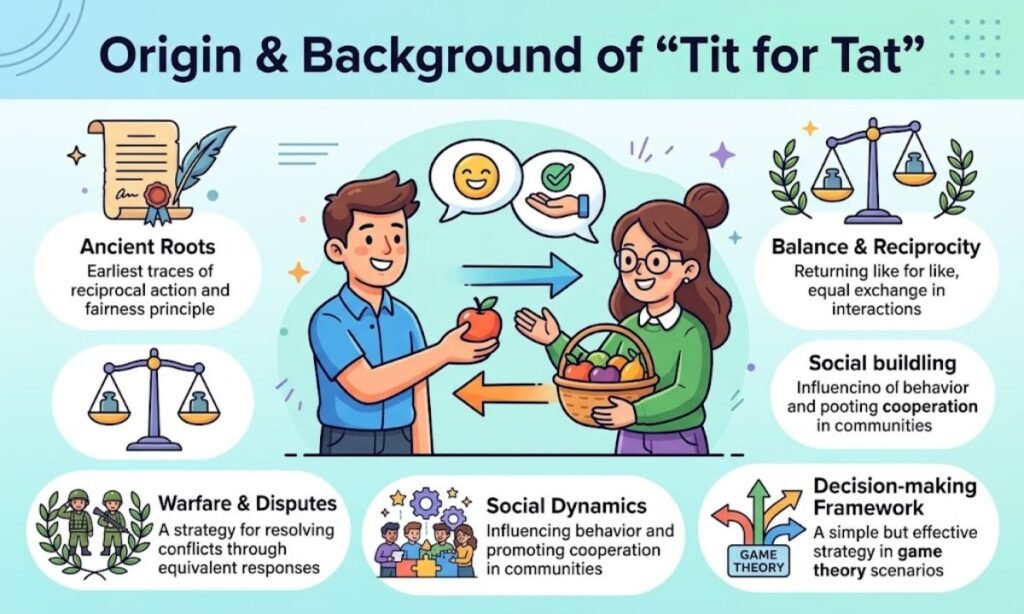
The phrase comes from 16th-century England. Dictionaries date it to the mid-1500s and say it is probably a variation of an older expression, “tip for tap.” Both “tip” and “tap” meant a light blow, so the first sense was a small hit given back for a small hit.
Why “tip” became “tit” is not fully clear. Early uses are often linked to the English writer John Heywood, but the exact starting point is still debated.
The phrase also left a small mark on British slang. In Cockney rhyming slang, “tit for tat” was shortened to “titfer,” which means hat.
In the 20th century, researchers gave the phrase a second, technical life in game theory. You will see that in the economics section below.
Real-Life Conversations (Mandatory Examples)
These short chats are made-up examples. They show how the phrase sounds in real use, from joking to serious.
WhatsApp Chat
Sana: You left me on read all day 😒 Zain: You didn’t answer my voice note last week Sana: So we’re doing tit for tat now? Zain: Maybe 😂 Okay, truce. Calling you now.
Here the phrase is light. Both people are teasing, and the mood is friendly.
Instagram DM
Hira: Why did you unfollow me? Ayesha: You muted my stories first Hira: Wow, that’s so tit for tat Ayesha: I’ll unmute you if you unmute me 😅
This is a small online “I did it because you did it” moment. It is petty, but it can also be a chance to clear the air.
TikTok Comment Section
@dancefan22: She answered his diss track with her own. Pure tit for tat 🔥 @lyricnerd: Song for song, I’m here for it @calmvibes: This is getting old, somebody call a truce
Commenters use the phrase to describe a public back-and-forth between two people. Some enjoy it as entertainment. Others see it as a sign the fight has gone on too long.
Emotional & Psychological Meaning
Tit for tat feels natural because humans care about fairness. Psychologists often call the urge to repay what we receive the norm of reciprocity. It works for kindness too. We tend to return favors and we tend to return disrespect.
Retaliation can feel like a way to restore balance. It tells the other person, “I noticed what you did, and I won’t just accept it.”
The risk is escalation. Each side sees its own move as a fair reply, while the other side sees it as a fresh attack. That is how small things, like a late reply or a missed invite, grow into a long cold war.
Sometimes tit for tat is also about hurt feelings. Keeping score can be a way of saying, “I feel overlooked,” without saying it directly.
Usage in Different Contexts
The meaning stays the same, but the weight changes with the setting.
Social Media
On social platforms, tit for tat describes public reactions: unfollowing, muting, quote-tweeting, replying to a post with a post, or trading comments. People often say “going tit for tat” when two accounts keep answering each other.
Friends & Relationships
Among friends and partners, it shows up in texting speed, who makes the plans, who pays and who apologizes first. A little balance is healthy. Strict score-keeping, however, slowly drains trust and warmth.
Work or Professional Settings
At work, the phrase usually signals conflict. Examples include refusing to help a colleague who did not help you, or answering a sharp email with a sharper one. It can also describe fair swaps of favors, but most managers use it as a warning sign that a disagreement needs a calm conversation.
Casual vs Serious Use
Casual use is playful: “You ate my fries, so I’m eating yours.” Serious use involves real harm, such as threats, harassment, legal fights, sanctions or trade penalties. A good rule of thumb is to check the tone and the stakes. Jokes and low stakes point to casual use. Anger and real damage point to serious use.
Common Misunderstandings
“Tit for tat always means revenge”
Not always. Revenge aims to hurt. Tit for tat aims to match. A person who returns a favor, a greeting or a compliment is also acting tit for tat, even if the phrase is rarely used that way today.
“It’s always negative”
Most speakers do use it negatively. Still, the core idea is reciprocity, and reciprocity can be kind. In game theory, the strategy actually starts with cooperation.
“It’s childish behavior”
It can look childish in petty fights. But in diplomacy, business and negotiation, a measured matching response is a deliberate tactic. The difference lies in whether the reply is thought through or emotional.
“It solves everything”
It does not. Matching every move can lock two sides into a loop where nobody backs down. Sometimes the better move is to stop, talk or forgive.
Comparison Table
| Term | Core Meaning | Typical Tone | Example |
| Tit for tat | An equal response to an action | Neutral to negative | “She skipped my party, so I skipped hers.” |
| Eye for an eye | Punishment equal to the harm done | Serious, often moral or legal | “Harm for harm is not real justice.” |
| Revenge | Hurting someone for a past wrong | Strongly negative | “He planned his revenge for months.” |
| Payback | Returning a favor or a hurt | Casual, can be either | “This is payback for last time.” |
| Quid pro quo | Something given in exchange for something | Formal, business or legal | “I’ll sign if you cut the fee.” |
| Reciprocity | Mutual give and take | Positive or neutral | “Good friendships rely on reciprocity.” |
Variations / Types of Tit for Tat
- Friendly tit for tat: kindness for kindness, like returning a favor or a gift.
- Hostile tit for tat: an insult for an insult, or a punishment for a punishment.
- Playful tit for tat: teasing that both sides enjoy, like prank wars between friends.
- Strategic tit for tat: a game theory strategy that starts cooperative, then copies the other side’s last move.
- Forgiving versions: “tit for two tats” retaliates only after two bad moves in a row, while “generous tit for tat” occasionally forgives a bad move.
- Adjective use: “tit-for-tat tariffs,” “tit-for-tat attacks” or “a tit-for-tat feud.”
- Slang use: “titfer,” the Cockney rhyming slang word for hat.
How to Respond When Someone Uses “Tit for Tat”
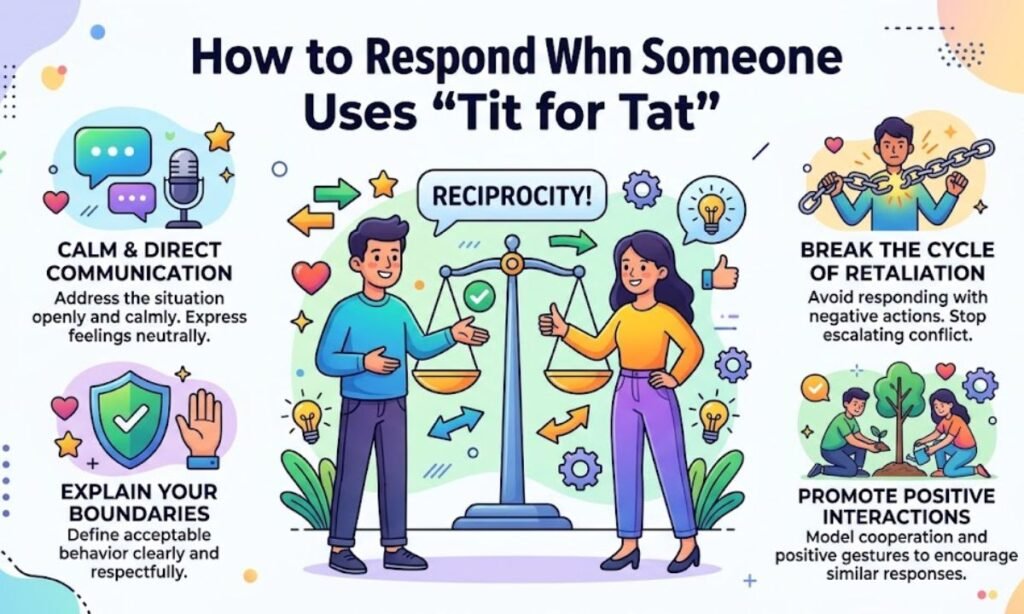
Your best reply depends on the mood. Is the person joking, hurt or truly angry? Read the tone first.
Casual Replies
- “Ha, fair enough.”
- “Okay, you got me this time.”
- “Alright, we’re even now.”
Funny Replies
- “Fine, but I’m keeping score in a spreadsheet.”
- “Tit for tat? More like tat for tit, I’m out of ideas.”
- “Do we get a referee for this?”
Mature & Confident Replies
- “I’d rather fix this than trade shots. What bothered you?”
- “I see why you did that. Can we reset?”
- “I’m not keeping score, but I do want us to be fair.”
Private or Respectful Replies
- “Can we talk about this one-on-one?”
- “I don’t want to argue in public. I’ll call you.”
- “I understand you’re upset. Let’s discuss it calmly later.”
Regional & Cultural Usage
Tit for tat is an English idiom, so the way it is used elsewhere depends on language and context. The points below are general patterns, not strict rules.
Western Culture
The phrase began in England and is common across the UK, the US, Canada and Australia. You will see it in politics, sports, business and relationship talk, mostly with a negative or critical tone.
Asian Culture
Many English speakers in Asia use the phrase the same way. Local languages have close cousins of the idea. Hindi and Urdu have jaise ko taisa (“like for like”), and Chinese has yi ya huan ya (以牙还牙), meaning “a tooth for a tooth.” These are similar in spirit, though not exact translations.
Middle Eastern Culture
The idea of proportional return, often known as “an eye for an eye,” is well known across the region and in ancient legal and religious traditions. In English conversation there, “tit for tat” is generally understood in the usual sense of matching a move with a move.
Global Internet Usage
Online, the phrase spreads through comment wars, meme culture, news headlines about politics and trade, and music. Because it is short and catchy, it works well in captions and replies, and the 2025 Tate McRae single gave it fresh attention.
tit for tat meaning tate mcrae
“TIT FOR TAT” is a 2025 single by Canadian singer Tate McRae, announced on September 24, 2025. Media reports connect it to her breakup with Australian rapper The Kid LAROI and to his song “A Cold Play.”
The title uses the idiom literally. The song is framed as answering a song with a song, which is why many outlets describe it as a response track.
Keep in mind that much of the story comes from fan and media interpretation. Treat the specific details as reported rather than confirmed by the artists.
tit for tat meaning song
In music, tit for tat usually points to a back-and-forth between two people, often in a breakup or a feud. Answer songs, where an artist replies to another artist’s track, are a long-running example of the same idea.
If you see the phrase in a song title or lyric, look at the tone. It may be teasing, defiant or bitter, depending on the story the song tells.
tit for tat meaning economics
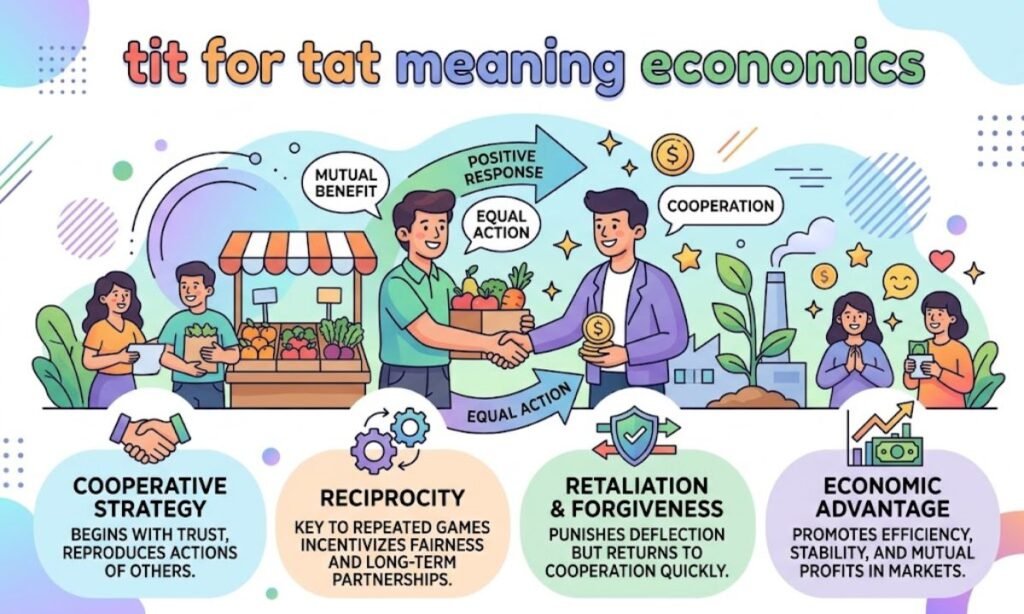
In economics and game theory, tit for tat is a strategy for the iterated prisoner’s dilemma, a game where two players repeatedly choose to cooperate or not. The rule is simple:
- Cooperate on the first move.
- After that, copy whatever the other player did last time.
Political scientist Robert Axelrod tested strategies in computer tournaments in the early 1980s. Tit for tat, submitted by Anatol Rapoport, performed very well. Axelrod explained its success with a few traits: it is nice (it never starts a fight), retaliatory, forgiving and easy to understand.
The phrase is also common in trade news. “Tit-for-tat tariffs” means one country raises import taxes and another answers with its own. The risk is the same as in personal life: each reply can push the conflict further.
Conclusion
Tit for tat means answering an action with a matching one. Most of the time it points to payback for something negative, but at its heart the phrase is about fairness and reciprocity.
Whether you meet it in a group chat, a song, a negotiation or a trade report, check the tone and the stakes before you read too much into it. A small, playful exchange can be harmless. A long, angry one usually needs someone to step back and break the loop.
Frequently Asked Questions
What does tit for tat mean in business negotiations?
In negotiations, it means matching the other side’s moves: a concession for a concession, a hard line for a hard line. It can keep deals fair and predictable, but if both sides only mirror each other, talks can stall.
What does tit for tat mean in business negotiations?
Negotiators often start cooperatively, then respond to the other side’s last move and forgive an occasional slip. This keeps the deal balanced without starting an unnecessary fight.
How does “tit for tat” apply in personal relationships?
It shows up as matching effort and treatment, such as returning texts, favors or apologies. A little balance builds trust, but strict score-keeping can create distance and resentment.
What does tit for tat mean in simple words?
It means “you do it to me, and I’ll do it back to you.” The reply is equal in size to the action.
Is tit for tat a good or bad thing?
It depends on the situation. Kindness for kindness is positive, while insult for insult usually makes things worse.
Where does the phrase tit for tat come from?
It comes from 16th-century England and is thought to be a variation of “tip for tap,” meaning a light blow for a light blow.
What does tit for tat mean in a text message?
It usually means someone is replying in the same way you treated them, like answering slowly because you answered slowly. It can be a joke or a sign of annoyance, so tone matters.
What is the tit for tat strategy in game theory?
It is a strategy that cooperates on the first move and then copies the other player’s previous move. It became famous after Robert Axelrod’s tournaments on repeated prisoner’s dilemma games.
What is another way to say tit for tat?
You can say “like for like,” “blow for blow,” “an eye for an eye,” “payback” or “give and take,” depending on the tone you want.
Is tit for tat the same as an eye for an eye?
They are close but not identical. “Eye for an eye” focuses on equal punishment for harm, while tit for tat can also describe small everyday swaps and even kind exchanges.

I am a dedicated author with 6+ years of experience writing and researching content for name meaning websites. My expertise includes American names, baby names, surnames, name origins, and cultural significance. I focus on creating accurate, well researched, and easy to read articles using trusted sources. My goal is to help readers discover the history, meaning, and uniqueness behind every name with reliable and engaging content.