

If you’ve seen 1437 pop up at the end of a text, in an Instagram caption, or scrolling through TikTok comments, you’ve probably wondered what it means — and whether you’re meant to reply to it.
This guide breaks down exactly what 1437 stands for, where it came from, how people use it today, and how to respond when someone sends it to you.
Why 1437 Is More Than a Random Number
At first glance, 1437 looks like nothing more than a random string of digits — maybe a locker combination, a flight number, or a leftover receipt total.
But if you’ve spotted it at the end of a text message, tucked into an Instagram caption, or dropped as a TikTok comment, it’s carrying something far more personal.
1437 is one of the most widely recognized numeric love codes on the internet, and understanding it opens a small window into how digital communication has quietly reshaped the way people express affection.
Unlike slang that fades after a season, 1437 has stuck around because it solves a real problem: sometimes “I love you” feels too big, too formal, or too exposed to type out in full — especially early in a relationship, in a group chat, or in a quick reply.
A four-digit code lets someone say something meaningful while keeping the tone light. That’s exactly why this guide breaks down everything the number means, where it came from, and how to use it — or respond to it — the right way.
It also helps to think of 1437 as part of a much bigger pattern in how people communicate online. Emojis, abbreviations, and numeric codes all exist for the same basic reason: typing full sentences takes time, and digital conversation moves fast.
When a code like 1437 becomes widely understood, it stops being “secret” and starts functioning almost like its own small piece of vocabulary — something anyone who spends time on TikTok or in group chats will eventually recognize without needing it explained.
1437 Meaning in Text – Quick Meaning
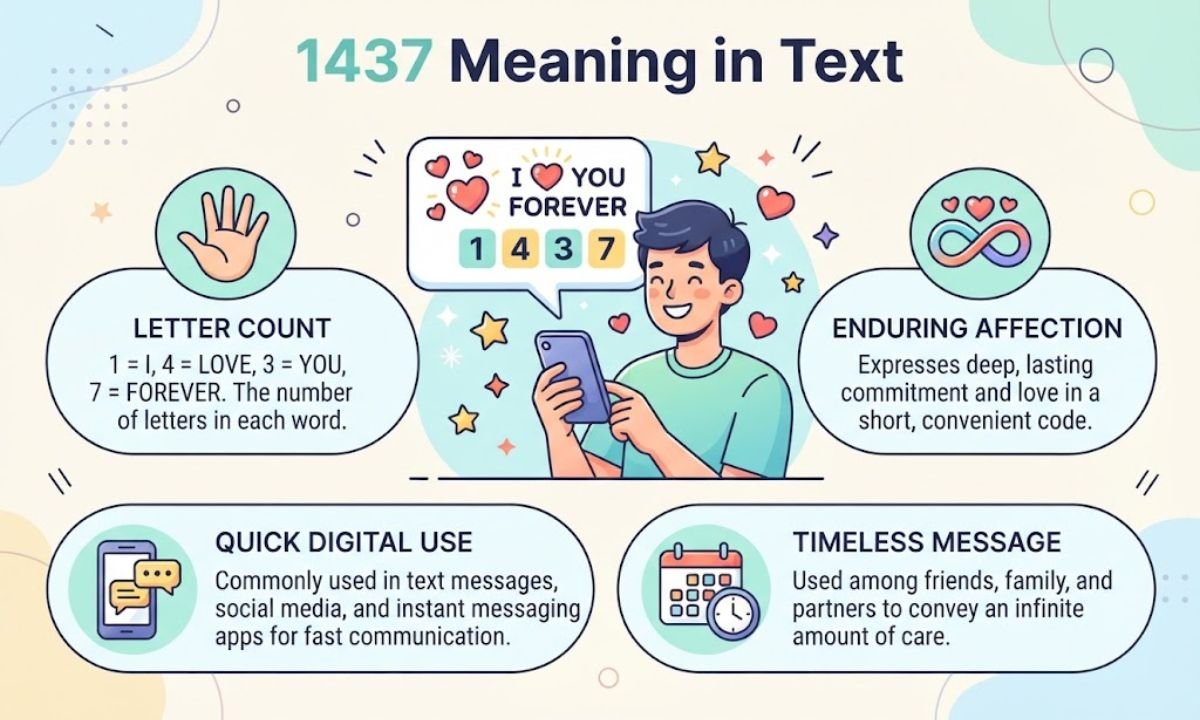
In short: 1437 means “I love you forever.” It’s a numeric shorthand built from the letter count of each word in that phrase, and it’s most commonly sent between romantic partners, though friends and family use it too.
What does each number represent?
Each digit in 1437 stands in for a word, based on how many letters that word has:
- 1 → I (1 letter)
- 4 → Love (4 letters)
- 3 → You (3 letters)
- 7 → Forever (7 letters)
Put them together and you get “I Love You Forever” — condensed into something you can type in under two seconds. It’s a small piece of internet numerology, but once you know the pattern, you’ll start noticing it everywhere.
Grammatically, the phrase reads a little differently in full — closer to “I will love you forever” — but the compressed version stuck because the point was never perfect grammar. It was speed, memorability, and a bit of charm. That combination is exactly why 1437 has outlasted plenty of other short-lived slang terms.
Origin & Background of 1437
From 143 to 1437
Long before smartphones, the number 143 was already circulating as shorthand for “I love you” — a legacy that traces back to pager culture in the 1990s, when people paid per character and needed the shortest possible way to say something meaningful. The same letter-count logic applied: I (1), love (4), you (3).
1437 is a direct descendant of that code. Someone eventually added a “7” to represent “forever,” turning a simple statement into a more permanent-sounding promise.
It’s a natural evolution — language, even numeric shorthand, tends to grow more specific over time as people look for new ways to add emphasis to old sentiments.
This kind of layering is common in internet slang more broadly. A short, simple phrase gets adopted widely, and then users start modifying it to fit new situations — adding intensity, changing the tone, or extending the meaning.
1437 is a textbook example of that process: it takes something already familiar (143) and builds on it rather than replacing it entirely.
Social media gave the code a new life
While 143 stayed relatively niche for years, 1437 found its real audience once platforms like TikTok, Instagram, and Snapchat took off. Short-form video culture rewards quick, visual, easily repeatable formats, and a four-digit love code fits that mold perfectly.
Creators started using #1437 in captions about relationships, milestones, and friendship anniversaries, and the hashtag has since been used tens of millions of times on TikTok alone. What began as private texting shorthand is now a public, searchable piece of internet culture.
Part of what fueled that growth is how easy the code is to build content around. A couple’s TikTok duet, a slideshow of relationship milestones, or a simple caption over a photo can all use “1437” as a shorthand emotional cue without needing extra text to explain it.
Viewers who already know the code feel a small sense of recognition, and viewers who don’t often ask in the comments — which only helps the term spread further.
Real-Life Conversations Using 1437
Numbers on a page only tell you so much — seeing 1437 in context makes the meaning click much faster.
WhatsApp between long-distance partners
“Landed safe. Missing you already. 1437 🌍”
“Goodnight, my love. Talk tomorrow. 1437”
For couples separated by time zones, a quick “1437” at the end of a message often replaces a longer, harder-to-type declaration when one person is exhausted, jet-lagged, or simply keeping things short.
Instagram DMs between close friends
“Can’t believe we’ve been friends since middle school. 1437, always.”
“Thank you for listening today, you’re the best. 1437 🤍”
Between friends, 1437 tends to carry warmth rather than romance — it’s a way of saying “you matter to me” without sounding overly formal.
TikTok comments on a relationship video
“This is exactly how me and my partner talk to each other 😭 1437”
“Sending this to my boyfriend right now. 1437 to you too.”
On public platforms, 1437 often appears as a supportive comment — a shorthand way of relating to someone else’s story or expressing affection toward a follower’s post.
Text messages after an argument
“I know we’re both upset, but 1437. We’ll figure it out.”
“Still mad, but never doubt that. 1437.”
This is where the code shows real emotional range. Sending 1437 after a disagreement signals that the underlying relationship is secure, even when the current conversation isn’t easy.
It’s worth noting that 1437 works best as a bridge, not a substitute, in these moments — it can soften tension and open the door to further conversation, but it shouldn’t replace actually resolving whatever caused the disagreement in the first place.
Emotional & Psychological Meaning
Why a number feels safer than words
For many people, typing out “I love you” can feel like a big, vulnerable moment — especially in a new relationship, or a situation where feelings aren’t fully mutual yet.
A numeric code softens that vulnerability. It still says the words, just wrapped in a layer of playfulness that makes rejection or awkwardness feel less likely.
The reassurance factor
Psychologically, short affirmations like 1437 function a bit like a quick hug or a squeeze of the hand. They’re brief, but they reinforce connection in low-effort, low-friction moments — a goodnight text, the end of a phone call, or a reply to a stressful day.
Small, repeated affirmations like this are often linked to feelings of security and consistency in a relationship over time.
A private language between two people
Once a couple or a friend group starts using 1437 regularly, it becomes a kind of shared code — something that means more to them specifically than it does to an outsider scrolling past.
That sense of “we have our own language” is part of what makes numeric codes like this stick around instead of fading out like other slang.
Relationship researchers often point out that couples with their own inside jokes, nicknames, and shorthand tend to report feeling more connected — not because the words themselves are magic, but because using them signals shared history.
A code like 1437 works the same way. It’s not just a substitute for a phrase; it’s a small reminder that two people have a communication style that belongs only to them.
Usage in Different Contexts
The meaning behind 1437 doesn’t change from one setting to another, but the weight it carries absolutely does. The same four digits can feel like a light, throwaway comment in one context and a genuinely emotional statement in another.
Social media
On platforms like TikTok, Instagram, and X, 1437 usually appears in captions, comments, or bios as a public but still personal reference to love — whether romantic, platonic, or familial.
Friends and relationships
Between friends, it typically means deep appreciation rather than romance. Between partners, it usually carries its full literal meaning: a promise of lasting love.
Work and professional settings
1437 essentially never appears in professional communication — using it with a coworker, client, or manager would come across as confusing at best and inappropriate at worst. It belongs firmly in personal, informal messaging.
The one narrow exception is when coworkers are also close personal friends outside of work and text each other on personal numbers rather than work channels.
Even then, most people are careful to keep that kind of shorthand out of anything that could be seen as an official communication.
Casual versus serious tone
The same four digits can land very differently depending on delivery and context:
| Tone | How 1437 Is Used | Example |
| Casual | Light affection, friendly banter | “You’re hilarious, 1437 lol” |
| Serious | Genuine romantic declaration | “I mean this with everything in me. 1437.” |
| Reassuring | After conflict or distance | “We’re okay. 1437, always.” |
When Not to Use 1437 and Common Misunderstandings
As harmless as 1437 usually is, timing and audience still matter. Sending it in the wrong context can come across as confusing, overly forward, or just out of place.
Situations where it may be inappropriate
- Early conversations with someone you’ve just met, where it could come across as too intense
- Professional emails, workplace chats, or client communication
- One-sided situations, where the other person hasn’t expressed similar feelings
- Public posts about someone who hasn’t consented to that level of public affection
What people often get wrong
A lot of people assume 1437 must be romantic every single time it’s used — it isn’t. Context always determines the weight of the message.
It’s also commonly mistaken for a random or meaningless number sequence by anyone unfamiliar with texting codes, which is exactly why guides like this one exist.
Another frequent mix-up is assuming every numeric love code follows the exact same letter-count formula as 1437.
As the comparison table further down shows, that’s not always true — some codes rely on phonetics or keypad letters instead, so it’s worth double-checking a code’s actual origin rather than guessing based on a pattern that worked for a different one.
1437 Compared With Similar Texting Codes
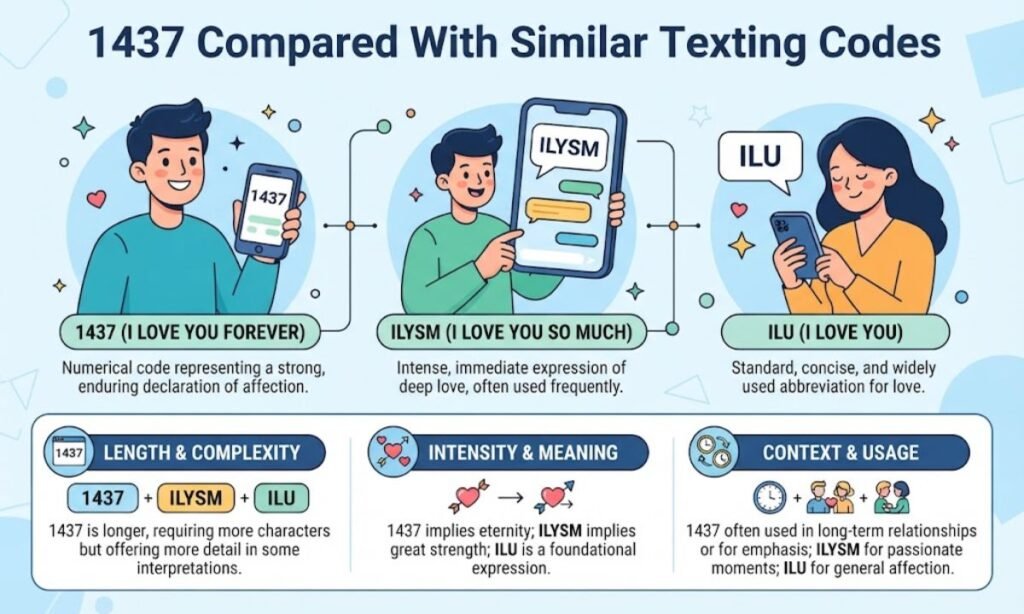
1437 belongs to a much larger family of numeric love codes that have circulated through texting culture for decades. Seeing them side by side makes it much easier to understand where 1437 fits, and how it differs from codes that sound similar but mean something slightly different.
| Code | Meaning | Typical Use |
| 143 | I love you | Classic, simple, pager-era origin |
| 1437 | I love you forever | Romantic partners, close friends |
| 14344 | I love you very much | Emphasis on intensity |
| 143637 | I love you always and forever | Long-term commitment |
| 831 | I love you (letters, words, sentence) | Alternative numeric code |
| 459 | I love you (keypad initials) | Older texting slang |
| 182 | I hate you | Joking or genuine frustration |
Key Insight
Most of these codes — including 143, 1437, and 14344 — follow the same letter-counting logic. Once you understand that pattern, you can decode a lot of similar texting shorthand without needing to look each one up individually.
A few outliers, like 182 and 459, are based on phonetics or keypad letters instead, which is worth knowing so you don’t try to force every code into the same formula.
It’s also worth noticing that almost every code on this list clusters around the theme of love, affection, or its opposite.
That’s not a coincidence — numeric shorthand tends to catch on fastest for emotionally charged phrases, since those are exactly the messages people want to send quickly, casually, and sometimes a little privately.
Variations and Related Types of 1437
Common numeric spin-offs
Beyond the core code, several variations circulate depending on how much emphasis someone wants to add:
- 14344 — “I love you very much”
- 143637 — “I love you always and forever”
- 1437143 — an informal, doubled-up version some users create for extra emphasis
Emoji and symbol pairings
1437 is frequently paired with hearts, infinity symbols, or the 🖤 emoji to reinforce tone, since the number alone can occasionally read as ambiguous to someone unfamiliar with it.
Platform-specific spins
On TikTok specifically, 1437 sometimes appears stylized in bios — such as “1437 🖤” — as a subtle, semi-private dedication to a partner without naming them directly.
On Snapchat, where messages and stories disappear quickly, 1437 is often used as a low-effort sign-off — something quick to type before a snap expires, rather than a drawn-out message.
On more permanent platforms like Instagram, it tends to show up in captions meant to last, such as anniversary posts or throwback photos.
How to Respond When Someone Sends 1437
There’s no single “correct” way to reply — the right response depends on your relationship with the sender, the platform you’re on, and how you actually feel. Here are a few directions to take it, depending on the tone you want to set.
Casual replies
- “1437 too 🤍”
- “Right back at you”
- “Always”
Funny replies
- “1437, but only on days you do the dishes”
- “Aw, 1437! Now Venmo me back”
- “1437 unless you’re stealing my fries again”
Mature replies
- “That means a lot to me, thank you”
- “I feel exactly the same way”
- “1437, and I mean every letter of it”
Respectful replies when you do not feel the same
- “I really appreciate you saying that”
- “That’s really sweet of you”
- “Thank you, that means something to me” — without echoing the code back if it doesn’t feel accurate yet
If you’re not ready to reciprocate, it’s okay to acknowledge the message warmly without repeating 1437 back. Sending the same code back when you don’t mean it can create confusion later, so a kind, honest response is usually the better move — both for you and for the person who sent it.
Regional, Cultural, and Generational Usage
Western culture
In the U.S., U.K., and Canada, 1437 is primarily a romantic or close-friendship code, popularized through texting and later amplified by social media trends. It’s common enough that most teens and young adults recognize it instantly, even if they’ve never sent it themselves.
Asian culture
In parts of Asia, similar number-based affection codes exist independently — for instance, “520” in Chinese internet culture sounds like “I love you” when spoken aloud, showing a parallel but linguistically different tradition of numeric shorthand.
Middle Eastern culture
Numeric love codes are less common in Middle Eastern texting culture specifically, though younger, internet-connected generations increasingly borrow Western codes like 1437 through global social media exposure.
Global internet usage
Because platforms like TikTok operate across borders, codes like 1437 spread quickly regardless of language, often adopted purely through repeated exposure rather than translation.
Non-English speakers frequently pick up the code the same way they pick up other viral internet phrases — by seeing it repeated in captions and comments until the meaning becomes obvious from context.
Gen Z versus Millennials
Millennials largely grew up with 143 during the early texting and instant-messaging era, while Gen Z popularized 1437 as an evolved, more emphatic version — a good example of how digital slang gets passed down and modified between generations rather than replaced entirely.
This generational handoff also shows up in tone. Millennials often used 143 quietly, in one-on-one texts.
Gen Z, having grown up with public-facing social platforms as the default, is far more comfortable using 1437 openly — in captions, comments, and bios — rather than keeping it strictly private.
Is 1437 Safe for Kids?
The short answer
Generally, yes. The underlying phrase — “I love you forever” — is affectionate and harmless, and younger users often send 1437 to parents, siblings, or friends rather than romantic partners.
What parents should still watch for
Context matters more than the code itself. If a child is sending 1437 to someone significantly older, or to an unfamiliar online contact, it’s worth having a broader conversation about safe and appropriate online communication rather than worrying about this specific number.
A normal part of digital literacy
Understanding codes like 1437 can actually help parents stay informed about how kids communicate online, without needing to treat every piece of texting shorthand as a red flag.
The far more useful habit is staying generally aware of who a child is talking to, rather than trying to memorize every numeric code that circulates online — those change constantly, while good communication habits stay useful regardless of which slang is trending.
143 meaning
143 means “I love you,” based on the letter count of each word: I (1), love (4), you (3). It’s the original, simpler predecessor to 1437.
1437 meaning islam
1437 is not a religious or Islamic term and holds no specific meaning within Islamic teaching as a texting code.
Separately, 1437 AH is simply a year on the Islamic Hijri calendar, corresponding to roughly 2015–2016 on the Gregorian calendar — but this is unrelated to the “I love you forever” texting code.
The overlap in numbers is purely a coincidence, and searching for a religious meaning behind the texting code will lead nowhere, since the two uses of “1437” developed completely independently of one another.
14344 meaning
14344 means “I love you very much,” adding an extra “4” to intensify the sentiment beyond the standard 1437.
14372 meaning
14372 isn’t a widely recognized texting code. Unlike 1437, it doesn’t follow the same letter-count pattern, and it doesn’t have an established, agreed-upon meaning across major platforms.
1437 reply
A common way to reply to 1437 is simply sending it back (“1437 too”), or responding with a heartfelt message that matches the sender’s tone, whether that’s casual, funny, or sincere.
1437 which country
1437 isn’t tied to a specific country. It’s an internet-born code that spread globally through English-language texting and social media platforms, most notably TikTok, Instagram, and WhatsApp.
182 meaning
182 typically means “I hate you,” though it’s based on phonetics rather than letter count: “I” is one character, “hate” is read as sounding like “8,” and “you” sounds like “2.”
It’s often used jokingly rather than as a literal statement of hatred, and functions as the emotional opposite of codes like 143 and 1437.
Conclusion
1437 might look like a random number at first, but it’s become one of the internet’s most recognizable shorthand ways to say “I love you forever.”
Whether it shows up in a goodnight text, an Instagram caption, or a TikTok comment, the code carries real emotional weight — softened just enough by its playful, numeric format to feel easy to send and easy to receive.
Understanding where 1437 came from, how it’s used across different relationships and platforms, and how to respond to it thoughtfully means you’ll never be caught off guard the next time it lands in your inbox.
And now that you know the pattern behind it, decoding similar texting shorthand should feel a lot less mysterious.
Codes like this come and go in popularity, but the underlying instinct behind them — finding quick, low-pressure ways to say something that matters — isn’t going anywhere.
Whether you send 1437 yourself, reply to it, or simply recognize it the next time it shows up on your screen, you now have the full picture of what those four small digits are really saying.
Frequently Asked Questions
What does the number 1437 mean in text messaging?
1437 means “I love you forever,” based on the letter count of each word in that phrase.
What does 1437 signify in text messages?
It signifies affection or love, most often used between romantic partners, though friends and family use it too.
Is 1437 used as a code by any popular texting apps or platforms?
It isn’t built into any app specifically — it’s user-generated slang that’s widely used on WhatsApp, Instagram, TikTok, and Snapchat.
Which companies use 1437 as a product or service code?
No major company uses 1437 as an official product or service code; it remains purely a piece of internet texting slang.
Where did the 1437 text code originate?
It evolved from the older code 143 (“I love you”), with a “7” added later to represent “forever.”
Can I buy merchandise or products featuring the number 1437?
Yes — independent sellers on sites like Etsy and Redbubble often create jewelry, apparel, phone cases, and gifts featuring 1437, aimed at couples and close friends.
How is 1437 used in social media posts?
It typically appears in captions, comments, or bios as a quick, meaningful way to reference love or appreciation.
Are there any texting services that recognize 1437 as a special keyword?
No standard SMS or messaging service treats 1437 as a functional keyword — its meaning is understood culturally, not technically.

I am a dedicated author with 6+ years of experience writing and researching content for name meaning websites. My expertise includes American names, baby names, surnames, name origins, and cultural significance. I focus on creating accurate, well researched, and easy to read articles using trusted sources. My goal is to help readers discover the history, meaning, and uniqueness behind every name with reliable and engaging content.