
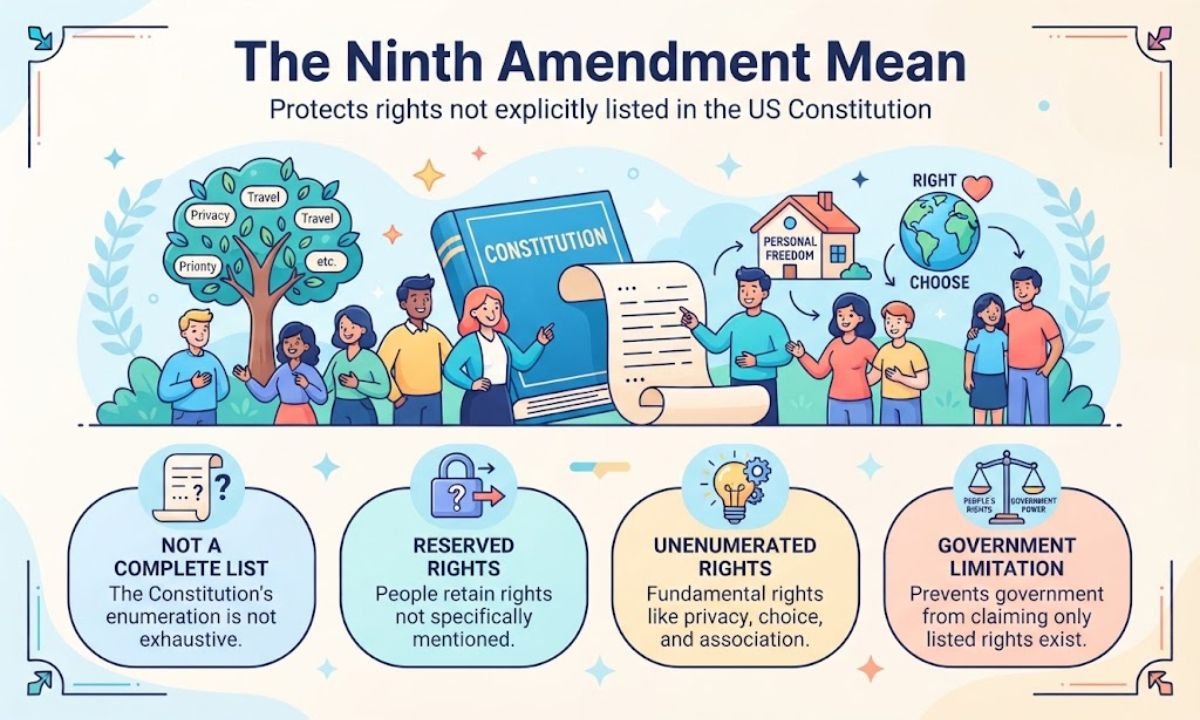

The Ninth Amendment is one of the shortest parts of the Bill of Rights. It is also one of the most misunderstood.
Ask ten people what it does, and you may get ten different answers. Some say it protects privacy. Others say it does nothing at all.
So what does the Ninth Amendment mean in real terms? In short, it says that the rights listed in the Constitution are not the only rights people have.
This guide explains the text, the history, the Supreme Court cases, the common myths, and the real-life examples. It also shows how the amendment differs from the Tenth Amendment, a mix-up that trips up many readers.
You will find plain-language explanations, tables, and quick answers throughout. Whether you are a student, a teacher, or simply curious, this article will give you a clear and accurate picture.
The Exact Text of the Ninth Amendment
Here is the full text, word for word:
“The enumeration in the Constitution, of certain rights, shall not be construed to deny or disparage others retained by the people.”
That is one sentence, with only twenty-eight words.
It was ratified on December 15, 1791, along with the rest of the Bill of Rights. It is sometimes called Amendment IX, using the Roman numeral.
Notice what the sentence leaves out. It does not list any rights. It does not name any government body. It simply tells readers how to interpret the list of rights found elsewhere.
9th amendment drawing
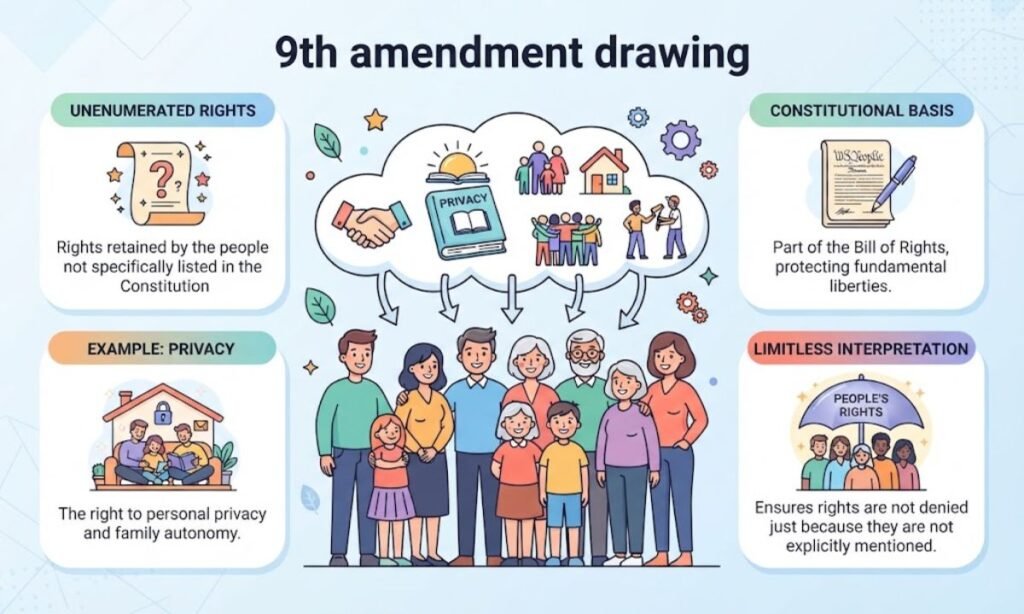
A quick drawing can make this idea stick. Picture a large filing cabinet with eight labeled drawers, each holding a famous right such as speech, religion, or a fair trial.
Now picture a ninth drawer with no label. Inside it sits a note: “Everything else the people already own.”
That unlabeled drawer is the heart of the amendment. Students often sketch it as a scale, an open door, or a long scroll that keeps unrolling past the printed words.
If you are making a poster or classroom project, keep the image simple. Show a short list of rights on one side and a wide, open space on the other. The open space is the point.
What Is the Ninth Amendment in Simple Terms?
In simple terms, the Ninth Amendment says that a list of rights is not a complete list.
The Constitution names some rights, such as free speech and freedom of religion. The Ninth Amendment reminds everyone that people have other rights too, even if those rights are not written down.
Think of it as a safety net. It blocks a dangerous argument: “If a right is not on the list, the government can take it away.”
This is the core of the Ninth Amendment meaning. It protects the idea that rights belong to the people first, and government comes second.
Key points to remember:
- The amendment does not name any specific right.
- It warns against reading the Bill of Rights as a full catalog.
- It says other rights are “retained by the people.”
- It works as a rule of interpretation, not as a list.
Why Was the Ninth Amendment Added?
The story starts in 1787. The Constitution was written in Philadelphia without a bill of rights, and that omission caused a fight.
Supporters of the new plan, called Federalists, said a bill of rights was unnecessary. The federal government could only use the powers it was given, so there was no need to list what it could not do.
Some went further. They argued that a list could be dangerous. If you name a few protected rights, critics said, the government might claim it could touch everything else.
Opponents, called Anti-Federalists, were not convinced. They wanted written guarantees, and several states made their approval conditional on adding amendments.
James Madison took on the task. In June 1789, he introduced proposed amendments in the House of Representatives. He wanted to answer both sides at once.
The Ninth Amendment was his solution to the “danger of the list.” It let the country protect named rights while making clear that the list was not a cage.
Here is a short timeline:
| Year | Event |
| 1787 | Constitution drafted with no bill of rights |
| 1787–88 | Ratification debates; Federalists and Anti-Federalists clash |
| 1789 | Madison proposes amendments in Congress |
| 1791 | Bill of Rights, including the Ninth, is ratified |
Clause-by-Clause Breakdown
The amendment is short, but every phrase carries weight. Let’s walk through it piece by piece.
“The enumeration in the Constitution”
“Enumeration” simply means a list. The word points to the rights that the Constitution spells out, such as those in the First through Eighth Amendments.
So the opening phrase says: “The fact that some rights are written down…”
This matters because the framers were worried about what a written list might imply. The sentence begins by naming that exact concern.
“of certain rights”
The word “certain” signals that the list is partial. It covers some rights, not all of them.
If the framers had meant to name every right, they would have said so. Instead, they chose a word that admits the list is incomplete.
This small phrase quietly confirms that the Bill of Rights was never meant to be a full inventory of human liberty.
“shall not be construed”
“Construed” means interpreted or understood. The phrase is a direct instruction to readers, judges, and lawmakers.
It says: do not read the list in a certain way. That makes the amendment a rule about how to read the rest of the Constitution.
Lawyers call this a “rule of construction.” It does not hand out rights by itself. It guides how other parts of the Constitution are understood.
“to deny or disparage”
To “deny” is to reject outright. To “disparage” is to treat as lesser or of little worth.
Together, the two words close two loopholes. The government cannot erase an unlisted right, and it cannot treat that right as second-class either.
The pairing is deliberate. It blocks both the loud approach and the quiet one.
“others retained by the people”
This final phrase names who holds the unlisted rights: “the people.” And the word “retained” is important.
Retained means kept, not given. The people did not receive these rights from the Constitution. They already had them, and they kept them when the government was formed.
That idea reflects the founding-era belief that rights come before government, not from it.
What Rights Does the Ninth Amendment Protect?
The honest answer is that the amendment does not list them. That is exactly why people debate it.
Rights that are not named in the Constitution are called unenumerated rights. The Ninth Amendment confirms that such rights exist, but it does not define them.
Over the years, people have argued that various rights belong in this category. Courts have treated some of them as protected under other parts of the Constitution.
Commonly discussed examples include:
- The right to travel between states
- The right to make choices about family and child-rearing
- The right to marry
- The right to personal privacy in certain matters
- The right to make some medical decisions
Important note: most of these have been protected through other clauses, especially the Due Process Clause of the Fourteenth Amendment, rather than through the Ninth alone.
| Type of Right | Where It Appears | Example |
| Enumerated | Written in the Constitution | Freedom of speech |
| Unenumerated | Not written, but recognized | Right to travel |
| Disputed | Debated by courts and scholars | Various privacy claims |
So the amendment works more like a shield of principle than a source of specific rules.
What the Ninth Amendment Does Not Mean
Because the amendment is vague, it attracts big claims. Some of them go too far.
First, it does not say that any right a person wants is automatically protected. It says that unlisted rights are not wiped out, which is a different point.
Second, it does not give judges a blank check. Courts have been cautious about using it as the only basis for a ruling.
Third, it does not shift power from the states to the federal government, or the other way around. That job belongs to the Tenth Amendment and other parts of the Constitution.
Here is a quick reality check:
| Claim | Reality |
| “It creates new rights.” | It protects existing ones without naming them |
| “It lets courts invent anything.” | Courts use it with caution |
| “It overrides state laws.” | It does not do so on its own |
| “It is meaningless.” | It shapes how the Bill of Rights is read |
The safest summary is this: the amendment is a principle, not a power. It guides interpretation rather than creating rules.
Ninth Amendment vs. Tenth Amendment
These two amendments sit side by side, and they are often confused. They do different jobs.
The Ninth Amendment is about rights held by individuals. The Tenth Amendment is about powers held by governments.
The Tenth reads: “The powers not delegated to the United States by the Constitution, nor prohibited by it to the States, are reserved to the States respectively, or to the people.”
Put simply, the Ninth protects what people keep. The Tenth divides authority between federal and state governments.
| Feature | Ninth Amendment | Tenth Amendment |
| Main focus | Unlisted individual rights | Unlisted government powers |
| Who it protects | “The people” | The states and the people |
| Type of rule | Rule of interpretation | Statement of reserved powers |
| Common use | Privacy and liberty debates | Federalism disputes |
| Frequency in court | Rare | More common |
A helpful memory trick: Ninth equals people’s rights. Tenth equals government powers.
9th amendment
When people search for “9th amendment,” they usually want one thing: a clear, short definition.
Here it is. The Ninth Amendment states that listing certain rights in the Constitution does not mean other rights are gone.
It sits in the Bill of Rights, the first ten amendments to the Constitution. The First through Eighth Amendments name rights. The Ninth and Tenth explain how to read those rights.
Think of the Ninth as a closing reminder to the list. It says, in effect: “This is not everything.”
ninth amendment
The phrase “ninth amendment” also points to a long-running scholarly debate about what the text really does.
Some legal scholars read it broadly. They argue it protects a wide set of natural rights that existed before the Constitution.
Others read it narrowly. They say it is only a rule that prevents the Bill of Rights from being used to expand federal power.
Both views start from the same sentence. They differ on how much weight “retained by the people” should carry.
This disagreement explains why the amendment appears in law review articles more often than in court rulings.
9th amendment simplified
Here is the simplified version you can repeat to a friend.
“Just because the Constitution lists some rights doesn’t mean those are the only ones you have.”
That is the entire idea in one sentence.
A few extra ways to say it:
- The list of rights is not complete.
- The government cannot ignore unlisted rights.
- Rights belong to people before government exists.
- Silence in the Constitution is not permission to take rights away.
If you can explain those four points, you understand the amendment better than many people do.
the 9th amendment
“The 9th Amendment” is often cited in debates about privacy, personal freedom, and the limits of government.
Politicians, activists, and commentators bring it up when they want to argue that a right exists even without clear text. That can make the amendment sound more powerful than it is in practice.
In court, the picture is quieter. Judges rarely rest a decision on the Ninth Amendment alone.
Still, the amendment shapes the background. It reminds everyone that the absence of a right from the text does not settle the question.
what is the 9th amendment
What is the 9th Amendment? It is part of the U.S. Bill of Rights, ratified in 1791.
Its purpose is to make sure the list of rights in the Constitution is not treated as the full list of rights people hold.
Quick facts:
- Ratified: December 15, 1791
- Part of: The Bill of Rights
- Main author: James Madison
- Core idea: Unlisted rights still exist
- Type: Rule of interpretation
That is the featured-snippet version. The sections below go deeper into the history and the cases.
what does the 9th amendment mean
What does the 9th Amendment mean? It means the Constitution’s list of rights is not exhaustive.
Its meaning rests on two ideas. First, people hold rights that exist apart from any written document. Second, the government may not use silence in the text as a reason to ignore those rights.
The meaning is easy to state but hard to apply. The hard part is deciding which unlisted rights count.
That question has no simple formula. Courts have generally looked to history, tradition, and other constitutional provisions for guidance.
what is the ninth amendment
The Ninth Amendment is a safeguard against a specific mistake in reasoning.
The mistake goes like this: “The Constitution lists rights A, B, and C. So the people have only A, B, and C.”
The amendment says that conclusion is wrong. Rights A, B, and C are protected, and so are others that are not listed.
It is one of only a few places in the Constitution where the framers speak directly about how to read the document itself.
the ninth amendment
As a piece of constitutional text, the Ninth Amendment is unusual. Most amendments tell the government what it cannot do. This one tells readers how to think.
It does not command anyone. It has no “Congress shall make no law” opening like the First Amendment does.
That difference is why it feels abstract. It is a statement of principle tucked into a list of practical protections.
Yet principles can matter. They set the tone for how the other amendments are read and applied.
9th amendment meaning
The 9th Amendment meaning can be summed up in three words: rights without lists.
The people have rights whether or not anyone writes them down. The Constitution names some, but naming is not the same as granting.
This reflects a founding-era view called natural rights. Under that view, people hold basic liberties simply by being human, and government exists to protect them.
The Ninth Amendment carries that idea into the constitutional text. It is a short bridge between political philosophy and written law.
amendment ix
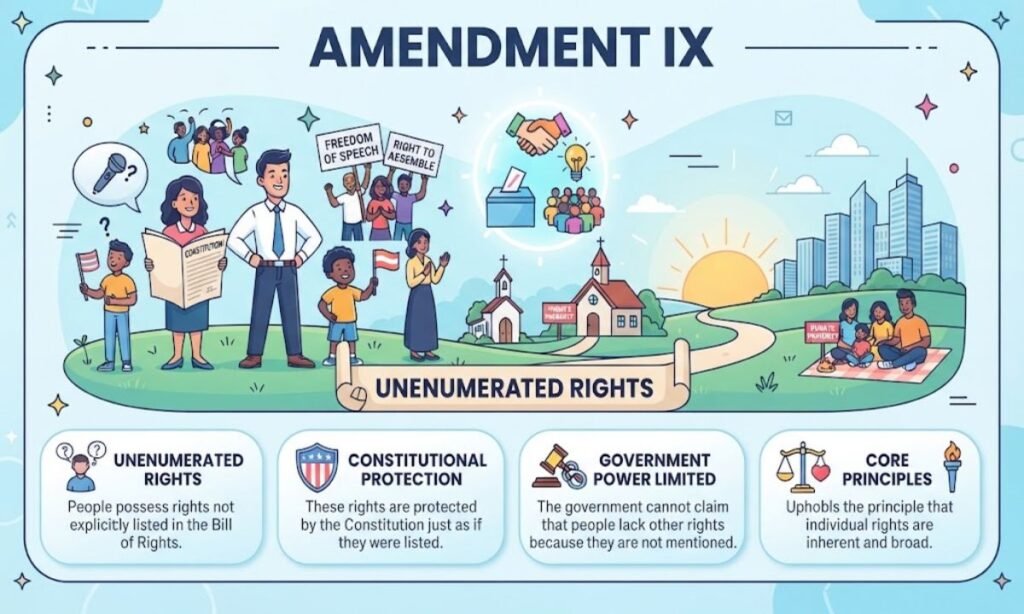
“Amendment IX” is the Roman numeral form you will see in legal texts, textbooks, and court opinions.
It refers to the same provision. Some sources use “Amendment IX,” others use “Ninth Amendment,” and others use “9th Amendment.”
For search and study purposes, all of these terms point to one sentence of constitutional text.
If you are reading old legal documents or historical collections, expect to see the Roman numeral more often than the digit.
How the Supreme Court Has Interpreted the Ninth Amendment
The Supreme Court has rarely built a decision directly on the Ninth Amendment. When it has mentioned the amendment, it has usually done so in passing or in separate opinions.
For much of American history, the amendment sat almost unused. That began to change in the twentieth century.
In the 1947 case United Public Workers v. Mitchell, the Court described the Ninth and Tenth Amendments as stating a general relationship between people and government. It did not treat the Ninth as a source of new claims.
The modern conversation really began with Griswold v. Connecticut in 1965, discussed in the next section.
Here are the main cases people usually cite:
| Case | Year | Ninth Amendment Role |
| United Public Workers v. Mitchell | 1947 | Mentioned as a general statement of retained rights |
| Griswold v. Connecticut | 1965 | Cited in a concurring opinion on privacy |
| Roe v. Wade | 1973 | Discussed, though the Court relied mainly on the Fourteenth Amendment |
| Richmond Newspapers v. Virginia | 1980 | Cited in support of a public right to attend criminal trials |
| Dobbs v. Jackson Women’s Health Organization | 2022 | Overruled Roe; Ninth Amendment not the basis for the holding |
The pattern is clear. The amendment appears in opinions, but it seldom carries a decision on its own.
Many judges worry that using it too freely would let courts replace the choices of elected lawmakers with their own views. That concern is one reason the amendment stays in the background.
Does the Ninth Amendment Protect Privacy?
This is the question people ask most. The short answer is: not directly, and not by itself.
The word “privacy” does not appear in the Constitution. Yet the Supreme Court has recognized privacy interests in several areas, relying on different provisions.
In Griswold v. Connecticut (1965), the Court struck down a state law banning the use of contraceptives by married couples. Justice Douglas wrote for the majority that several amendments create “zones of privacy.”
Justice Goldberg wrote a separate concurring opinion. He leaned heavily on the Ninth Amendment, arguing that it supports the idea that fundamental personal rights exist beyond those listed.
Justice Black disagreed sharply. He argued that the Court had no authority to strike down a law just because it seemed unwise.
That debate still echoes today. Here is how the main views compare:
| View | Argument |
| Supportive | The Ninth confirms fundamental rights like privacy exist |
| Skeptical | The Ninth is not a source of rights judges can apply |
| Middle path | The Ninth informs how other clauses are read |
Later privacy cases, such as Eisenstadt v. Baird (1972) and Lawrence v. Texas (2003), rested mainly on the Fourteenth Amendment’s guarantee of liberty.
In 2022, Dobbs overruled Roe v. Wade and held that the Constitution does not confer a right to abortion. The decision did not turn on the Ninth Amendment.
In a separate opinion in Dobbs, Justice Thomas suggested the Court should reconsider other privacy-related precedents. That shows how unsettled the area remains.
So, does the Ninth Amendment protect privacy? It is part of the argument, but it is rarely the legal foundation.
A Simple Real-Life Analogy
Imagine you rent an apartment. The lease lists several rules: pay rent on time, keep the noise down, and do not paint the walls.
Now suppose your landlord says, “The lease doesn’t say you can have friends over, so you can’t.”
That would feel wrong. The lease lists some rules, but you did not give up every other freedom by signing it.
The Ninth Amendment works the same way. The Constitution lists certain protections, but the people did not give up everything else by adopting it.
Another way to see it is a restaurant menu. The menu lists popular dishes, but a good kitchen can still make a simple salad if you ask.
In both cases, the written list is helpful but incomplete. The amendment exists to say so out loud.
Common Misconceptions
The Ninth Amendment attracts confusion. Here are three of the most common myths, and the facts behind them.
“The Ninth Amendment creates any right a judge wants.”
This is the most popular myth, and it is wrong.
The amendment does not hand judges a list of secret rights. It says unlisted rights are not erased, which is very different from saying judges may invent new ones.
Courts tend to be careful here. They look for rights that are deeply rooted in history and tradition, and they often rely on other clauses to do the work.
Critics of broad readings worry about unelected judges deciding big social questions. That worry explains why the Ninth is so seldom the main basis for a ruling.
“The Ninth Amendment is basically the Tenth Amendment.”
The two are related, but they are not the same.
The Ninth concerns individual rights retained by the people. The Tenth concerns governmental powers reserved to the states or the people.
Some scholars do see them as companions. Both respond to the same fear: that the Constitution’s written list might be read as complete.
Still, one protects liberty and the other divides authority. Mixing them up leads to muddled arguments.
“If a right is not listed, it cannot be constitutional.”
This is exactly the claim the Ninth Amendment was written to block.
Many well-established rights are not spelled out in the text. The right to travel and the right to raise your children are two familiar examples.
Courts have found these rights through other parts of the Constitution, such as due process. The lack of a specific word in the text does not end the discussion.
So a right can be constitutional without being listed. The real question is how courts find and limit it.
What Most Articles Miss About This Topic
Most explainers stop at “unlisted rights exist.” That is true, but it skips some of the most interesting parts.
1. The amendment answers a specific fear. It was not created in a vacuum. It responded to the argument that a bill of rights would be dangerous because a list implies limits.
2. It is a rule of reading, not a rule of power. It tells readers how to interpret the Constitution. It does not, on its own, limit any government action.
3. Scholars truly disagree. Some read it as protecting natural rights. Others see it as protecting state-level rights or limiting federal power. The text supports more than one reading.
4. The “inkblot” remark. During his 1987 Senate confirmation hearing, Robert Bork compared the amendment to an inkblot, saying judges could not tell what it meant. The comment still shapes how people talk about it.
5. It rarely wins cases. Despite its fame, the amendment is seldom the deciding factor in court. Its real influence is on how the broader Bill of Rights is understood.
6. Its meaning may be more about method than content. Some scholars argue the amendment tells judges to take unlisted rights seriously, without telling them which rights count.
Understanding these points gives you a fuller picture than a simple definition can.
Quick Summary
Here is the whole topic in a handful of lines.
- The Ninth Amendment says the Constitution’s list of rights is not complete.
- It was written by James Madison and ratified in 1791.
- It responds to the fear that a list of rights would limit other rights.
- It does not name any specific rights.
- Courts rarely rely on it alone, but it shapes privacy debates.
- It is different from the Tenth Amendment, which deals with government powers.
- Scholars still disagree about how far it should reach.
| Question | Short Answer |
| What is it? | A rule that unlisted rights still exist |
| Who wrote it? | James Madison |
| When was it ratified? | 1791 |
| Does it protect privacy? | Indirectly, through debate and other clauses |
| Is it the same as the Tenth? | No |
what does the ninth amendment mean bill of rights
Within the Bill of Rights, the Ninth Amendment plays a special role. It is a guide for reading the first eight amendments.
Those amendments protect speech, religion, assembly, fair trials, and more. The Ninth says those named rights are not the outer limit of what people hold.
Without it, a reader might treat the Bill of Rights as a complete checklist. With it, the list becomes a sample of a larger body of liberty.
That is why the Ninth is often grouped with the Tenth as a “closing pair.” Together, they frame how the earlier amendments should be understood.
what does the ninth amendment mean in kid words
Here is how you might explain it to a child.
“Imagine a list of rules in your classroom that says what you are allowed to do. The list is not everything you are allowed to do.”
“Just because ‘reading quietly’ is on the list doesn’t mean ‘drawing quietly’ is banned.”
The Ninth Amendment says the same thing about people’s rights. The Constitution lists some of them, but you have others too.
The grown-up rule is simple: a short list does not mean a short set of rights.
what does the ninth amendment mean in plain language
In plain language, the amendment says this: “Listing some rights does not cancel the rest.”
It is a reminder that the government does not hand out rights. People already have them. The Constitution names some to make sure they get extra protection.
Plain-language takeaways:
- Your rights do not shrink because they weren’t written down.
- The government cannot use silence as permission.
- Courts must think carefully before treating unlisted rights as nonexistent.
No legal training is needed to grasp this. The idea is older than the Constitution itself.
10th Amendment
The Tenth Amendment is the final piece of the Bill of Rights. It deals with power, not individual rights.
Its text says that powers not given to the federal government, and not prohibited to the states, belong to the states or to the people.
This is the foundation of American federalism. The federal government has limited, listed powers. The states hold the rest.
Courts have applied the Tenth Amendment more often than the Ninth. In cases like New York v. United States (1992) and Printz v. United States (1997), the Court held that Congress cannot force state governments to carry out federal programs.
9th Amendment examples
Examples help make the idea concrete. Here are some situations where the Ninth Amendment often comes up in discussion.
Right to travel. Nothing in the text says you may move freely between states. Courts have recognized the right anyway.
Parental rights. Decisions about raising children are not listed in the Constitution. The Court has still treated them as protected.
Marriage. The right to marry is not written in the text. The Court has protected it under the Fourteenth Amendment’s guarantees.
Personal privacy. The Court has recognized privacy interests in areas such as contraception and intimate relationships.
| Example | Protected Mainly Through |
| Right to travel | Privileges and due process principles |
| Parental rights | Due Process Clause |
| Marriage | Due Process and Equal Protection |
| Contraception | Privacy doctrine |
Notice the pattern. The Ninth Amendment supports the idea behind these rights, while other clauses usually do the legal work.
9th Amendment U.S. Constitution
In the U.S. Constitution, the Ninth Amendment sits near the end of the Bill of Rights, just before the Tenth.
The Constitution was signed in 1787 and took effect after ratification in 1788. The Bill of Rights followed in 1791, added in response to demands from several states.
Here is where the Ninth fits:
| Amendments | General Theme |
| 1st–4th | Speech, arms, housing soldiers, searches |
| 5th–8th | Criminal justice and fair process |
| 9th | Unlisted rights retained by the people |
| 10th | Unlisted powers reserved to states and people |
The placement is not random. After naming specific protections, the framers closed with two statements about what lies beyond the list.
Why is the 9th Amendment important
The amendment matters even though courts seldom rely on it. Its value lies in the principle it protects.
First, it keeps the Bill of Rights from being read as a ceiling. The listed rights are a floor, not a limit.
Second, it reminds the government that it does not control every aspect of life. Rights come from the people, not from official permission.
Third, it gives future generations room to recognize rights that the founders could not foresee.
Here is why it still matters today:
- It supports the idea that liberty is broader than the written text.
- It anchors debates about privacy and personal autonomy.
- It pushes courts to think carefully about unlisted rights.
- It reflects the founders’ view of natural rights.
Even critics of broad readings admit that the amendment has symbolic force. It captures a core American idea in a single sentence.
10th Amendment simplified
Here is the Tenth Amendment in everyday words.
“If the Constitution doesn’t give a power to the federal government, and doesn’t forbid it to the states, the states or the people keep it.”
That is the heart of federalism. The national government has a limited job list. Everything else stays closer to home.
A simple way to picture it is a company with a head office and local branches. The head office can only do what its charter allows. The branches handle everything else.
The Tenth is often used in debates about education, policing, and health policy. The Ninth, by contrast, appears more in debates about personal freedom.
10th Amendment Rights
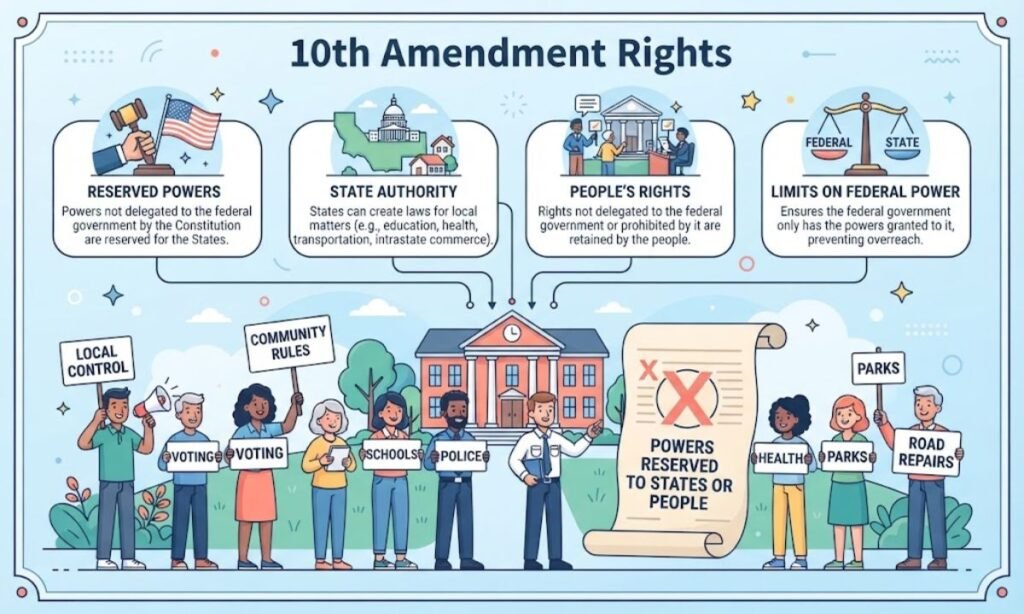
Strictly speaking, the Tenth Amendment protects powers, not rights. But people often talk about “10th Amendment rights,” meaning state authority.
In practice, these “rights” include the ability of states to run their own police forces, set many local laws, and manage education systems.
They also include what courts call the anti-commandeering principle. Under it, Congress cannot order state officials to carry out federal programs.
In Murphy v. NCAA (2018), the Court applied that principle to strike down a federal law on sports betting.
| Tenth Amendment Idea | Meaning |
| Reserved powers | States hold powers not given to the federal government |
| Anti-commandeering | Federal government cannot order state officials around |
| Dual sovereignty | Federal and state governments each have their own sphere |
The Tenth is also not a free pass. Federal law still wins when it rests on a valid constitutional power.
Conclusion
The Ninth Amendment is brief, but its message is powerful. The Constitution’s list of rights is not the full list.
It grew out of a real debate in the 1780s about whether a written list might limit people’s freedom. Madison answered that concern with a single sentence.
Today, courts rarely use the Ninth Amendment as the sole basis for a decision. Yet it continues to shape conversations about privacy, liberty, and the limits of government.
It is also easy to confuse with the Tenth Amendment, so remember the simple difference: the Ninth is about rights, and the Tenth is about powers.
Understanding the amendment helps you read the Bill of Rights with a wider lens. The listed rights matter, but they are not the whole story.
If you are studying the topic, try reading the text aloud, then rewriting it in your own words. That small exercise is often the quickest way to grasp it.
Frequently Asked Questions
What does the Ninth Amendment mean in simple terms?
It means the Constitution’s list of rights is not complete. People keep other rights even if they are not written down.
What does the Ninth Amendment mean for individual privacy?
It supports the idea that unlisted personal rights exist, but courts usually protect privacy through other clauses, such as due process.
How do legal services explain the Ninth Amendment?
Most describe it as a rule of interpretation that stops the Bill of Rights from being read as a full list of rights.
Where can I find online courses about constitutional amendments including the Ninth?
Free options include the National Constitution Center’s Interactive Constitution, Khan Academy, and Hillsdale College’s online constitutional courses.
How has the Ninth Amendment been interpreted by courts?
Courts mention it sometimes, especially in Griswold, but they rarely rely on it alone. They usually use other clauses to protect unlisted rights.
Which law firms specialize in constitutional rights related to the Ninth Amendment?
No firm focuses on the Ninth alone. Look for constitutional or civil rights attorneys through your state bar referral service or groups like the ACLU.
Can I get a subscription to a legal research platform explaining the Ninth Amendment?
Yes. Westlaw, LexisNexis, and HeinOnline offer paid access, while Cornell’s Legal Information Institute and Oyez are free.
What unenumerated rights are protected by the Ninth Amendment?
The amendment names none. Rights such as travel, marriage, and parental decision-making have been recognized through other constitutional provisions.
What is the 9th Amendment in simple words?
It says the rights listed in the Constitution are not the only rights you have. Other rights still belong to the people.
Why was the 9th Amendment created?
It was added to calm fears that listing some rights would let the government ignore all the others.
Does the 9th Amendment give me a right to privacy?
Not directly. It supports the idea of unlisted rights, but courts usually rely on other parts of the Constitution for privacy.

I am a dedicated author with 6+ years of experience writing and researching content for name meaning websites. My expertise includes American names, baby names, surnames, name origins, and cultural significance. I focus on creating accurate, well researched, and easy to read articles using trusted sources. My goal is to help readers discover the history, meaning, and uniqueness behind every name with reliable and engaging content.