
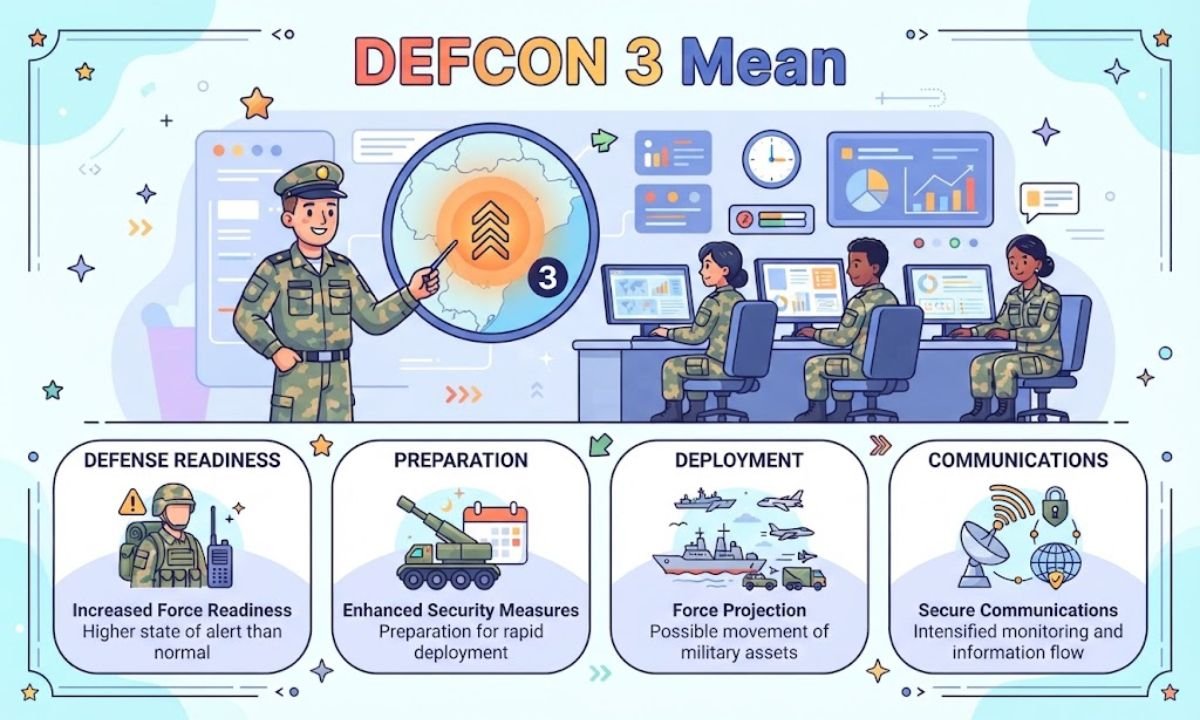

You spot the word in a breaking headline, a group chat, or a video game briefing, and it sounds alarming. So, what does DEFCON 3 mean? It is the middle step on the U.S. military’s five-level readiness scale, and it signals that forces are on higher alert than normal.
Quick answer: DEFCON 3 is called “Round House” in exercises. It means force readiness is raised above normal, and the Air Force should be able to mobilize within 15 minutes. It is not a declaration of war.
DEFCON stands for Defense Readiness Condition. The scale runs from DEFCON 5 (normal peacetime) to DEFCON 1 (maximum readiness). Lower numbers mean higher danger, and that backward logic confuses a lot of people.
The U.S. has publicly confirmed DEFCON 3 only a few times. The most recent was after the September 11, 2001 attacks.
This guide covers the meaning, the code words, the color code, the history, and the slang. It also answers the question everyone keeps asking: what is the DEFCON level today?
Death con 3 vs DEFCON 3
“Death con 3” is not a real military term. It is a mishearing or a playful misspelling of DEFCON 3, and it mostly shows up in social posts and search boxes.
The name DEFCON is short for Defense Readiness Condition. “DEF” stands for defense and “CON” stands for condition. Nothing in it refers to death.
The mix-up is easy to understand. The scale grew out of nuclear-era planning, so a darker spelling feels natural to some people.
If you see “death con 3” online, read it as a joke or a typo. The correct spelling is DEFCON 3, and it means heightened readiness, not doom.
DEFCON 3 exercise/code term (Round House)
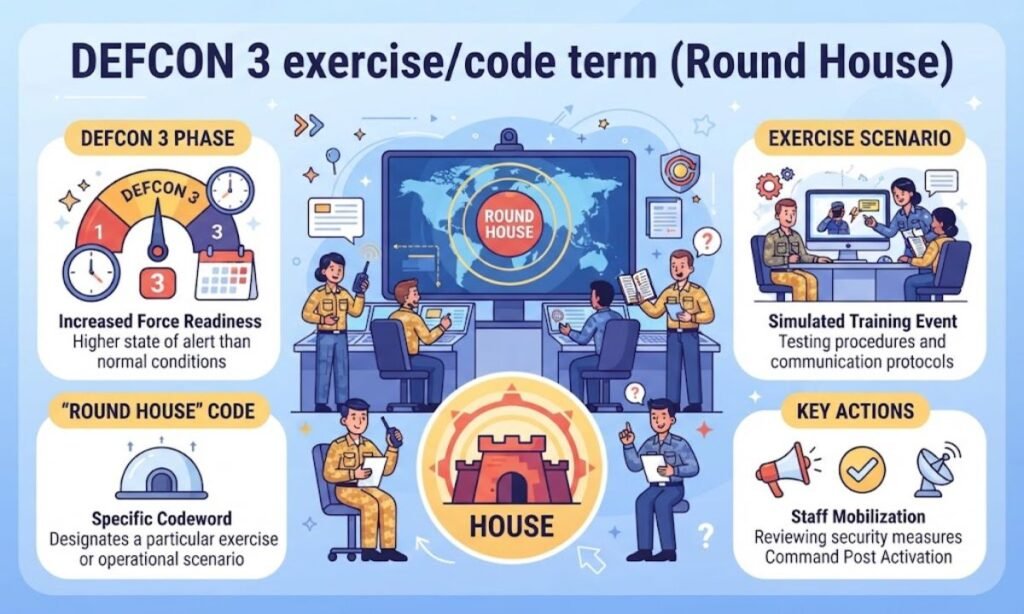
Round House is the exercise term for DEFCON 3. The military uses a separate set of code words during drills so practice orders are never mistaken for real ones.
Think of it as a safety label. A message that says Round House is part of an exercise. A message that says DEFCON 3 is the real thing.
That split matters because a mix-up could send real forces into motion for no reason. Clear wording protects everyone involved.
You will usually see the phrase in capital letters, ROUND HOUSE. It is a code word rather than an acronym, so there is no hidden meaning behind it.
DEFCON 3 mobilization time (15 minutes)
The number most people quote for DEFCON 3 is 15 minutes. At this level, the Air Force is expected to be ready to mobilize within a quarter of an hour.
That figure is a readiness standard, not a ticking clock. It describes how fast certain units should be able to move once an order comes down.
In practical terms, a DEFCON 3 posture can look like this:
- Leaves and passes may be cancelled.
- Personnel are called back to their units.
- Aircraft and crews are prepared for quick departure.
- Command centers increase staffing and communication checks.
Compare that with DEFCON 2, which is usually described as readiness to deploy and engage within about six hours. The jump from 15 minutes to six hours can seem odd, but each level measures a different kind of preparation.
DEFCON kaun declare karta hai
The short answer is that the top of the chain of command decides. The president and the Secretary of Defense hold ultimate authority, and orders travel through the Chairman of the Joint Chiefs of Staff.
The Joint Chiefs manage the system day to day. They also write the guidance that explains what each level requires of the forces.
History shows a few patterns:
- In 1973, the Chairman of the Joint Chiefs relayed the order to raise readiness during the Yom Kippur War.
- On September 11, 2001, Defense Secretary Donald Rumsfeld ordered the move to DEFCON 3.
- In 1976, the increase applied only to U.S. forces in South Korea.
No one outside the government can declare a DEFCON level. News sites, social media accounts, and trackers can only guess.
DEFCON 1/2/4/5 codewords
Every level has its own exercise code word. These words appear in drills and training messages, not in public announcements.
| DEFCON Level | Exercise Code Word | Plain-English Meaning |
| DEFCON 5 | Fade Out | Normal peacetime readiness |
| DEFCON 4 | Double Take | Extra intelligence watch and tighter security |
| DEFCON 3 | Round House | Readiness above normal; Air Force ready in 15 minutes |
| DEFCON 2 | Fast Pace | Forces ready to deploy and engage in about six hours |
| DEFCON 1 | Cocked Pistol | Maximum readiness; conflict imminent or underway |
The names are easy to remember once you see them together. Each one hints at how tense the moment is, from a quiet fade-out to a cocked pistol.
Remember the rule behind the table. Code words are for exercises, while the numbered levels are used for real orders.
DEFCON color code (Yellow alert)
Popular charts attach a color to each level, and DEFCON 3 is yellow. That is why people sometimes call it a “yellow alert.”
The colors most often shown online are listed below.
| Level | Common Chart Color |
| DEFCON 5 | Blue |
| DEFCON 4 | Green |
| DEFCON 3 | Yellow |
| DEFCON 2 | Red |
| DEFCON 1 | White |
Treat this as a popular convention rather than an official public standard. Different charts occasionally swap a color or two.
Yellow also has a history in civilian life. The old Homeland Security Advisory System used a color scale too, which retired in 2011, so the two systems often get mixed up. DEFCON is a military readiness scale, not a public warning system.
DEFCON texting/slang/relationship usage
Outside the military, DEFCON 3 has become shorthand for “things are getting tense.” People use it in texts, memes, and everyday jokes.
A few examples show how it works:
- “Traffic is bad, so I’m at DEFCON 3 about being late.”
- “My boss just called an all-hands meeting. DEFCON 3 in the office.”
- “We argued twice this week. Relationship is at DEFCON 3.”
In a relationship context, the phrase usually means trouble is building but nothing has broken. It sits above casual annoyance and below a full-blown fight.
Tone matters here. Between friends it reads as humor, but in a serious conversation it can sound dramatic, so pick the moment carefully.
Tips for using the phrase in messages
Keep it short and clear. “DEFCON 3 at work today” tells readers your mood in four words.
Avoid using it for real emergencies or real tragedies. Comparing a minor annoyance to a military alert can come across as careless.
If your audience includes veterans or service members, choose lighter wording. They know the real weight behind the scale.
How the joke spread online
Memes made the scale popular. A dramatic number gives any small problem instant comic energy.
Over time, DEFCON became shorthand for a whole range of feelings, from mild worry to full panic. The playful use keeps the term alive, even when the real system stays quiet.
Alag branches alag DEFCON par ho sakte hain
Yes, different commands and branches can hold different readiness levels at the same time. The system is flexible, and threats rarely affect every unit equally.
The 1962 Cuban Missile Crisis is the classic example. Strategic Air Command moved to DEFCON 2, while most other forces stayed at DEFCON 3.
The 1976 Korea incident shows the same idea on a smaller scale. Only U.S. forces in South Korea went up, and the rest of the military stayed put.
So when someone claims “the whole military is at DEFCON 3,” ask for details. The real posture may be regional or limited to one command.
DEFCON gaming reference
Games and films have kept DEFCON in the public eye. The 1983 film WarGames put the scale on the big screen, and many people first learned the term there.
Introversion Software’s strategy game DEFCON (2006) builds its whole design around the countdown. Players begin at DEFCON 5 and move toward DEFCON 1 as a global nuclear conflict unfolds.
Shooters and thrillers also borrow the vocabulary. A mission briefing that mentions DEFCON 3 is usually signaling rising tension without full war.
Game versions simplify the real system for drama. Use them for flavor, not for facts.
Why games love the scale
A countdown from five to one creates built-in suspense. Players feel the pressure rise with every step.
What games get wrong
Most games show DEFCON as an instant switch to global war. In reality, levels change in steps, apply to specific commands, and are rarely made public.
What Are the Military’s DEFCON Levels?
The military uses five levels, numbered 5 through 1. DEFCON 5 is the most relaxed, and DEFCON 1 is the most severe.
Here is the full scale at a glance.
| Level | Name | General State |
| DEFCON 5 | Fade Out | Normal peacetime readiness |
| DEFCON 4 | Double Take | Above normal; tighter security and intelligence watch |
| DEFCON 3 | Round House | Increased readiness; 15-minute Air Force mobilization |
| DEFCON 2 | Fast Pace | Next step to maximum; about six hours to deploy |
| DEFCON 1 | Cocked Pistol | Maximum readiness |
Each step up requires more of the forces involved. Commanders decide which actions to take at each level, based on Joint Chiefs guidance.
What Is the DEFCON Level Today?
The honest answer is that the public does not officially know. The Pentagon does not announce the current DEFCON level, and that has long been standard practice.
As of September 30, 2026, I found no official public announcement of a change. Some independent tracking websites post an estimated level of DEFCON 3 based on open-source information.
Those estimates are opinions, not government statements. Sites that track news and military movements can point to tension, but they cannot confirm a real order.
| Source Type | Can It Confirm the Official Level? |
| Department of Defense / Pentagon | Does not publish the live level |
| News outlets citing officials | Only if an official confirms it |
| Independent tracker websites | No, these are estimates |
| Social media posts | No |
If you want a reliable read on global tension, follow official defense briefings and major news reports. Treat any claim of a “confirmed” level with caution.
Why the level is kept private
Publishing the live level would reveal how worried leaders are. Rivals could read that signal and adjust their own plans.
Secrecy also prevents panic. A public alert with no context could shake markets, travel plans, and social feeds.
Past changes usually surface later through memoirs, leaks, and declassified records. That delay is normal.
How to judge tracker websites
Tracker sites blend news, troop movements, and world events into one estimate. Some explain their method clearly, which helps.
Look for a stated disclaimer that the figure is unofficial. Be wary of any site that says “confirmed” without citing an official.
Use trackers as a starting point, never a final answer. Cross-check with major news outlets before you share anything.
What Is DEFCON?
DEFCON is the U.S. military’s alert system for defense readiness. It describes how prepared armed forces are to respond to threats, especially serious ones.
The system took shape in the late 1950s, during the Cold War. Planners needed a simple way to signal how close the country was to a possible nuclear confrontation.
The Joint Chiefs of Staff maintain the framework. Each level gives commanders a menu of steps to take, from routine watchfulness to full combat posture.
DEFCON is not the only alert scale. FPCON covers force protection against terrorism at military installations, and INFOCON covers network defense. DEFCON stays focused on broader defense readiness.
How the system began
The scale was born in the Cold War, when nuclear weapons made speed a matter of survival. Leaders wanted one shared language for alert status.
Early versions included extra emergency states above the top level. Over time, the system settled into the five-level form people know today.
How the scale is used today
Commanders use DEFCON to match their posture to the threat. The level can apply to the whole force or to one region.
Day to day, most commands sit at the lowest level. The scale comes into focus only when a crisis pushes leaders to raise readiness.
What Are the DEFCON Levels?
The scale has five levels, and they run in reverse. A smaller number means a higher state of alert.
That reverse order is the most common source of confusion. People see “DEFCON 3” and assume it is a high number, yet it is only midway up the danger ladder.
Here are the five levels explained one at a time. Each one builds on the level below it.
DEFCON 5
DEFCON 5 is normal peacetime readiness, code-named Fade Out. Forces train, maintain equipment, and follow routine security procedures.
This is the baseline for the military. It does not mean nothing is happening, only that no special heightening is required.
Most of the time, most commands operate at this level. News rarely mentions it, since nothing has changed.
DEFCON 4
DEFCON 4 is called Double Take. Readiness moves above normal, with stronger intelligence gathering and tighter security measures.
Most people outside the military would never notice a move to DEFCON 4. Routine life on bases continues, though security staff pay closer attention.
After the September 11 attacks, forces were lowered from DEFCON 3 to DEFCON 4 on September 14, 2001. It works as a cautious step down, not a return to full normality.
DEFCON 3
DEFCON 3 is called Round House. It represents an increase in force readiness above what is required for normal operations.
The Air Force is expected to be able to mobilize in 15 minutes. Leaves may be cancelled, and units prepare to move.
Public records show it in 1962 for most forces, then in 1973, 1976, and 2001. That makes it rare, but not unheard of.
Everyone in uniform notices DEFCON 3. It is a clear signal that leaders see a real possibility of a crisis.
It is still a step short of war. The forces are preparing, not fighting.
What changes on the ground
At a base, DEFCON 3 can mean tighter gate checks and longer shifts. Crews may sleep near their aircraft, and supply teams top off critical stocks.
Leaders also review plans and communication lines. The goal is to shorten the time between an order and action.
Why DEFCON 3 is rarely announced
DEFCON changes are not meant for public broadcast. Even when a level rises, officials may say little until the moment has passed.
That silence is part of the design. It keeps operational details away from rivals and avoids unnecessary public alarm.
DEFCON 2
DEFCON 2 is called Fast Pace. It is the next step before maximum readiness, and armed forces are ready to deploy and engage in about six hours.
Public records place DEFCON 2 during the Cuban Missile Crisis in 1962, when Strategic Air Command moved to it. Some accounts also report it during the opening phase of the Gulf War.
DEFCON 2 suggests a serious and imminent threat. It is extremely rare in public history.
DEFCON 1
DEFCON 1 is called Cocked Pistol. It stands for maximum readiness, used when attack is imminent or underway.
To the public’s knowledge, the United States has never declared DEFCON 1. The level exists as a planning tool, not a part of modern public history.
Because it has never been publicly used, most details remain theoretical. That rarity is part of why the term has such dramatic weight in pop culture.
What Is the Highest DEFCON Level Ever Reached?
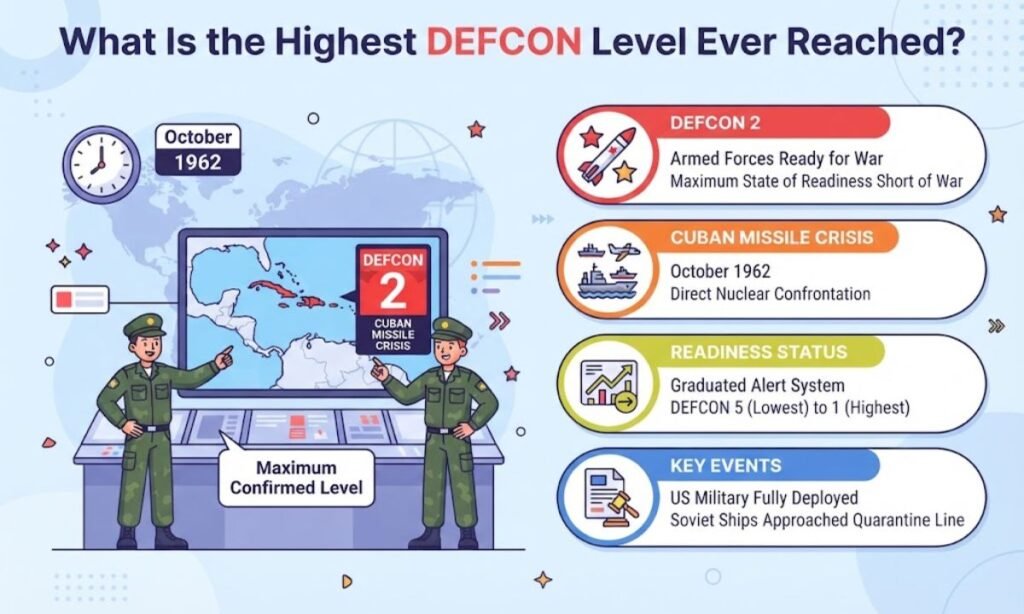
The highest level publicly documented is DEFCON 2. It was reached during the Cuban Missile Crisis in October 1962.
Strategic Air Command went to DEFCON 2 and stayed there until mid-November of that year. Most other U.S. forces remained at DEFCON 3 at the time.
Some accounts also report DEFCON 2 during the early stage of the Gulf War in 1991. Official confirmation has been limited, so treat details carefully.
No public record shows a DEFCON 1 declaration. Early versions of the system even had emergency states above DEFCON 1, which were later dropped.
Why DEFCON 1 has never been declared
DEFCON 1 would mean war is imminent or already underway. Even in the tensest Cold War moments, leaders found ways to step back.
Diplomacy, backchannel talks, and careful signaling kept the top level unused. Its absence from public history is a sign the system worked as a warning, not a trigger.
Why DEFCON 2 stayed so rare
Moving to DEFCON 2 tells rivals that conflict is close. Leaders avoid that message unless the danger is severe.
Because of that cost, DEFCON 2 appears only in a few moments of extreme crisis. Most alerts stop at DEFCON 3 or lower.
Interested in Joining the Military?
If stories about alert levels spark your interest, military service may be worth exploring. Each branch offers different career paths, from aviation and logistics to cyber operations and intelligence.
The best first step is to speak with a recruiter from the branch that appeals to you. Ask about job options, eligibility, training, and what daily life looks like.
Take your time and compare more than one branch. A good fit depends on your skills, goals, and lifestyle.
Get The Military.com Newsletter
Following defense news is easier when stories come to you. A regular newsletter can summarize key developments, policy changes, and military life topics in a few minutes.
Look for one that separates confirmed reporting from speculation. That habit keeps you grounded when alert levels trend online.
It also helps you learn the vocabulary. Terms like DEFCON, FPCON, and readiness posture become familiar once you see them used correctly.
Get The Military.com Newsletter
Once you subscribe to any defense newsletter, use it wisely. Read headlines, then open the full story before sharing it.
Check the date on each report. Old alert stories often return to social feeds and look new.
Save reliable sources that cite officials or documents. When a rumor about DEFCON appears, you will know where to verify it.
What does DEFCON mean?
DEFCON means Defense Readiness Condition. It is a scale the U.S. military uses to describe how alert its forces are.
The scale has five levels. DEFCON 5 is the calmest, and DEFCON 1 is the most severe.
Its purpose is coordination. Everyone in the chain of command understands what a given level requires, so leaders can communicate quickly and clearly during a tense period.
What DEFCON 3 means in simple terms
In simple terms, DEFCON 3 means “get ready.” Forces are on higher alert than usual because leaders see a real risk.
Imagine a fire station when a wildfire is reported nearby. The trucks are ready, crews are nearby, and everyone is listening for the call, but no one is fighting flames yet.
That is the spirit of DEFCON 3. Preparation goes up, and action waits for orders.
For ordinary citizens, it rarely changes daily life. The effects are mostly inside the military.
A quick everyday comparison
Picture a hospital before a major storm. Extra staff are called in, supplies are checked, and the emergency room stays ready.
Patients may notice little, yet the team is fully prepared. DEFCON 3 works in a similar way for the armed forces.
What it does not tell you
It does not reveal who the threat is or where it may appear. It also does not say how long the alert will last.
For those answers, you need official statements and solid reporting. The number alone only tells you readiness has gone up.
Does DEFCON 3 mean war?
No, DEFCON 3 does not mean war. It means the military is preparing for a possible crisis.
In each confirmed case, the situation cooled or was managed without a major war involving U.S. forces. The 1973 crisis eased, the 1976 Korea incident ended after a show of force, and the forces raised after 9/11 were lowered within days.
War-level readiness belongs to DEFCON 2 and DEFCON 1. DEFCON 3 sits earlier in the escalation path.
Still, it is not casual. It reflects genuine concern among senior leaders.
Where DEFCON 3 sits on the DEFCON scale
DEFCON 3 is the exact middle of the five levels. Two levels are calmer (4 and 5), and two are more severe (2 and 1).
| Position | Level | Meaning |
| Lowest | DEFCON 5 | Normal readiness |
| Lower-middle | DEFCON 4 | Above normal |
| Middle | DEFCON 3 | Increased readiness |
| Upper-middle | DEFCON 2 | Near-maximum readiness |
| Highest | DEFCON 1 | Maximum readiness |
Being in the middle gives DEFCON 3 a special role. It is the point where heightened watchfulness turns into active preparation to move.
DEFCON 3 vs DEFCON 4 vs DEFCON 2
These three levels are the ones people mix up most. Comparing them side by side clears up the differences.
The main idea is easy to hold on to. DEFCON 4 means watchful, DEFCON 3 means prepared, and DEFCON 2 means nearly ready to fight.
DEFCON 4
DEFCON 4 adds vigilance. Intelligence gathering increases, and security measures tighten.
Units keep working normally, and most service members see little change. Leaders simply pay closer attention.
DEFCON 3
DEFCON 3 adds preparation. Forces are readied so that they can move quickly, including the 15-minute Air Force mobilization standard.
Leaves can be cancelled and units may be recalled. Personnel feel the change directly.
DEFCON 2
DEFCON 2 adds near-combat readiness. Forces should be able to deploy and engage in about six hours.
It signals that conflict is a serious possibility. Public history records it only in extreme moments.
Quick comparison
| Feature | DEFCON 4 | DEFCON 3 | DEFCON 2 |
| Code word | Double Take | Round House | Fast Pace |
| Main idea | Watchful | Prepared | Nearly ready to fight |
| Key standard | Tighter security | 15-minute Air Force mobilization | About six hours to deploy |
| Public history | Post-9/11 step down | 1973, 1976, 2001 | 1962 (and reportedly 1991) |
Real examples of DEFCON 3 in history
History gives DEFCON 3 its meaning. Each example shows a different kind of crisis and a different response.
Looking at them together reveals a pattern. The level rises when leaders want to show resolve and prepare without triggering a wider conflict.
1. Cuban Missile Crisis
In October 1962, the United States and the Soviet Union came close to nuclear confrontation over Soviet missiles in Cuba. Strategic Air Command went to DEFCON 2.
Most of the rest of the armed forces moved to DEFCON 3. The split shows how commands can hold different levels at the same time.
The crisis ended through negotiation. Strategic Air Command returned to a lower level in November.
2. 1973 Arab-Israeli War
The Yom Kippur War began on October 6, 1973, when Egypt and Syria attacked Israel. Late in the conflict, Washington worried the Soviet Union might intervene directly.
On October 24 and 25, U.S. forces including Strategic Air Command, European Command, and the Sixth Fleet were placed at DEFCON 3. It was a signal to Moscow as much as a military step.
The tension eased, and forces stood down over the following weeks.
3. Korean crisis in 1976
On August 18, 1976, North Korean soldiers killed two American officers at Panmunjom in the demilitarized zone. The killings happened during a dispute over tree trimming.
U.S. forces in South Korea moved to DEFCON 3. The military launched Operation Paul Bunyan, a show of force that included B-52 bombers and fighter escorts.
The response removed the tree and avoided a larger war. The readiness level eased afterward.
4. September 11, 2001
After the terrorist attacks on New York and Washington, Defense Secretary Donald Rumsfeld ordered U.S. forces to DEFCON 3. It was the first confirmed DEFCON 3 since 1973.
The scale was never designed for terrorism. Still, it was the tool available to put forces on alert and strengthen base security quickly.
The military lowered the level to DEFCON 4 on September 14, 2001.
What people often get wrong about DEFCON 3
Few military terms are as misunderstood. Movies, memes, and breaking-news feeds all add confusion.
The four mistakes below cause most of it. Fixing them makes any DEFCON headline easier to read.
Mistake 1: Thinking DEFCON 3 means nuclear war has started
DEFCON 3 does not mean a nuclear war has begun. It means readiness has increased.
Historical DEFCON 3 events involved regional crises and a terrorist attack, not nuclear exchange. Nuclear war would involve the most severe levels.
Mistake 2: Thinking DEFCON 3 is the highest level
The highest level is DEFCON 1, and DEFCON 2 is the highest publicly documented. DEFCON 3 sits in the middle.
The reverse numbering is to blame. People see a low number and assume it is mild, or see a high number and assume it is severe.
Mistake 3: Treating DEFCON 3 and DEFCON 2 as basically the same
The two levels are far apart. DEFCON 3 is about being ready to move within 15 minutes for the Air Force, while DEFCON 2 is about readiness to deploy and engage in about six hours.
The jump also signals a different level of concern. One is a strong caution, and the other is a step toward conflict.
Mistake 4: Using the term without context
Saying “we are at DEFCON 3” without a source tells the listener almost nothing. Who said it, and which command does it apply to?
A reliable statement names the authority and the scope. Without both, treat the claim as speculation.
How to understand DEFCON 3 in news or online discussion
A few simple checks help you read alert headlines with confidence. They take less than a minute.
- Find the source. Look for a named official or a formal announcement.
- Check the scope. Is it global, regional, or limited to one command?
- Look at the date. Old stories often recirculate as if they were new.
- Separate estimates from orders. Tracker sites and bloggers estimate. Only the government can declare.
- Watch the language. Phrases like “sources suggest” usually signal guesswork.
Keep in mind that the Pentagon does not announce live levels. A real announcement would be unusual and would show up across many major outlets.
When in doubt, wait for confirmation. A calm pause beats sharing a false alarm.
Red flags in viral posts
Some posts are built to spread fear. Watch for all-caps headlines, vague “insiders,” and screenshots with no link.
Another warning sign is a post with no date. Old alert stories often return to feeds and look fresh.
Trusted places to verify
Start with official defense briefings and established news organizations. Good reporters name their sources and explain what remains unknown.
If only one obscure account reports a change, wait. A real shift in national posture would draw wide coverage within hours.
Why this term matters
DEFCON 3 matters because it translates a complex military reality into a simple signal. A single number tells leaders, allies, and rivals how seriously the country views a moment.
It also shapes public conversation. Journalists, students, and writers all use DEFCON shorthand when discussing international tension.
Understanding it protects you from panic and from misinformation. When a rumor spreads, you can judge it calmly.
The term has also become part of everyday language. Knowing its real meaning helps you use it accurately, whether you are reading the news or joking with friends.
A window into Cold War thinking
The scale reflects how planners once viewed the world. Every step was tied to how fast forces might need to respond to a sudden threat.
Reading it today shows how deeply nuclear risk shaped military planning. The vocabulary survived long after the Cold War ended.
Lessons for everyday readers
The biggest lesson is to check scope and source. A level claim means little without an authority and a region behind it.
A second lesson is emotional. Understanding the scale lets you take serious news seriously without being swept away by fear.
what does defcon 3 mean in black ops 2
If you heard the term in Call of Duty: Black Ops II, it works like the real one. DEFCON 3 signals raised readiness, not open war.
The game is a near-future military thriller, and its story borrows alert language to build tension. Game writers may adjust details for drama, so the exact situation depends on the scene.
For the real-world meaning, rely on the scale itself. DEFCON 3 is the middle level, with heightened readiness and a 15-minute Air Force mobilization standard.
what is defcon 3 mean kanye
People often search this after seeing the term in a song or a social post linked to Kanye West. There is no special Kanye-specific definition.
Artists usually use DEFCON 3 as a metaphor. It suggests being on edge, alert, and ready for trouble.
To get the intended meaning, read the surrounding context. The line usually tells you whether the speaker means tension, danger, or pure swagger.
going defcon 3 mean
“Going DEFCON 3” means moving up to a higher state of alert. In the military, it refers to an order raising readiness to that level.
In everyday speech, it means becoming more vigilant or more tense. Someone might say a team is “going DEFCON 3” when a deadline suddenly tightens.
The phrase works best with clear context. Used alone, it sounds vague, so add a short explanation when talking to people who may not know the term.
Are we in DEFCON 3
No one outside the government can say for certain. The current official level is not published.
As of September 30, 2026, I could not find an official announcement confirming a change. Some tracking sites list an estimated DEFCON 3, but they explain that their figures are not official.
Here is a safe way to think about it:
- Official public statement: None found.
- Independent estimates: Often DEFCON 3, but unverified.
- Best approach: Follow major news and government briefings.
Keep the source question in mind. An estimate may reflect real tension in the world, but it is not proof of an order.
What a real change would look like
A genuine shift would likely appear in statements from officials and across many major outlets. Independent reporters would confirm it from several angles.
Even then, details might stay limited. Officials often share the fact of heightened readiness without describing specific actions.
Why estimates differ
Each tracker weighs events differently. One may focus on conflicts, while another watches military movements or nuclear signaling.
That is why two sites can show different levels on the same day. Their numbers reflect opinion, not access to classified orders.
DEFCON 0
DEFCON 0 is not part of the current scale. The official levels run from 5 to 1.
The idea of a “zero” level comes from pop culture and from the early system. Older versions had emergency states above DEFCON 1, including Defense Emergency and Air Defense Emergency.
Modern use simply stops at DEFCON 1. When you see DEFCON 0 online, it is usually a joke or a dramatic figure of speech.
DEFCON 6 meaning
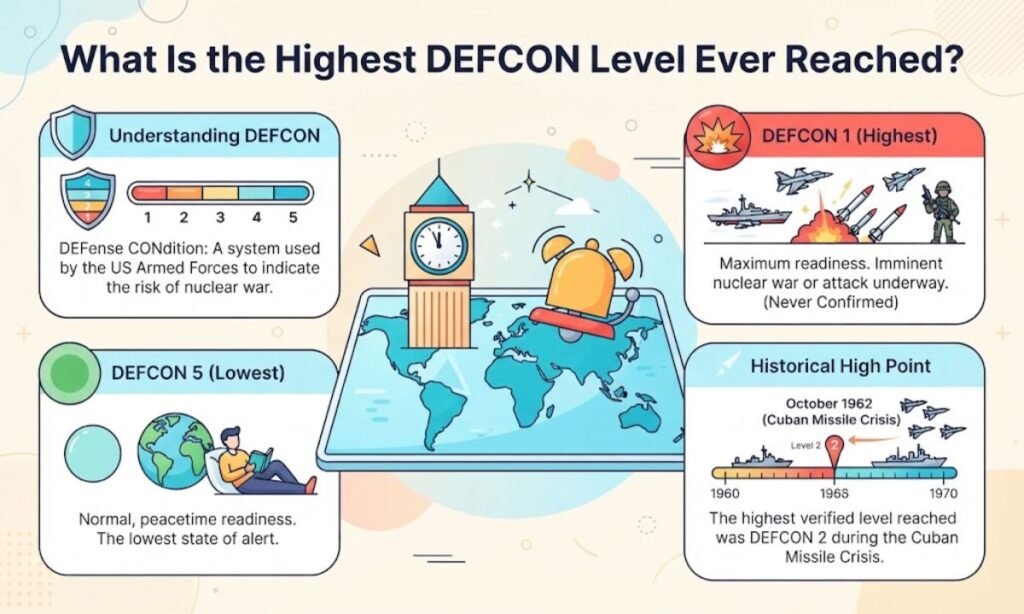
DEFCON 6 does not exist either. The scale stops at DEFCON 5, which already marks normal readiness.
Some people use “DEFCON 6” humorously to mean total relaxation. It is comic shorthand, not a military level.
Because the numbers run backward, a sixth level would have nothing left to describe. Peacetime is already covered by DEFCON 5.
Final Thought
DEFCON 3 is a serious signal, but not a sign of war. It marks the middle of the readiness scale, where forces prepare to move while leaders weigh the next step.
The key facts are simple. Round House is the exercise term, the Air Force mobilization standard is 15 minutes, the color is yellow, and confirmed use came in 1973, 1976, and 2001.
The public does not officially see the live DEFCON level. That is why context, sources, and calm reading matter more than any dramatic headline.
Keep this guide handy the next time the term trends. You will know what it means, what it does not mean, and how to check the claim.
Frequently Asked Questions
What does defcon 3 mean in military terms?
It is an increase in force readiness above normal, called Round House in exercises. The Air Force is expected to be able to mobilize in 15 minutes.
What does a DEFCON 3 alert level mean for national security?
It shows that leaders see a real risk and want forces ready to move. It does not mean an attack has happened or that war is starting.
How do security companies use defcon 3 status in their services?
Some private firms borrow the DEFCON style to label their own risk levels. Those labels are unofficial and do not reflect the military’s actual status.
How has DEFCON 3 been used in past global events?
The U.S. used it during the 1973 Yom Kippur War, the 1976 Korean crisis, and after the September 11, 2001 attacks. It was also the level of most forces during the 1962 Cuban Missile Crisis.
Which defense contractors provide updates on defcon levels?
None do officially, because the government does not release live DEFCON levels. Be careful with websites that claim to offer confirmed updates.
What are the primary differences between DEFCON 3 and DEFCON 2?
DEFCON 3 means readiness above normal with a 15-minute Air Force mobilization standard. DEFCON 2 means forces are ready to deploy and engage in about six hours.
Can I subscribe to alerts about defcon 3 status changes?
There is no official alert service for DEFCON changes. Some third-party sites offer notifications, but they are estimates rather than government notices.
What immediate actions are taken by military forces during a DEFCON 3 alert?
Units may cancel leaves, recall personnel, increase staffing, and prepare aircraft and crews to move quickly. Security and communication checks also increase.
What products help monitor defcon 3 alerts for personal safety?
No product can monitor the official DEFCON level. For real safety alerts, use your phone’s emergency alerts, a NOAA Weather Radio, and trusted news apps.
What are recommended emergency supplies for a family preparedness kit?
Common items include water (about one gallon per person per day for several days), nonperishable food, a flashlight, a battery or hand-crank radio, extra batteries, a first aid kit, medications, and important documents. Ready.gov offers a full checklist.
What does DEFCON 3 mean?
DEFCON 3 means the U.S. military has raised its readiness above normal. It is the middle of the five-level scale and is not a declaration of war.
Are we at DEFCON 3 right now?
The official level is not made public. Some websites estimate DEFCON 3, but those figures are unofficial.
Is DEFCON 3 dangerous?
It signals increased concern, but it is not itself a sign of attack or war. Historically, DEFCON 3 has been used to prepare and show resolve.

I am a dedicated author with 6+ years of experience writing and researching content for name meaning websites. My expertise includes American names, baby names, surnames, name origins, and cultural significance. I focus on creating accurate, well researched, and easy to read articles using trusted sources. My goal is to help readers discover the history, meaning, and uniqueness behind every name with reliable and engaging content.