
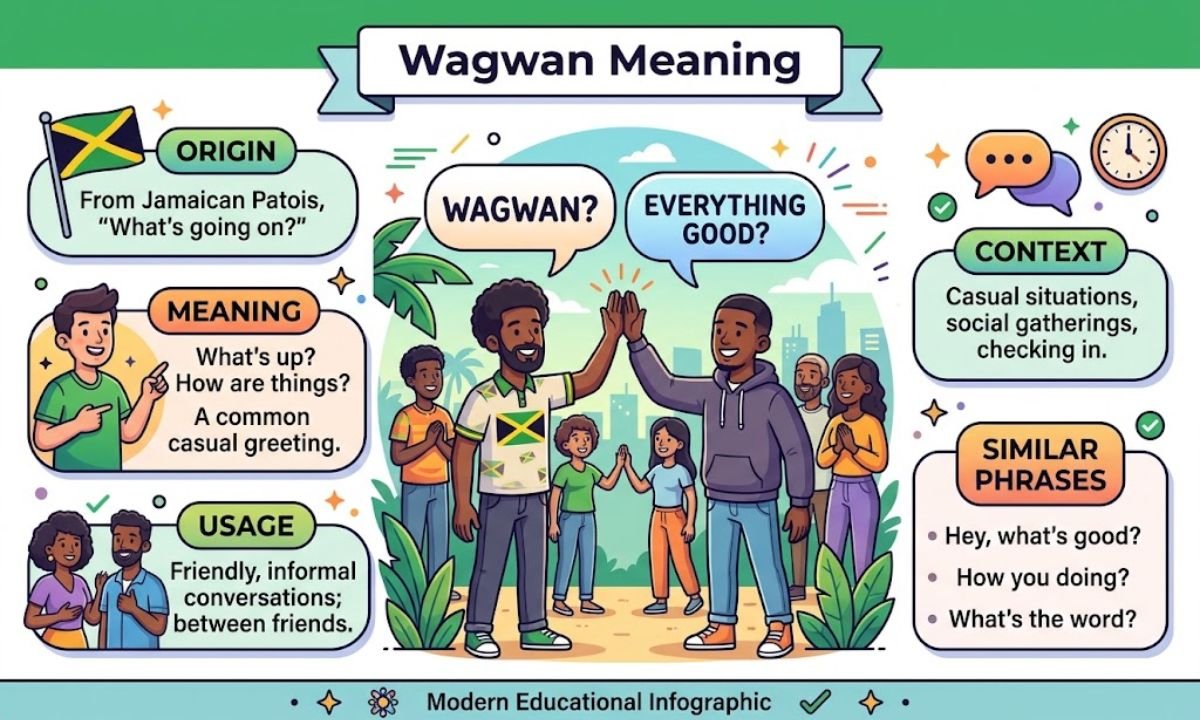

Wagwan is a casual greeting that means “what’s going on?” or “what’s up?” It comes from Jamaican Patois and is now common in London, across the UK, and in online chats worldwide.
If someone just sent you “wagwan” and you are not sure what to say back, this guide covers the meaning, where it comes from, how people use it, and simple replies you can use.
Wagwan Meaning – Quick Meaning
Wagwan = “What’s going on?”
It works like “what’s up?” or “how’s it going?” You say it to start a chat, not to ask for a detailed answer.
- Literal sense: “What is happening?”
- Real sense: “Hey, how are you?”
- Common reply: “Nothing much,” “Safe,” or “Nagwan” (nothing’s going on)
Origin & Background of “Wagwan”
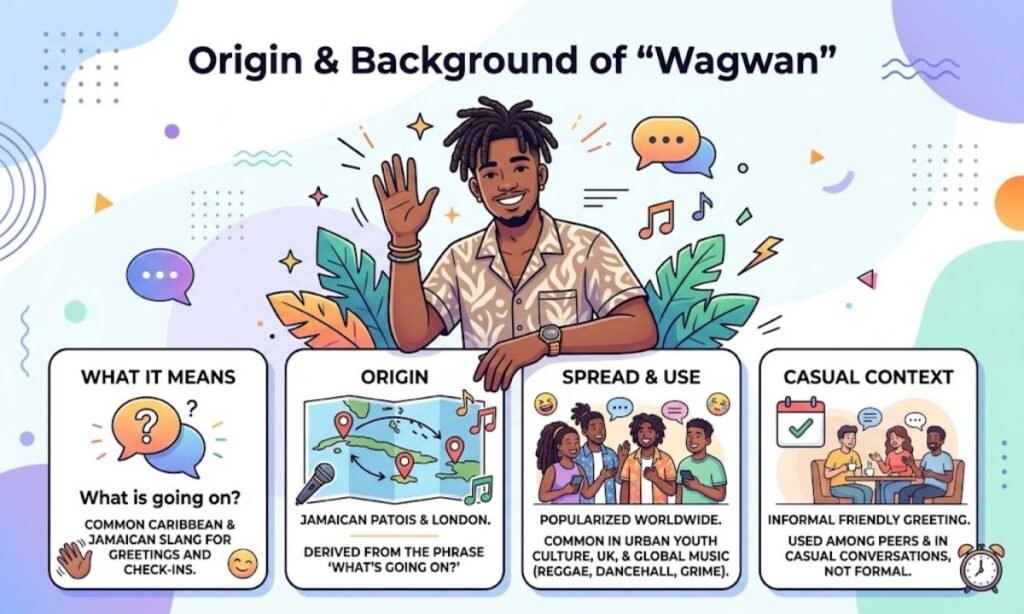
Wagwan comes from Jamaican Patois, an English-based Creole language. The Patois form is usually written “wah gwaan” or “wah gwan.” It is a reshaped version of the English phrase “what’s going on?”
In the Jamaican diaspora, it was shortened further into “wagwan.” Dictionary sources link its spread in London to Jamaican communities settling there, with the greeting becoming well known around the 1980s and 1990s.
How It Evolved
The phrase moved from Jamaican speech into Multicultural London English (MLE), a youth dialect shaped by Caribbean and other immigrant communities in London. From there, grime, UK rap, and TV shows carried it to a wider audience.
Today you will see it in captions, comments, and song titles. Central Cee and YoungBoy Never Broke Again have both released tracks named “Wagwan.”
Real-Life Conversations (How People Actually Use “Wagwan”)
People rarely say “wagwan” alone. It usually comes with a nickname or a follow-up question.
WhatsApp Chat
Friend: Wagwan, you coming tonight? You: Yeah, I’ll be there by 8.
Instagram DMs
Them: Wagwan! Saw your story, where was that? You: Wagwan! Brighton, it was a last-minute trip.
TikTok Comments
Commenter: Wagwan fam, what’s the song in this? Creator: Check my bio, it’s linked there.
Text Message
Them: wagwan You: nothing much, you?
In quick texts, some people shorten it to “wag1” or “wag.”
Emotional & Psychological Meaning
On the surface, wagwan is a plain greeting. Underneath, it carries a relaxed, friendly tone. It tells the other person, “I’m easy to talk to.”
What It Reflects
- Familiarity: People use it with those they already feel comfortable with.
- Belonging: For many Caribbean and British communities, it is part of how they naturally speak.
- Informality: It drops the stiffness of “How do you do?” and keeps things light.
Usage in Different Contexts
Social Media
Wagwan is common in comments, DMs, and captions, especially among younger users. It is a quick way to open a conversation or get attention.
Friends & Relationships
Between friends, it feels warm and normal. With a partner or crush, it can sound playful. Adding a pet name or nickname (“wagwan, bro” or “wagwan, you”) sets the mood.
Work or Professional Settings
Avoid it in formal emails, client calls, or first messages to a manager. Use “Hi” or “Hello” instead. With a close colleague who already chats casually with you, it is fine.
Casual vs Serious Tone
Wagwan suits a light, casual mood. If the situation is serious, such as bad news or a formal complaint, a standard greeting fits better.
Common Misunderstandings About Wagwan
1. Thinking It’s Rude
It is not rude. The phrase is a friendly greeting. It can sound blunt only if the person is not used to the slang or if it is used in the wrong setting.
2. Using It With Strangers
Saying it to someone you have never met can feel forced, especially if you do not normally speak this way. Some people may take it as imitation. Match your usual speech and the other person’s tone.
3. Overusing It
Using wagwan in every message can sound like a performance. A natural greeting, used where it fits, works better.
4. Mispronouncing It
Many people say it as “wag-wan,” as if it were two English words. The Jamaican form sounds closer to “wah-gwaan.” There is more on this in the pronunciation section below.
Wagwan vs Similar Terms (Comparison Table)
| Term | Meaning | Where It Is Common | Tone |
| Wagwan | What’s going on? | UK, Jamaica, Caribbean diaspora | Casual, friendly |
| What’s up / Wassup | What’s happening? | US and global English | Casual |
| Alright? | How are you? | UK | Casual, often a quick hello |
| Yo | Hey | Global, mainly US | Very casual |
| Wesh | What’s up? (French slang from Arabic) | France, now heard in UK youth slang | Very casual |
| Wah gwaan | What’s going on? (Patois spelling) | Jamaica | Casual, closest to the original |
Variations & Types of Wagwan (Common Forms)
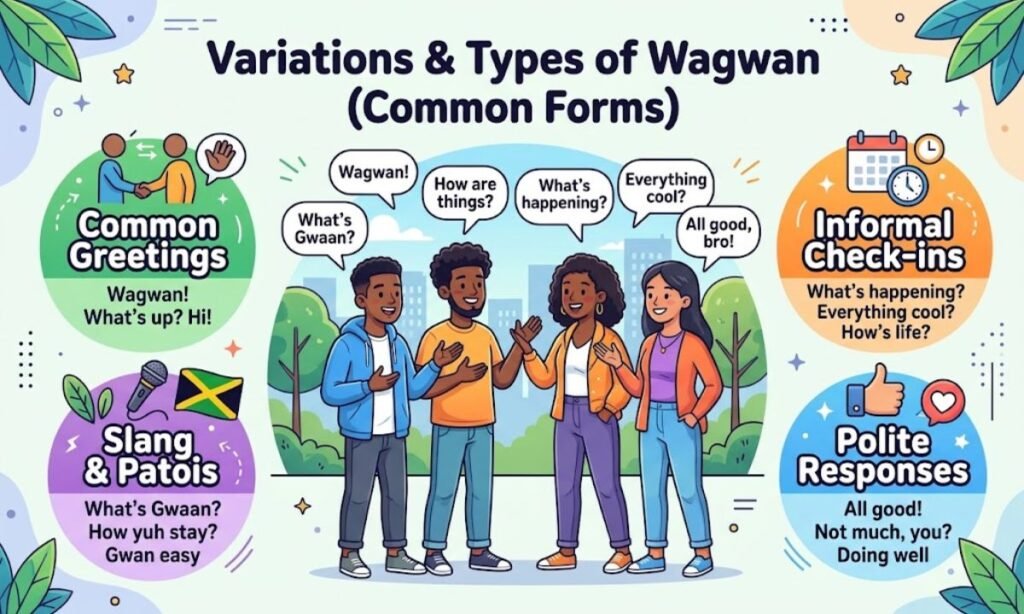
Spellings vary because the phrase comes from speech, not formal writing.
- Wagwan: The most common form online.
- Wah gwaan / Wah gwan: The Patois-style spellings.
- Wha gwan / Wa gwan: Shortened spellings.
- Wat a gwaan: A longer Jamaican form.
- Wag1: A texting shortcut.
- Wagwan + nickname: “Wagwan, bro,” “Wagwan, fam,” “Wagwan, blud,” “Wagwan, mandem.”
How to Respond When Someone Says “Wagwan”
You do not need Patois to reply. Pick a response that matches your relationship with the person.
Casual Replies
- “Nothing much, you?”
- “All good, you?”
- “Just chilling.”
- “Safe, wagwan with you?”
Funny Replies
- “Nagwan, just me and my snacks.”
- “Wagwan! Still waiting for my payday.”
- “Not much. Overthinking dinner again.”
Mature / Confident Replies
- “Hey, doing well. How about you?”
- “All good here. What’s on your mind?”
- “Busy but good. What’s up?”
Private or Respectful Replies
If you do not know the person well or want to keep things calm:
- “Hi, I’m doing fine. How are you?”
- “Hello. All good, thanks.”
Regional & Cultural Usage
Western Culture
Wagwan is most at home in the UK, particularly London, and in cities with large Jamaican communities such as Toronto. It also shows up in UK rap, grime, and TV dialogue. In the US, it is recognised mostly through music and online culture.
Asian Culture
Wagwan is not a native greeting in Asian languages. Where people use it, it usually comes through music, social media, and UK or Caribbean communities abroad.
Middle Eastern Culture
It is not part of traditional Middle Eastern speech either. Some young people in the diaspora may mix it with local greetings, which is where playful blends like “wagwan alaikum” come from (see below).
Global Internet Usage
Online, wagwan has become a general-purpose greeting. Many users, including people with no Jamaican or UK background, use it in comments and chats. Familiarity with the culture behind it helps you use it respectfully.
wagwan meaning slang
As slang, wagwan is a greeting and an opener, similar to “what’s up.” It is informal and best with friends, peers, and people your age group who speak this way.
wagwan meaning and reply
Wagwan means “what’s going on?” A short, easy answer is enough: “Nothing much, you?” or “Safe, you good?” Use “Nagwan” if you want the Patois-style answer.
wagwan meaning jamaican
In Jamaican Patois, “wah gwaan” is a standard everyday greeting. It is reshaped from “what’s going on?” and carries the same friendly, relaxed meaning. The usual Patois answer is “Nutten nah gwaan” (nothing is going on) or a short reply like “Mi deh yah” (I’m here / I’m fine).
wagwan meaning uk
In the UK, especially London, wagwan is part of Multicultural London English. Young people of many backgrounds use it as a casual hello. In Britain, it can feel like a Londoner’s greeting even though its roots are in Jamaica.
Wagwan Mandem Meaning
“Mandem” means a group of guys, usually your own mates or crew. It comes from Caribbean English “man” plus “them.” The female version is “gyaldem.”
So “wagwan mandem” means “What’s up, lads?” or “Hey, everyone.” It is a greeting to a group.
Wagwan alaikum
“Wagwan alaikum” is not a standard greeting. It appears to be a playful blend of “wagwan” and the Arabic greeting “assalamu alaikum.” Some people use it jokingly among friends, but it is informal and can sound out of place to people who treat the Islamic greeting with seriousness. Avoid it in respectful or religious settings.
Wagwan pronunciation
Wagwan is two beats: wag-WAN in many UK accents, and closer to wah-GWAAN in Jamaican speech. The stress usually falls on the second part.
Listening to a Jamaican or London speaker will help more than any written guide.
Wagwan meaning Central Cee
Central Cee, a rapper from West London, has a song called “Wagwan” on his All Roads Lead Home EP. In the song, the greeting works as a cultural marker. It shows that his slang and background stay with him as his life and travel change.
The title keeps the usual meaning, “what’s going on,” but the song uses it to talk about identity and status.
Wagwan meaning Arabic
Wagwan is not Arabic. It is Jamaican Patois in origin.
The confusion can come from “wesh,” a French slang greeting that comes from an Arabic expression used mainly in Algeria, and from blends like “wagwan alaikum.” These are separate things that happen to sit near each other in youth slang.
Is wagwan offensive
No, wagwan is not offensive. It is a friendly, everyday greeting.
It can feel awkward or insincere when used in formal settings, or when someone uses it to mock an accent or culture. Use it naturally and respectfully.
Conclusion
Wagwan is a casual Jamaican-rooted greeting that means “what’s going on?” It spread through London and the Caribbean diaspora and is now familiar worldwide.
It works best with friends and in relaxed chats. If someone says it to you, a simple “Nothing much, you?” is always a good reply.
Frequently Asked Questions
What does “wagwan” mean in modern slang?
In modern slang, “wagwan” means “what’s going on?” or “what’s up?” It is a casual greeting used in chats, comments, and conversations.
What does “wagwan” signify in conversation?
It signals a relaxed, friendly start to a conversation. It usually shows you are comfortable with the person.
Which companies use “wagwan” in their marketing campaigns?
There is no reliable list of companies known for using “wagwan” in campaigns. Brands aimed at younger UK audiences sometimes use slang in social posts, but specific examples would need to be checked case by case.
How is “wagwan” typically pronounced?
It is usually said as “wag-WAN” in the UK, or closer to “wah-GWAAN” in Jamaican speech. Both are recognised.
What does it mean when someone texts me “wagwan”?
They are saying hello and asking what you are up to. A short reply like “Nothing much, you?” is enough.
Can I say “wagwan” if I’m not Jamaican or British?
Yes, many people use it. It sounds best when it matches how you normally talk and when you use it respectfully with people who are comfortable with it.
How do I reply to “wagwan” in a polite way?
Keep it simple: “Hi, I’m good, thank you. How are you?” This works with people you do not know well.
Is “wagwan” the same as “what’s up”?
It has almost the same meaning, but wagwan carries Jamaican and London roots, while “what’s up” is general English.
Is wagwan a formal greeting?
No. It is informal and best kept out of professional emails, interviews, and official messages.
What is the difference between “wagwan” and “wah gwaan”?
They mean the same thing. “Wah gwaan” is the Patois-style spelling, and “wagwan” is the shorter version common in London and online.

I am a dedicated author with 6+ years of experience writing and researching content for name meaning websites. My expertise includes American names, baby names, surnames, name origins, and cultural significance. I focus on creating accurate, well researched, and easy to read articles using trusted sources. My goal is to help readers discover the history, meaning, and uniqueness behind every name with reliable and engaging content.