

If you have spent any time on TikTok, X, or Instagram lately, you have probably seen the letters FAFO pop up in comments, captions, or memes. It looks random at first, almost like a typo. But it is actually one of the fastest-growing slang terms in modern internet culture.
This guide breaks down exactly what FAFO means, where it came from, and how people use it across social media and everyday conversation. By the end, you will know when to use it, when to avoid it, and why it has become such a popular phrase.
What Does FAFO Mean?
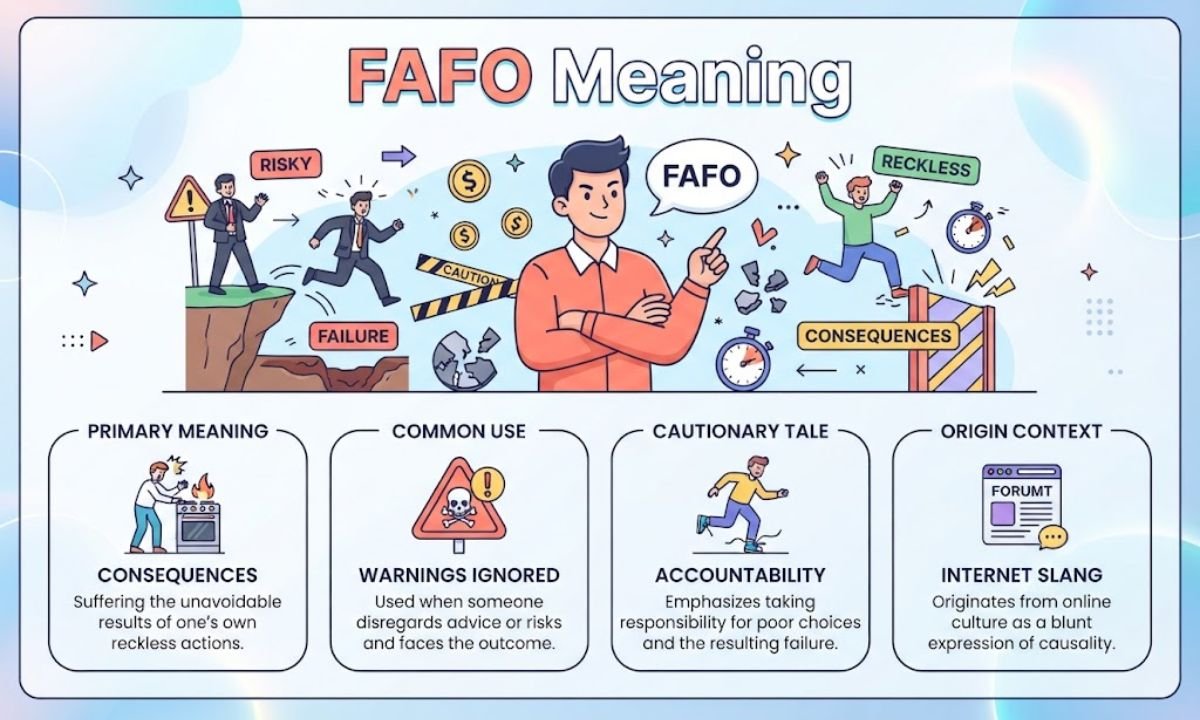
FAFO stands for “F* Around and Find Out.”** It is a blunt way of saying that reckless actions come with consequences. When someone “fafo’s,” they take a risky or foolish action and end up facing the fallout.
The phrase works as both a warning and a prediction. You can use it to tell someone to stop before they get hurt, or you can use it after the fact to describe what just happened to them. Either way, the core idea stays the same: actions have results, and not always good ones.
Simple Example
Imagine a friend keeps poking a wasp nest with a stick despite being told to stop. When they finally get stung, you simply say, “That’s FAFO.” No further explanation needed.
FAFO Meaning in Texting
In texts and direct messages, FAFO usually shows up as a short reaction or a warning. It fits naturally into casual conversation because it is quick to type and instantly understood by anyone familiar with internet slang.
People often pair it with emojis like 💀 or 😂 to soften the tone, or they use it flatly to sound more serious. The meaning barely changes depending on format, but the tone shifts based on punctuation and context.
Examples
- “Don’t touch my food again. FAFO.”
- “He ignored the check engine light for months. FAFO.”
- “You really thought that plan would work? FAFO.”
FAFO Meaning on TikTok
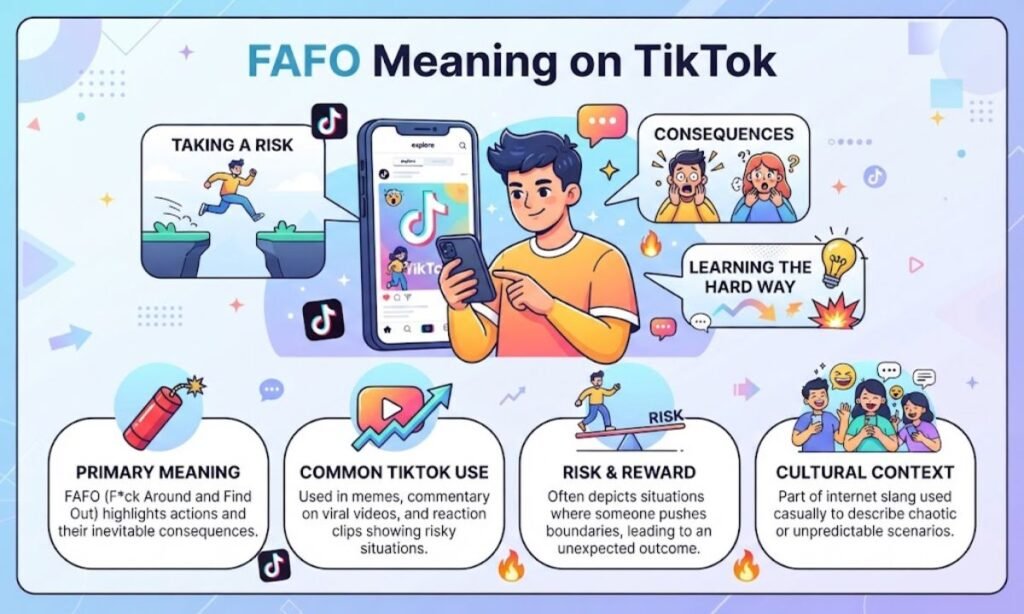
TikTok is where FAFO really took off. Comment sections under videos showing risky stunts, bad decisions, or instant karma moments are often flooded with the term. It has become a shorthand way of narrating cause and effect in real time.
Creators also use FAFO directly in captions to preview a video’s punchline, letting viewers know a consequence is coming before they even hit play.
FAFO Meaning on Instagram
On Instagram, FAFO shows up most in comment threads and Reels, similar to TikTok. It is common under posts featuring pranks gone wrong, dramatic confrontations, or “watch what happens next” style content.
Some users also use it in captions on their own posts, usually with a self-deprecating tone, admitting they made a mistake and are now living with the result.
FAFO Meaning on Snapchat
Snapchat usage tends to be more personal and conversational since the platform is built around private messaging. Friends use FAFO in one-on-one chats as a quick jab or inside joke, often referencing a shared memory or an ongoing situation between them.
Because Snapchat messages disappear, the phrase often carries a more playful, low-stakes tone compared to public platforms.
FAFO Meaning on X (Twitter)
X is where FAFO leans more political and confrontational. It shows up in replies to news stories, public disputes, and viral threads, often used as a one-word response predicting or celebrating a downfall.
Public figures, brands, and everyday users alike have picked up the phrase, which has helped push it from internet slang toward mainstream recognition.
Origin of FAFO
FAFO is not a brand-new invention. Language researchers and cultural commentators trace its roots to older, blunt warning phrases used in military circles, street culture, and African American Vernacular English (AAVE) long before it became an online staple.
The full phrase “f*** around and find out” has existed in spoken conversation for decades as a way to warn someone against testing their luck. Social media did not create the phrase, but it did compress it into a punchy acronym and spread it globally within a few years.
Reddit threads and comment sections helped popularize the shortened version, and meme culture did the rest, turning it into one of the internet’s most recognizable catchphrases.
Why Has FAFO Become So Popular?
FAFO did not go viral by accident. Several factors made it the perfect phrase for how people communicate online today.
1. It’s Short
Four letters say what would otherwise take a full sentence. In a world of character limits and fast scrolling, brevity wins.
2. It’s Funny
There is something inherently comedic about watching someone face instant karma. FAFO captures that humor in a single word.
3. It’s Relatable
Almost everyone has ignored good advice and paid for it later. The phrase taps into a universal experience.
4. It’s Easy to Remember
The acronym is catchy and rolls off the tongue, which makes it easy to recall and reuse in different situations.
5. It Fits Meme Culture
Memes thrive on quick, punchy language paired with visuals. FAFO slots perfectly into captions, comments, and reaction images.
Different Ways People Use FAFO
FAFO is not a one-note phrase. Its tone shifts significantly depending on the context and the person using it.
Humorous
Used to laugh at someone’s self-inflicted mishap, usually with no real animosity behind it.
Sarcastic
Delivered with a dry, knowing tone, often implying “I told you so” without actually saying it.
Serious
Used as a genuine warning, especially in confrontations or when someone is about to make a harmful decision.
Motivational
Occasionally flipped into encouragement, pushing someone to take a calculated risk and learn from the outcome, good or bad.
Real-Life Examples of FAFO
The acronym applies far beyond social media. Here is how it plays out in everyday situations.
Example 1: School
A student skips studying all semester and then panics before finals. Classmates simply respond, “FAFO.”
Example 2: Workplace
An employee cuts corners on a project despite warnings from their manager. When the client complains, coworkers quietly say the project was a classic case of FAFO.
Example 3: Sports
A trash-talking player gets outplayed after underestimating their opponent. Fans in the stands or comments call it FAFO in real time.
Example 4: Relationships
Someone repeatedly ignores their partner’s boundaries and ends up single. Friends describe the breakup as a textbook FAFO moment.
Example 5: Social Media
A creator posts something controversial for attention and faces intense backlash. Commenters flood the post with a single word: FAFO.
When Should You Use FAFO?
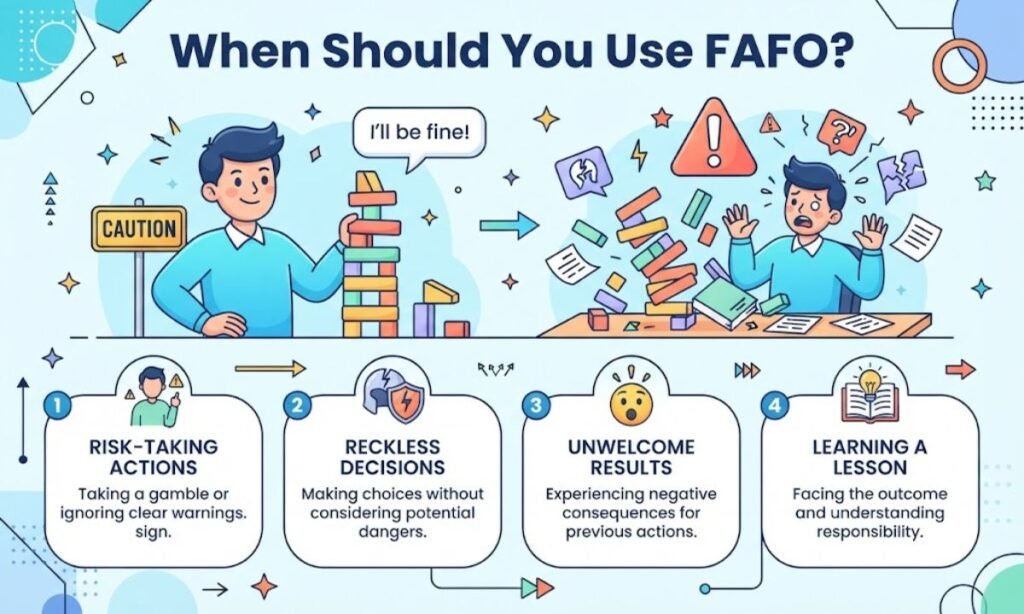
FAFO works best in casual, low-stakes settings where a little humor or bluntness fits the mood. It is ideal for:
- Reacting to a friend’s self-inflicted mistake
- Commenting on viral videos or memes
- Light warnings among people who know each other well
- Describing obvious cause-and-effect situations online
When You Should Avoid Using FAFO
There are situations where the phrase can come across as harsh, dismissive, or inappropriate. Avoid using FAFO:
- In professional or formal communication
- When someone is genuinely hurt or grieving
- Around people unfamiliar with internet slang
- In situations involving real danger or serious harm
FAFO Examples in Conversations
Seeing the phrase in context makes its meaning even clearer.
Example 1
“I told him not to invest his savings in that scheme.” “Yeah, well, FAFO.”
Example 2
“She kept driving on that bald tire.” “And now she’s stranded on the highway. FAFO.”
Example 3
“He skipped the warm-up before the game.” “Pulled a hamstring in the first five minutes. FAFO.”
Example 4
“I’m going to eat this expired yogurt anyway.” “That’s a bold move. FAFO.”
Example 5
“They ignored the storm warning and went hiking.” “Classic FAFO.”
Common Misunderstandings About FAFO
Because the phrase sounds aggressive, people sometimes misread its intent. Here is what it actually does and does not mean.
It Doesn’t Mean Violence
FAFO is about consequences in general, not a threat of physical harm. Most uses online are about embarrassment, inconvenience, or minor setbacks, not violence.
It Isn’t Always Negative
While it is often used sarcastically, FAFO can also carry a lighthearted or even encouraging tone, especially among close friends.
It Isn’t an Official Phrase
FAFO has no formal dictionary entry or governing definition. Its meaning shifts slightly depending on platform, region, and community.
It Doesn’t Encourage Harm
The phrase describes what happens after a risky choice; it does not tell people to go make reckless decisions in the first place.
Similar Slang Terms
FAFO belongs to a broader family of internet acronyms built around consequences, warnings, and reactions.
| Slang Term | Meaning |
| FAFO | F*** Around and Find Out |
| YOLO | You Only Live Once |
| IYKYK | If You Know, You Know |
| SMH | Shaking My Head |
| NGL | Not Gonna Lie |
Synonyms and Similar Expressions
If you want to express the same idea without using the acronym, several alternatives work well:
- “Play stupid games, win stupid prizes”
- “Actions have consequences”
- “You reap what you sow”
- “Karma’s coming”
- “Told you so”
Is FAFO Offensive?
FAFO is generally not considered offensive, though its underlying phrase includes a curse word, which is why the acronym exists in the first place. It is widely used across mainstream platforms without much pushback.
That said, tone and context matter. Using it to mock someone in a genuinely painful situation can come across as unkind, so reading the room is important before typing it out.
Why People Like Using FAFO
Beyond humor, FAFO gives people a quick way to express a shared cultural sentiment: accountability. It reflects a growing online attitude that choices matter and outcomes are earned, not random.
It also builds a sense of community. Recognizing the phrase and using it correctly signals that you are plugged into current internet culture.
Tips for Using FAFO Correctly
- Match the tone of the conversation before using it
- Avoid it in professional settings
- Use it after the consequence has happened, not as a threat
- Pair it with humor when the situation is lighthearted
- Skip it entirely in serious or sensitive moments
FAFO Meaning Trump
FAFO has occasionally appeared in political commentary and social media posts referencing public figures, including former President Donald Trump, particularly around statements on trade, tariffs, and foreign policy.
In these cases, the phrase is typically used by commentators or the public to describe a warning about consequences tied to a policy decision.
Its use in political contexts follows the same core meaning as everywhere else: a blunt statement that actions, especially high-stakes ones, come with results.
FAFO Military Meaning
Some accounts trace FAFO’s roots partly to military and law enforcement slang, where blunt warnings are common. In these circles, the phrase historically served as a no-nonsense way to tell someone to back off before facing real consequences.
While the internet version is usually lighter and meme-driven, the military-adjacent origin explains why the phrase carries such a direct, no-filler tone.
FAFO Meaning Urban Dictionary
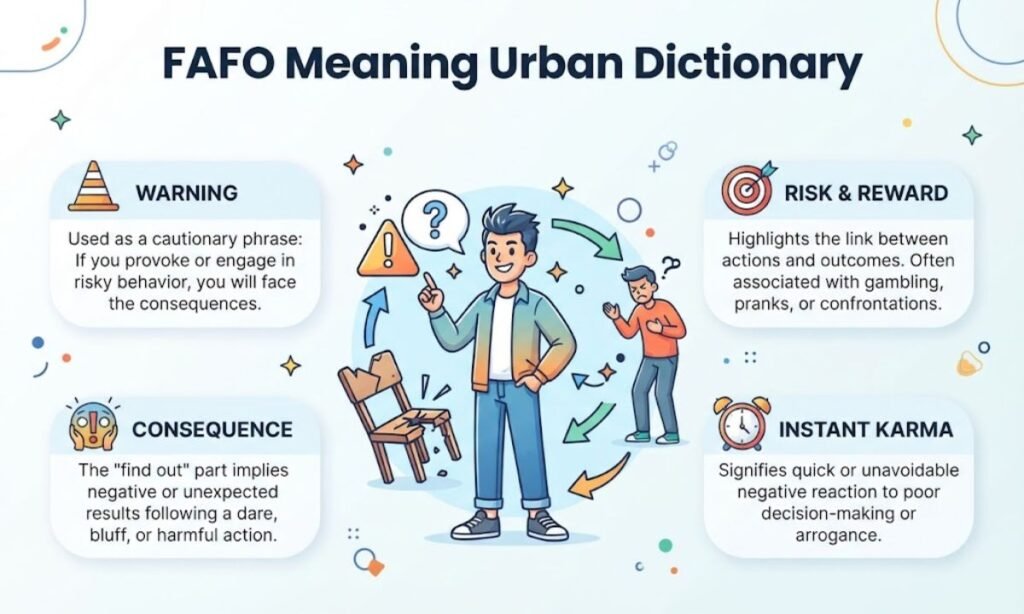
Urban Dictionary entries for FAFO generally define it the same way this guide does: “F*** Around and Find Out,” used to describe someone facing the results of their own reckless behavior.
Definitions on the site vary slightly in wording, but the core meaning stays consistent across submissions.
Crowdsourced slang sites like this one are often the fastest place to see new or evolving uses of the term before they hit mainstream dictionaries.
FAFO Meaning WWE
Within pro wrestling fan communities, FAFO sometimes shows up in commentary and merchandise as a nod to a wrestler’s aggressive, no-nonsense persona.
It is not an official, universally recognized WWE storyline term, but fans and independent wrestlers alike have adopted it informally to describe moments when a cocky competitor gets taken down a notch.
If you see FAFO connected to wrestling, it is almost always tied to this same “actions have consequences” theme rather than an official league branding.
Conclusion
FAFO has grown from a blunt, old-school warning into one of the internet’s most recognizable slang terms. It captures a simple truth in just four letters: choices carry consequences, and eventually, everyone finds that out for themselves.
Whether you see it on TikTok, in a group chat, or in a political comment section, the meaning stays consistent. Use it wisely, read the room, and you will fit right into the conversation.
Frequently Asked Questions
What does the term “fafo” mean in corporate branding?
FAFO has no official corporate branding or trademarked business meaning. Any brand use is typically informal, borrowing the internet slang tone for marketing or social media engagement.
What does fafo mean in internet slang?
In internet slang, FAFO stands for “F*** Around and Find Out,” describing someone facing the consequences of a reckless or foolish action.
How is “fafo” used in business analytics platforms?
FAFO is not an established term in business analytics; it does not refer to any recognized software, metric, or platform in that industry.
How is fafo used in online communities?
Online communities use FAFO in comments and captions to react to risky behavior, call out bad decisions, or humorously predict consequences before they happen.
Where can I find services related to “fafo” technology?
There is no recognized “FAFO technology” sector or associated service industry; the term remains rooted in internet slang rather than any tech product category.
What products are associated with the “fafo” concept in the tech industry?
No mainstream tech products are officially tied to the FAFO concept. Any merchandise using the phrase, such as apparel or stickers, is typically fan-made or novelty branding rather than a recognized tech product line.
How to explain fafo to someone unfamiliar with internet culture?
Tell them it is short for “F*** Around and Find Out,” a phrase used to describe what happens when someone takes a reckless action and faces the resulting consequences.

I am a dedicated author with 6+ years of experience writing and researching content for name meaning websites. My expertise includes American names, baby names, surnames, name origins, and cultural significance. I focus on creating accurate, well researched, and easy to read articles using trusted sources. My goal is to help readers discover the history, meaning, and uniqueness behind every name with reliable and engaging content.