
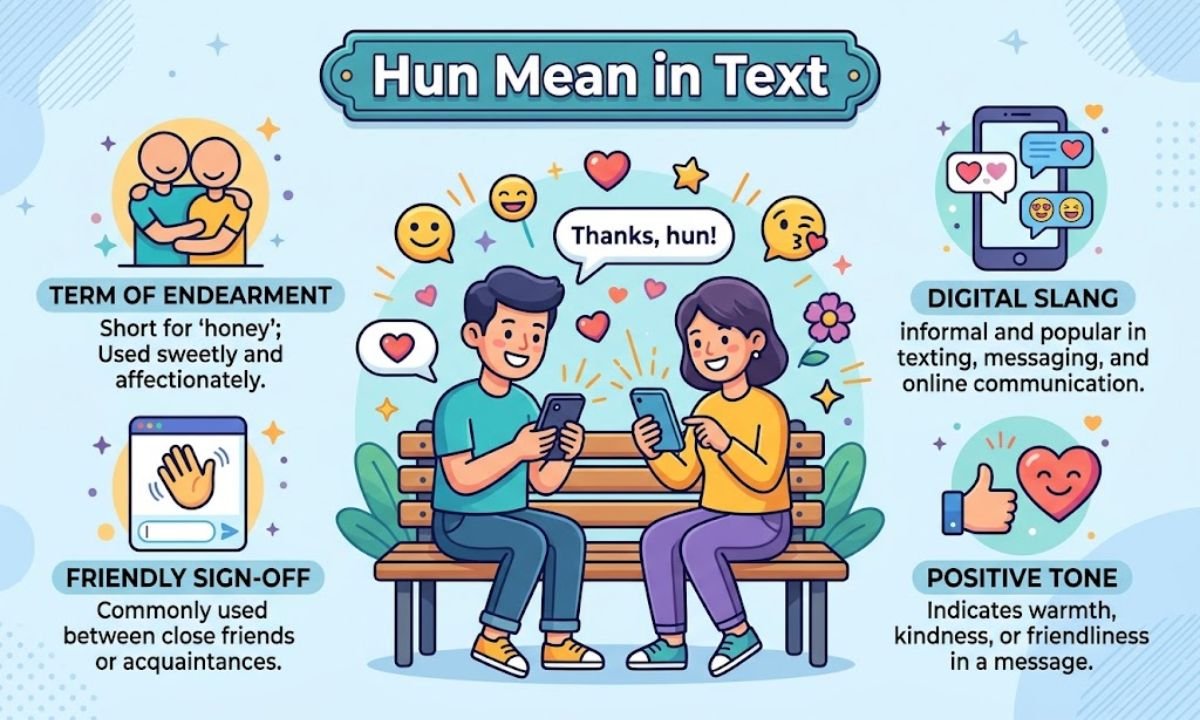

Hun is a short, friendly nickname for “honey.” The hun meaning in text is simple: the sender is being warm, caring, or casually affectionate. It can come from a partner, a close friend, a relative, or even a stranger who is just being polite.
The tone changes with the person and the moment. In this guide, you’ll learn what “hun” means, where it comes from, how to reply, and the rare cases where the word can be offensive.
Hun Meaning in Text – Quick Meaning
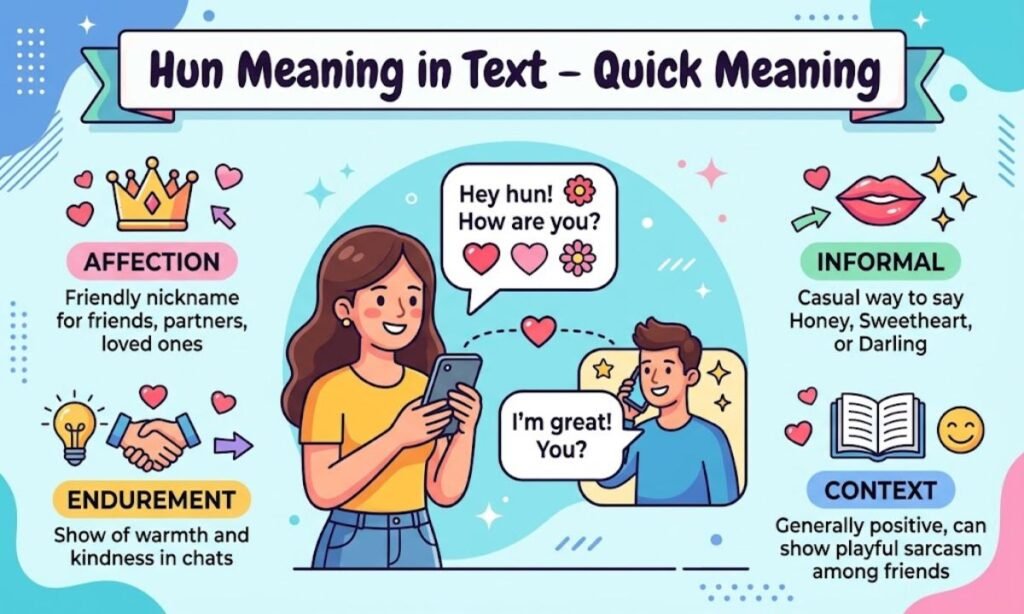
In texts and DMs, “hun” means honey. People use it as a pet name or a soft, friendly way to address someone. It is also a spelling of “hon,” which sounds the same.
Common meanings
- Romantic affection: A partner uses it like “babe” or “sweetheart.”
- Friendly warmth: Friends use it to sound kind and close, especially when comforting someone.
- Casual politeness: Customer service teams, neighbours, and acquaintances sometimes use it to sound approachable.
- Soft or sarcastic tone: A line like “Sure, hun” can sound patronizing if the context is tense.
- Offensive meaning (rare): In some places, “Hun” is a slur. This is covered in a later section.
Quick examples
- “Good luck with your exam, hun!” – kind and encouraging.
- “Miss you, hun.” – affectionate, usually between close people.
- “Thanks, hun, you’re a lifesaver.” – friendly gratitude.
- “Whatever you say, hun.” – possibly sarcastic or dismissive.
Origin & Background
“Hun” is a variant spelling of “hon,” which dictionaries record as a shortened form of “honey.” Dictionary.com dates “hon” to around 1905–10. “Honey” itself has been a loving nickname for a long time, because it suggests sweetness.
So the word is not a new internet invention. People simply typed out how “hon” sounds in everyday speech.
Evolution in digital communication
Texting rewards short words, and “hun” is quick to type. It spread through comment sections, group chats, and DMs, where people want to sound warm without writing much.
You’ll also see playful spellings like “hunny,” “hunni,” and “hunn.” They all carry the same basic meaning.
Real-Life Conversations
WhatsApp conversation
Sana: Did you reach home safely?
Mina: Yes, just got in. Thanks for asking, hun!
Sana: Anytime. Get some rest.
Here, “hun” shows care between friends.
Instagram DM conversation
Zoya: Your new reel is so good!
Hira: Aww thank you hun, that means a lot.
Zoya: You deserve it, hun!
It works as a friendly, supportive label between two people who may not be very close.
Text message conversation
Ali: Running late, sorry. Traffic is terrible.
Noor: It’s okay hun, take your time.
Ali: You’re the best.
In a relationship, “hun” adds calm and reassurance to a simple message.
Emotional & Psychological Meaning
Pet names signal closeness. When someone calls you “hun,” they are often saying, “I feel comfortable with you” or “I want to be kind to you.” That small word can make a message feel softer.
It can also lower the tension. Compare “Don’t worry about it” with “Don’t worry about it, hun.” The second line feels more caring.
But the same word can feel unwelcome. If the sender is a stranger, a rival, or someone you’re arguing with, “hun” may sound condescending. People can feel talked down to, or even disrespected.
The emotion behind the word depends on three things: your relationship, the tone of the chat, and what was said just before it.
Usage in Different Contexts
1. Social Media
On Instagram, Facebook, and TikTok, “hun” is common in comments and replies. People use it to compliment, comfort, or support others. It is usually friendly, but it can also be used sarcastically in arguments.
2. Friends & Relationships
Between friends, “hun” is a gentle way to show care. Between partners, it works like any pet name. How romantic it sounds depends on the relationship and the rest of the message.
3. Work or Professional Settings
At work, “hun” is risky. Many people find it too personal or patronizing when it comes from a manager, colleague, or client. For professional chats, it’s safer to use the person’s name.
4. Casual vs Serious Tone
“Hun” fits light, friendly chats. In serious or formal conversations, such as complaints, conflicts, or official emails, it can sound out of place or even insulting.
Common Misunderstandings
1. Assuming it’s always romantic
Many people read “hun” as flirting. But it is often just a friendly habit. Some people call everyone “hun,” and it means nothing more than “I’m being kind.”
2. Thinking it’s always polite
Kind words can be used unkindly. “Calm down, hun” or “Okay, hun” can sound dismissive. Look at the surrounding message before deciding how it was meant.
3. Using it with strangers
Calling someone you’ve just met “hun” can feel overly familiar. Some people won’t mind, but others may feel uncomfortable, especially in a professional or first-contact situation.
Comparison Table
The meaning of “hun” shifts a lot with context. This table shows how.
| Context | Likely Meaning | Tone | Safe to Use? |
| Partner to partner | Pet name, affection | Loving | Yes |
| Close friends | Warmth, support | Friendly | Yes |
| Casual social media comment | Kind or casual address | Light, polite | Usually |
| Customer service chat | Approachable address | Friendly, sometimes too familiar | Use with care |
| Heated argument | Sarcasm or condescension | Dismissive | No |
| Workplace | Over-familiar address | Can feel patronizing | Best avoided |
| Football and sectarian settings in Scotland | Offensive term | Insulting | No |
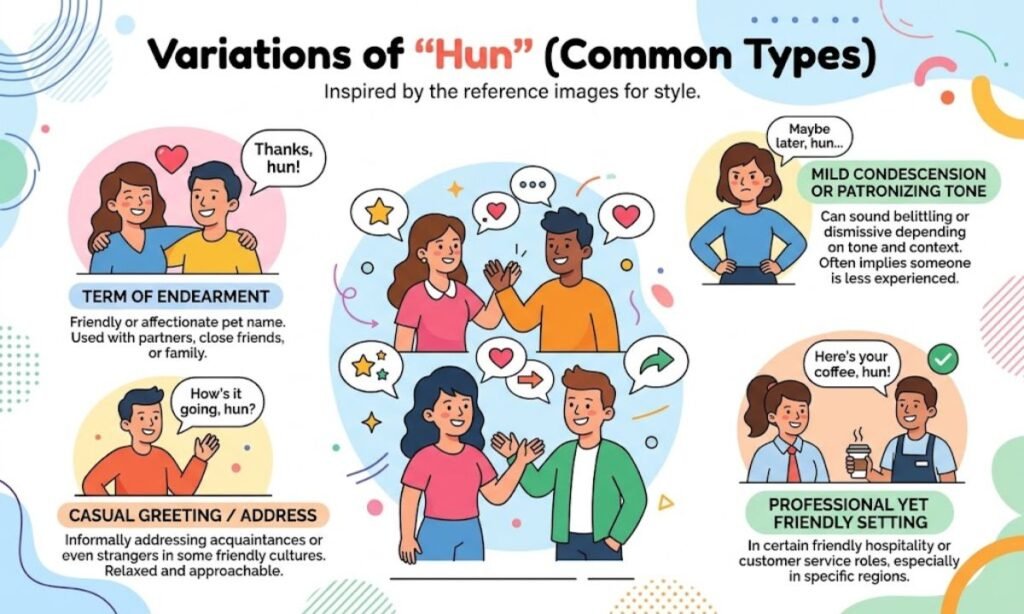
Variations of “Hun” (Common Types)
1. Hunny
A playful, cute spelling of “honey.” It tends to appear between partners or close friends.
2. Honey
The full form. It sounds warm and a bit more traditional than “hun.”
3. Hon
The same word as “hun” in a different spelling. It is often heard in casual speech, including from shop workers and waitstaff in the US.
4. Babe
Common between partners and close friends. It usually sounds more romantic or flirty than “hun.”
5. Sweetie
Gentle and caring. People often use it to comfort someone, including children.
6. Darling
A little more formal and old-fashioned. It can sound elegant or dramatic.
7. Love
Very common in British English, where strangers may say “alright, love” without any romantic meaning.
8. Dear
Polite and slightly formal. Older speakers often use it.
9. Bestie
Used only for close friends. It is about friendship, never romance.
10. Boo
A casual nickname for a partner or very close friend, popular in informal speech and texting.
How to Respond When Someone Uses “Hun”
Your reply depends on your relationship and how you feel about the word.
Casual replies
- “Thanks, hun!”
- “Hey you, how’s your day going?”
- “Aww, that’s sweet of you.”
Funny replies
- “Hun? Now I’m blushing.”
- “Careful, I might start charging for compliments.”
- “You called me hun, so you owe me coffee.”
Mature and confident replies
- “Thanks, I appreciate the kind words.”
- “I’m happy to help. What do you need?”
- “Good to hear from you.”
Private or respectful replies
If you’d rather not be called “hun,” you can say so politely:
- “I’d prefer if you use my name, thanks.”
- “I’m not comfortable with nicknames, but I appreciate the thought.”
You don’t have to explain more than that.
Regional & Cultural Usage
Western Culture
In the UK, Ireland, and parts of the US, “hun” and “hon” are everyday friendly words. They’re often used by women, but anyone can use them. Context matters: a waitress saying “hon” is usually just being friendly.
Asian Culture
In many Asian countries, “hun” shows up mainly in English-language chats and social media. In local languages, people use their own pet names, such as “jaan” in Hindi and Urdu or “jagiya” in Korean. In English chats, “hun” is usually read as a soft, friendly word.
Middle Eastern Culture
In Arabic, common endearments are “habibi” (to a male) and “habibti” (to a female). In English-language chats, “hun” is understood the same way as elsewhere. Still, in more conservative circles, a man calling an unrelated woman “hun” can feel too familiar, so it’s safer to be careful.
Global Internet Usage
Online, “hun” has become a common international way to sound friendly in comments, DMs, and group chats. People often pick it up from English-speaking social media. Because the tone is hard to read in text, it’s wise to check the context first.
hun meaning in text message
In a text message, “hun” is almost always an affectionate or friendly label. Because you can’t hear the voice, the tone comes from the words around it, the emojis, and the history between you and the sender.
A message like “Text me when you’re home, hun” reads as caring. But “Fine, hun” after an argument may be cold or sarcastic.
Hun meaning in text from a girl
When a girl texts you “hun,” it is most often a friendly or caring habit, not a sign of romantic interest. Many women use it freely with friends, family, and even acquaintances.
Look for other clues: how often she texts, whether she uses it with everyone, and whether the message feels personal. If she only calls you “hun” and the chats are long and warm, she may be more interested.
Hun meaning in English
In standard English, “hun” is an informal, affectionate address meaning “honey.” Dictionaries list the spelling “hon,” and “hun” is a common variant in writing.
The capitalized word Hun has a different meaning. It refers to a nomadic people who lived in Europe and Asia in the 5th century. In the past, “Hun” was also used by British speakers as an insulting word for Germans. Today, that use is considered dated and offensive.
Hun meaning in text from a guy
When a guy uses “hun,” it usually depends on how well you know him. From a partner, it’s a pet name. From a male friend, it can be a jokey or caring nickname.
From a man you hardly know, it can feel overly familiar or like flirting. If it makes you uncomfortable, you can ask him to stop.
Thanks hun meaning from a girl
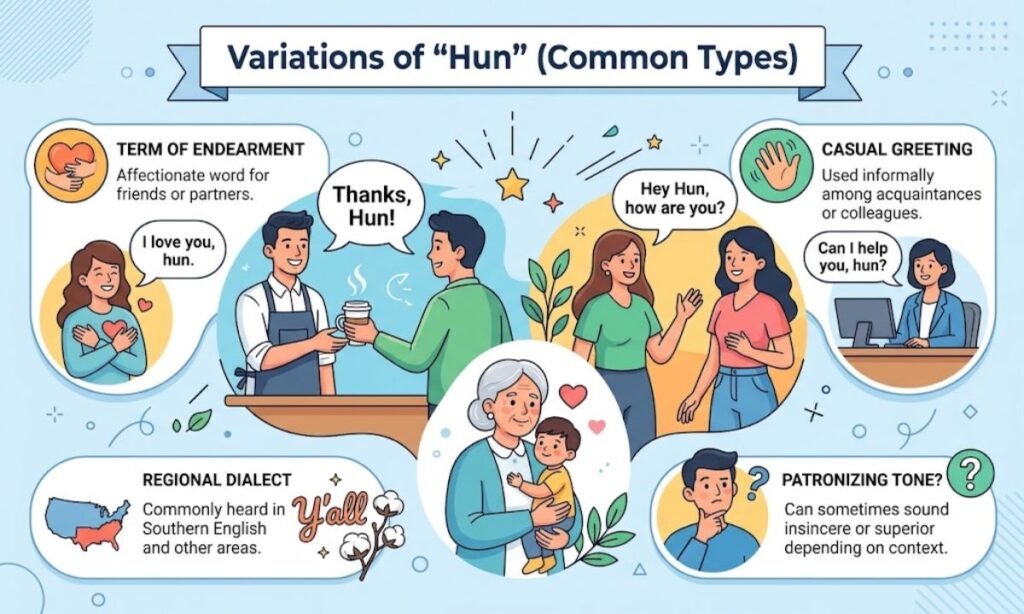
“Thanks hun” is a warm, casual way to say thank you. It usually means she’s grateful and friendly. It doesn’t automatically mean romantic interest.
Check the tone. After a favor or kind message, it’s sincere. After a disagreement, it may be a short, polite way to end the chat.
Hun meaning arabic
“Hun” is not an Arabic word of endearment. Arabic speakers who write it in English chats generally mean the same as English speakers: “honey.”
Don’t confuse it with the Arabic word “huna” (هنا), which means “here.” They look similar in transliteration but are unrelated. For a true Arabic equivalent, people say “habibi” or “habibti.”
Hun meaning slang Protestant
In Scotland, and in some contexts in Northern Ireland, “Hun” (usually capitalized) is a derogatory term. It is often directed at supporters of Rangers FC, and some use it as an insult for Protestants. The Scottish Government lists it among terms linked to sectarianism.
Scottish courts have discussed whether it counts as religious abuse. Even so, many people consider it offensive.
This is a completely different word from the loving “hun” in texting. If you’re in Scotland or Northern Ireland, avoid using “Hun” in football or religious settings. Also, if someone calls you this during an argument, it’s meant to insult.
Conclusion
“Hun” is a friendly short form of “honey.” Most of the time, it signals warmth, care, or casual affection, from partners, friends, or even polite strangers.
Tone is what matters. Context, relationship, and the words around it decide whether “hun” feels sweet, sarcastic, or too familiar. When in doubt, use someone’s name, and avoid the word in professional chats.
Frequently Asked Questions
What does “hun” mean in online chat slang?
In online chat slang, “hun” means “honey.” It is a friendly or affectionate way to address someone.
What is the common meaning of “hun” in casual conversation?
In casual conversation, “hun” is a warm, informal nickname used between friends, partners, or in polite small talk. It does not always mean romantic interest.
How do companies use “hun” as a nickname in marketing?
Some brands and social media teams use warm nicknames like “hun” in casual replies to sound friendly and relatable. It can backfire if customers find it too familiar, so many companies prefer to use names instead.
Is hun flirty?
It can be, but not always. Many people use it as a friendly habit, so check the tone and the relationship.
Can I call my boss or coworker hun?
It’s best not to. Many people see it as too personal or patronizing in the workplace, so use their name.
Is hun the same as hon?
Yes. “Hun” and “hon” are two spellings of the same word, both short for “honey.”
Can hun be sarcastic?
Yes. In arguments or tense chats, a phrase like “Sure, hun” can sound dismissive or condescending.
Why do some people write hunny or hunni?
These are playful spelling variants of “hun” and “honey.” They mean the same thing and usually sound cute or casual.
Is hun a bad word?
The texting word “hun” is not bad. However, the capitalized “Hun” can be an offensive term in Scotland and was once used as an insult for Germans.

I am a dedicated author with 6+ years of experience writing and researching content for name meaning websites. My expertise includes American names, baby names, surnames, name origins, and cultural significance. I focus on creating accurate, well researched, and easy to read articles using trusted sources. My goal is to help readers discover the history, meaning, and uniqueness behind every name with reliable and engaging content.