
Seen “ide” in a chat and had no idea what it meant? You are not alone. Many people search for the IDE meaning in text slang right after spotting it in a DM or a comment.
Here is the honest answer. IDE is not a standard slang acronym like IDK or TBH. It usually appears as a typo, a rushed spelling, or a tech term.
This guide covers every likely meaning, real chat examples, and smart ways to reply. By the end, you will know exactly what the sender meant.
IDE Meaning in Text Slang – Quick Meaning
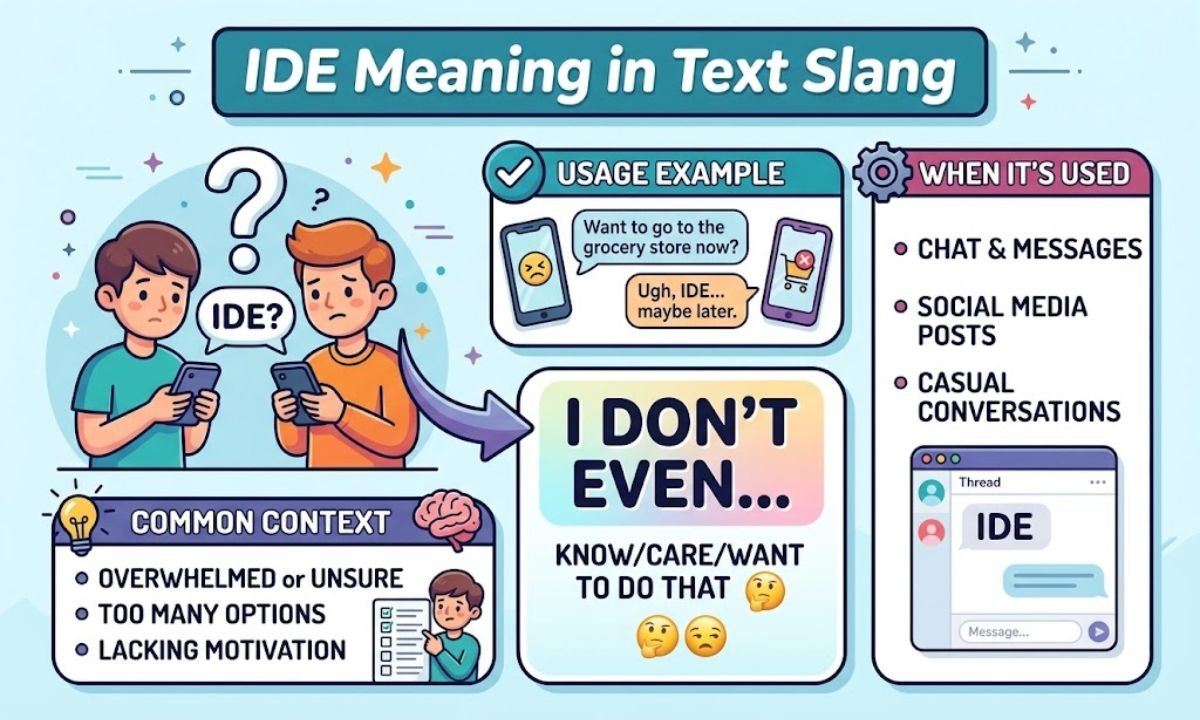
In text slang, IDE has no single official meaning. Most of the time it is a typo or a quick version of “IDK” (I don’t know) or “IDEK” (I don’t even know).
It can also be a clipped “idea” or a missing apostrophe in “I’d” (I would or I had). Outside chat, IDE means Integrated Development Environment, the software programmers use to write code.
Here is the quick breakdown:
- Most likely in chat: a typo of IDK or IDEK
- Also possible: short for “idea,” or “I’d” typed without the apostrophe
- In tech talk: Integrated Development Environment
- In other languages: a real word, such as “ide” in Indonesian (idea) or Croatian (goes)
Simple examples
- “Ide what to cook tonight” → “IDK what to cook tonight”
- “Ide go if you go” → “I’d go if you go”
- “That’s a great ide” → “That’s a great idea”
- “Opened the project in my IDE” → the coding tool
The sentence around the word almost always gives the answer. Read the whole message before you guess.
Origin & Background of IDE in Slang
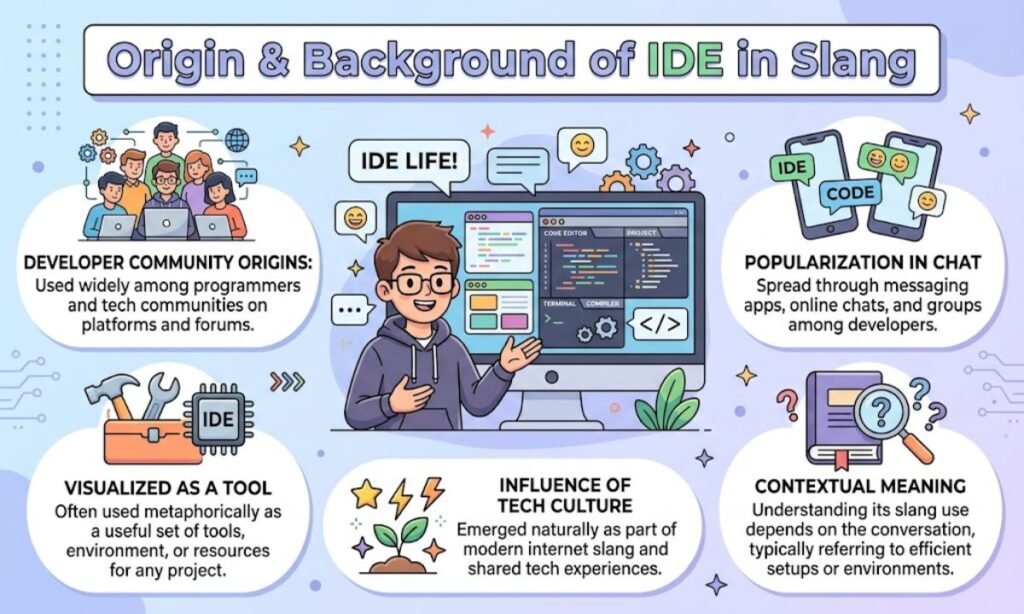
There is no recorded origin story for IDE as a slang term. It did not spread through a viral video or a famous meme, as far as anyone can verify.
Instead, it looks like a by-product of fast typing. The letters I, D, and E sit close to the usual starting letters of “I don’t even know,” so slips happen easily.
The technical meaning is much older. Programmers have used the term IDE for decades to describe tools that bundle a code editor, a debugger, and build features in one window.
Why abbreviations became popular
Early mobile phones charged by the message and limited text length. People trimmed words to fit, and habits stuck.
Later, speed took over. Typing “idk” is quicker than typing “I don’t know,” and it sounds relaxed.
Real-Life Conversations Using IDE
These sample chats show how “ide” might appear. They are written examples, not quotes from real users.
1. WhatsApp Chat
Sara: Where should we eat after class?
Ali: Ide, you pick
Sara: Okay, pizza then 🍕
Here, “ide” is a quick form of “IDK.” Ali is leaving the choice to Sara.
2. Instagram DM Conversation
Maya: Did you see his story?
Zoya: Yeah, ide why he posted that
Maya: Same, so random
Zoya means “IDEK why he posted that.” She is confused, not angry.
3. TikTok Comment Section
Comment: Why is this song everywhere now?
Reply: ide but I can’t stop replaying it
The reply reads as “IDK.” Comment threads are fast, so typos pass without notice.
4. Text Message Example
Dev: Should I take the job offer?
Sam: Ide take it if the pay is good
This one is different. Sam likely meant “I’d take it,” with the apostrophe skipped.
Emotional & Psychological Meaning
When “ide” stands in for IDK or IDEK, the feeling behind it is uncertainty. The sender is unsure, a little confused, or simply has no strong opinion.
It also lowers pressure. Saying “ide” sounds lighter than “I really don’t know,” so the chat stays easy.
Tone matters here. A cheerful “ide lol” is very different from a flat “ide.”
Why people relate to it
Everyone has been stuck on a question they could not answer. A short, casual word makes that moment feel normal.
It also shows honesty without drama. You admit you are unsure and move on.
Usage in Different Contexts
Because IDE is not an official abbreviation, where you use it matters a lot. The same word can read as friendly, confusing, or careless.
1. Social Media
On social platforms, short and messy replies are normal. A typo like “ide” in a comment rarely gets a second look.
2. Friends & Relationships
Between close friends, “ide” can pass as relaxed shorthand. Your friends know your style and will read it correctly.
In a romantic chat, vague replies can cause worry. If your partner asks something important, a full sentence feels more caring.
3. Work or Professional Settings
Avoid slang in most workplace messages. Even common ones like IDK can seem casual in formal emails.
In tech teams, IDE is a normal and respected word. There it only means the coding environment.
4. Casual vs Serious Tone
Casual tone is where “ide” fits best. Think quick banter, group chats, and low-stakes questions.
For serious talks, such as health, money, or feelings, write the full sentence. Short slang can feel dismissive when the topic is heavy.
Common Misunderstandings
A rare term invites guessing. These are the mix-ups that happen most.
Misunderstanding 1: Thinking it’s a typo
Often it is a typo, but not always. In some languages, “ide” is a normal word.
Indonesian speakers use “ide” for “idea.” In Croatian, Serbian, and Bosnian, it means “goes,” and in Hungarian it can mean “here” or “to here.”
So if the sender chats in more than one language, the word may be perfectly correct.
Misunderstanding 2: Confusing it with technical terms
Not every “ide” is about code. If nobody is talking about software, the coding meaning probably does not apply.
Misunderstanding 3: Using it too formally
Some people try “ide” in emails or school work. This backfires because most readers will not recognize it.
Stick to “I don’t know” in formal writing. Save the short versions for friends.
Comparison Table
This table shows the main meanings of “ide” side by side.
| Meaning | Where You See It | Example | Confidence |
| IDK / IDEK (typo) | Chats, comments, DMs | “Ide what to watch” | Most common |
| I’d (missing apostrophe) | Texts, replies | “Ide say yes” | Common |
| Idea (shortened) | Casual chat | “Good ide” | Occasional |
| Integrated Development Environment | Tech, coding forums | “Open it in your IDE” | Very common in tech |
| Real word in another language | Multilingual chats | “Ide” (Indonesian: idea) | Depends on the sender |
Variations and Related Expressions
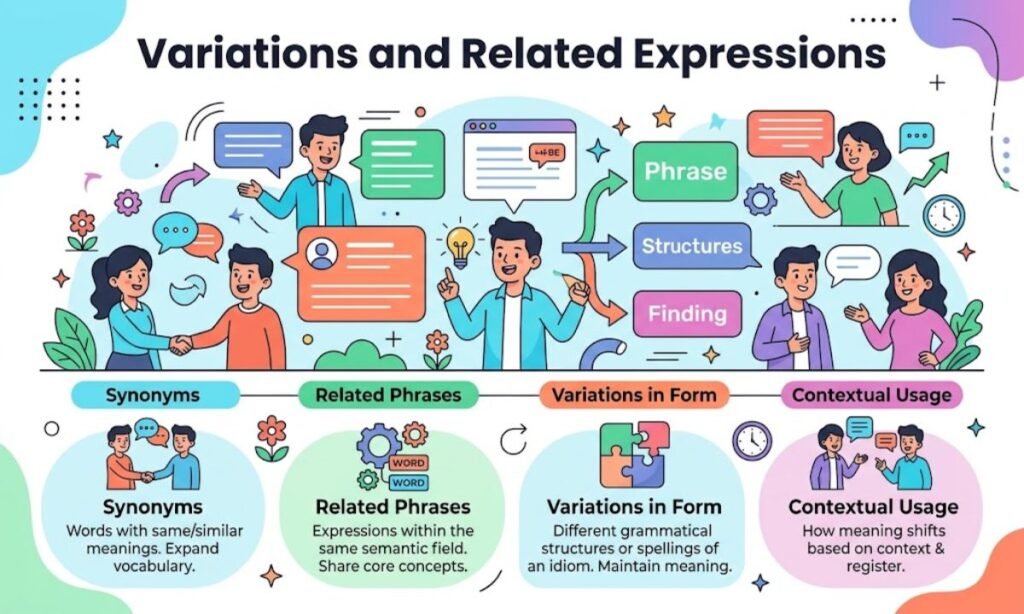
If you want a proper abbreviation, these are the real ones people use. Each is widely understood.
1. IDEK
IDEK means “I don’t even know.” It shows stronger confusion than IDK.
Example: “idek how I passed that test.”
2. IDTS
IDTS means “I don’t think so.” It is a polite, soft way to disagree.
Example: “Will it rain today?” “idts, looks clear.”
3. SMH
SMH means “shaking my head.” People use it when something is disappointing or silly.
Example: “He forgot again, smh.”
4. ICYMI
ICYMI means “in case you missed it.” Creators and brands use it to repost older updates.
Example: “ICYMI, our new video is live.”
5. TBH
TBH means “to be honest.” It introduces an honest opinion.
Example: “tbh I liked the first one more.”
6. FWIW
FWIW means “for what it’s worth.” It softens advice or an opinion.
Example: “fwiw, I would wait a week.”
7. IDK
IDK means “I don’t know.” It is the most common version of the idea behind “ide.”
Example: “idk, maybe tomorrow?”
8. IDC
IDC means “I don’t care.” Be careful, as it can sound cold.
Example: “idc, pick any movie.”
9. IYKYK
IYKYK means “if you know, you know.” It points to an inside joke.
Example: “That cafe on 5th Street, iykyk.”
10. SMFH
SMFH is a stronger form of SMH. It shows more frustration.
Example: “He did it again, smfh.”
How to Respond When Someone Uses IDE
Your reply depends on what you think they meant. If you are unsure, ask a short question.
Casual Replies
- “Haha, did you mean IDK?”
- “No worries, we can decide later.”
- “Okay, I’ll pick then.”
Funny Replies
- “Ide? Is that a new language?”
- “Is that IDK or an IDE for your brain?”
Mature or Supportive Replies
If the sender seems stressed, be kind first.
- “It’s okay not to know. Want to talk it through?”
- “No pressure. Take your time.”
- “I’m here if you want to figure it out together.”
Private or Respectful Replies
When the topic is personal, keep your answer calm and short.
- “Thanks for being honest with me.”
- “We can talk about it whenever you’re ready.”
Regional & Cultural Usage
Slang changes with language and culture. “Ide” is a good example because it looks like a typo in one place and a real word in another.
Western Culture
In the US, UK, and Canada, most readers will see “ide” as a typo for IDK or “I’d.” In tech circles, they will think of coding software.
Asian Culture
Many Asian users chat in romanized scripts. In Indonesian, “ide” simply means “idea.”
Middle Eastern Culture
Chats often mix Arabic, Persian, Urdu, and English. In Persian, the word for idea is pronounced “ide,” so it may appear in Latin letters.
Global Internet Usage
Online, “ide” has no fixed global meaning. Its meaning depends on the language, the platform, and the person typing.
ide meaning in text slang tiktok
On TikTok, “ide” has no special trending meaning that can be verified. It shows up the same way it does elsewhere, as a typo of IDK or “I’d.” In a tech tutorial, it means the coding tool.
IDR meaning in text slang
IDR means “I don’t remember.” People use it when they cannot recall a detail.
It is easy to confuse with “ide” because both start with the same letters. Example: “idr what time the class starts.”
Ide meaning in text slang urban dictionary
Crowd-written dictionaries do not show one clear, widely accepted slang entry for “ide.” Entries on such sites can also change at any time.
If you see a definition there, treat it as a user opinion. Check it against the chat context before trusting it.
What does ide mean in instagram
On Instagram, “ide” in a DM or comment most likely means IDK or “I’d.” Captions and replies are informal, so typos are common. If unsure, ask the sender what they meant.
IDE meaning coding
In coding, IDE stands for Integrated Development Environment. It is a program that combines a code editor, a debugger, and build tools in one place.
Popular examples include Visual Studio, IntelliJ IDEA, Eclipse, and Android Studio. Developers use them to write and test software faster.
What does IDE mean on snapchat
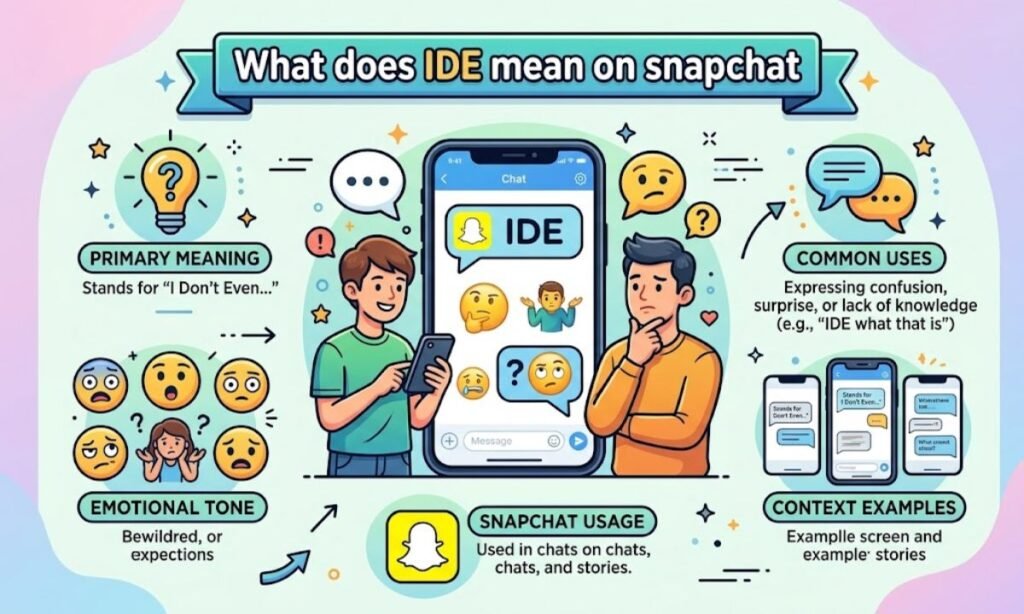
Snapchat has no official slang meaning for IDE. Snaps and chats are quick, so people typically type “ide” by mistake.
Treat it as IDK unless the context clearly points to something else.
IDE acronym
As an acronym, IDE has a few established meanings. Which one fits depends on the field.
- Integrated Development Environment: software for programmers
- Integrated Drive Electronics: an older hard drive connection standard
- Insulin-degrading enzyme: a term in biology and medicine
None of these are chat slang, which is why context matters so much.
Conclusion
IDE is not a true text slang acronym. In most chats, it is a quick typo for IDK, IDEK, or “I’d,” and in tech talk it means Integrated Development Environment.
Read the message around it, think about who sent it, and ask if you are unsure. A short, friendly question clears things up fast.
When you write it yourself, choose the real abbreviation or the full sentence. Clear words always win.
Frequently Asked Questions
What does “ide” mean in text slang on social media platforms?
It is usually a typo of IDK or “I’d,” not an official abbreviation. Tech posts use IDE for coding software.
What does “ide” mean when someone texts it?
Most often the sender meant “I don’t know” or “I’d.” Check the sentence around it.
Can you show examples of brands using “ide” in their digital marketing or social media?
No well-known brand campaign uses “ide” as slang. Tech companies use IDE for developer tools.
Is “ide” a widely recognized internet abbreviation?
No. Unlike IDK or TBH, most people do not recognize it as slang.
What does IDE mean in a text message?
It is usually a typo for IDK or “I’d.” If the chat is about code, it means Integrated Development Environment.
Is IDE the same as IDK?
Not officially. People often type “ide” when they mean IDK, but IDK is the real abbreviation.
How do I reply when someone texts me IDE?
Ask a short question like “Did you mean IDK?” Then answer based on what they say.

I am a dedicated author with 6+ years of experience writing and researching content for name meaning websites. My expertise includes American names, baby names, surnames, name origins, and cultural significance. I focus on creating accurate, well researched, and easy to read articles using trusted sources. My goal is to help readers discover the history, meaning, and uniqueness behind every name with reliable and engaging content.