

Anger that gets swallowed instead of spoken doesn’t disappear. It sits, it feeds, and eventually it grows into something with roots of its own. That’s the exact idea behind one of tattoo culture’s most literary and emotionally loaded designs: the poison tree tattoo.
Rooted in an 18th-century poem but reborn again and again in modern ink, this symbol has quietly become a favorite among people who want body art that says something real about the human condition.
This guide breaks down where the design comes from, what it actually means, who wears it, and how to choose a version that fits your own story.
The Origins: William Blake’s “A Poison Tree” (1794)
The poison tree tattoo traces directly back to English poet William Blake, who published A Poison Tree in 1794 as part of his collection Songs of Experience.
The poem is closely associated with how suppressed anger and unspoken emotions can develop into something harmful over time.
The poem’s story is simple but unsettling. The speaker gets angry at a friend, talks it through, and the anger fades. Then he gets angry at an enemy, says nothing, and instead lets the feeling grow in secret.
He waters it with fear, tends it with false smiles, and it eventually blossoms into a tree bearing a single, tempting apple. His enemy sneaks into the garden at night, eats the fruit, and dies.
Blake wasn’t writing a horror story. He was writing about what happens inside a person who refuses to say “I’m angry with you” out loud. The tree is never really a tree — it’s resentment given a body.
That’s the layer tattoo collectors are drawn to: a two-century-old poem that still describes exactly how modern grudges behave.
Poison Tree Tattoo Meaning: Core Symbolism
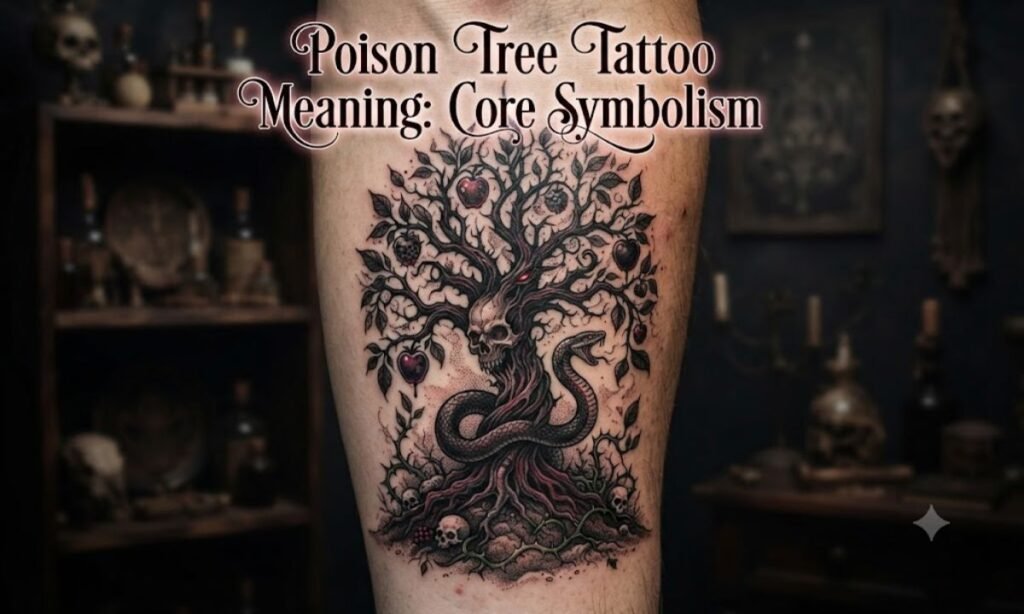
At its core, the poison tree tattoo meaning centers on one idea — emotion that grows stronger the longer it’s hidden. Depending on the wearer, that can shift into several related themes:
- Suppressed anger — feelings that were never spoken and instead took root internally
- Toxic relationships — a reminder of a connection that quietly poisoned itself over time
- Emotional honesty — a personal vow to stop bottling things up
- Betrayal and consequence — the idea that silence and dishonesty eventually produce fallout
- Survival and self-awareness — proof that someone recognized their own shadow side and came out the other end
Unlike a lot of tattoo symbols with one fixed meaning, this one is genuinely flexible. Two people can get nearly identical artwork and mean two very different things by it — one marking a painful chapter they survived, another marking a warning to their future self about letting resentment fester.
Who Gets a Poison Tree Tattoo — and Why
This design tends to attract a specific kind of collector: people who process life through metaphor rather than literal imagery. A few common reasons people choose it include:
- Literary lovers who want a tribute to Blake’s poem specifically, sometimes paired with a line from the text
- People healing from toxic relationships, using the tree as a marker of what they walked away from
- Those confronting their own anger issues, choosing the tattoo as a daily reminder to communicate instead of suppress
- Writers, artists, and introspective personalities drawn to the poem’s psychological depth
- Survivors of betrayal, who see the “poisoned fruit” as a symbol of consequences finally catching up
It’s worth noting this isn’t a purely “dark” tattoo in the wearer’s mind. Most people describe it as reflective rather than negative — less “I am poison” and more “I understand how poison forms.”
Popular Design Variations
Artists have taken Blake’s central image in a lot of visual directions. Here’s how the most requested styles compare.
| Style | Visual Approach | Best For |
| Black and Grey Gothic | Heavy shading, twisted bark, dramatic contrast | Wearers who want a darker, more intense look |
| Blake-Inspired Illustration | Etching-style linework echoing 18th-century book art | Literary tattoo fans, poem purists |
| Half-Dead, Half-Living Tree | One side barren, one side blooming | People marking transformation or recovery |
| Serpent and Fruit Motif | A snake coiled around the trunk near the apple | Those emphasizing temptation and deceit |
| Heartfruit Design | The apple replaced or overlaid with a heart shape | Tattoos tied to heartbreak or toxic love |
| Minimalist Line Art | Single continuous line, no shading | First tattoos, subtle placements, modern aesthetic |
| Watercolor Style | Soft color bleeds behind black linework | Wearers who want emotion over darkness |
Black and Grey Gothic Style
This is the most traditional take — thick roots, gnarled branches, and heavy shadow work that makes the tree look genuinely menacing. It leans into the poem’s darker undertones and suits larger canvases like the forearm, thigh, or back.
Blake-Inspired Illustration
Designed to look like it was lifted straight from a 1790s engraving, this style often includes fine crosshatching and sometimes a fragment of the poem’s text curling around the branches.
Half-Dead, Half-Living Tree
One of the most requested variations in 2026. Half the tree is cracked and lifeless; the other half is green and thriving. It’s a visual metaphor for growth after emotional damage — arguably the most hopeful version of this design.
Serpent and Fruit Motif
Adding a snake pulls in Garden of Eden symbolism, layering betrayal and temptation on top of Blake’s original meaning. It’s popular with wearers who want the piece to feel mythic rather than purely literary.
Heartfruit Design
Swapping the apple for a heart (or blending the two) shifts the focus toward romantic betrayal specifically, rather than anger in general.
Minimalist Line Art
A stripped-down, single-line tree with no shading. Popular for smaller placements like the forearm, ankle, or ribs, and for people who want the meaning without an overtly dark visual.
Watercolor Style
Soft blues, purples, or greens bleeding behind a black outline. This softens the poem’s grim ending and reframes the tattoo as more about growth and release than punishment.
Color Meanings in Poison Tree Tattoos
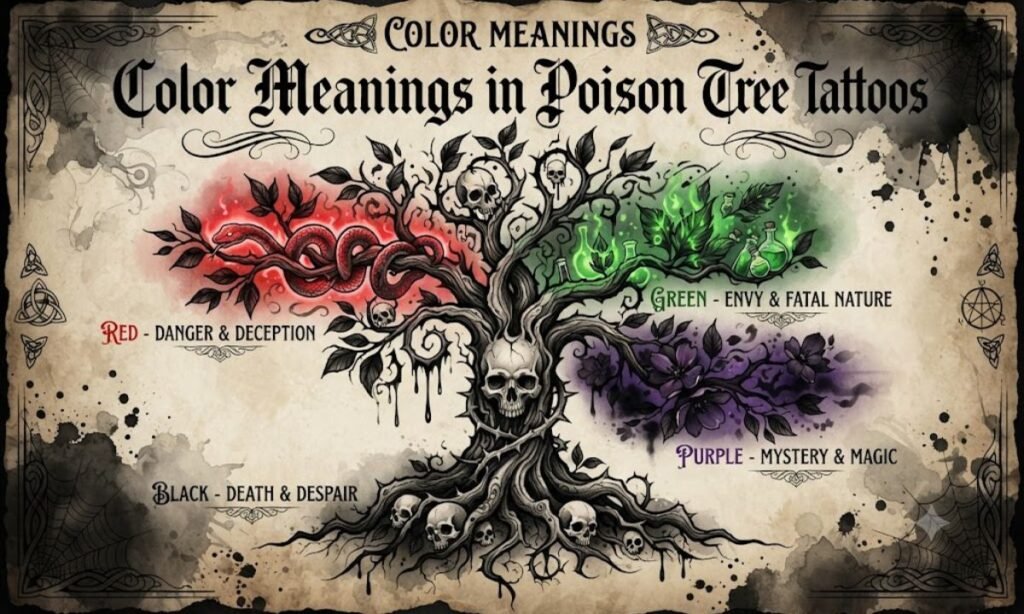
Color choice quietly changes the tone of the whole piece. Here’s how wearers typically use it:
| Color | Common Meaning |
| Black and grey | Classic, grief-heavy, emphasizes the “hidden” or “buried” nature of the emotion |
| Deep red | Anger, passion, unresolved conflict |
| Green | Growth, healing, life continuing after pain |
| Purple | Introspection, mystery, emotional complexity |
| Gold/yellow (on the apple) | Temptation, false beauty, the “deceitful fruit” |
| Blue-grey watercolor | Sadness processed calmly, distance from the original pain |
Many wearers deliberately mix a “dead” color palette on one side of the tree with a livelier one on the other, echoing the half-dead, half-living design concept.
Best Placement Options for a Poison Tree Tattoo
Because this design usually includes a full trunk, branches, and roots, placement matters more than with simpler tattoos.
- Forearm — great visibility, works well with vertical tree shapes
- Back/shoulder blade — ideal for large, detailed versions with full branch spread
- Thigh — plenty of space for gothic or illustrative styles
- Ribs — a more private placement, popular for personal, meaningful pieces
- Calf — allows the roots to wrap naturally around the leg
- Upper arm/sleeve piece — works well when combined with other nature or literary elements
Smaller, minimalist versions also do well on the wrist, ankle, or behind the ear for wearers who want something quieter.
Psychological Dimension: Why This Symbol Resonates So Deeply
Part of the reason this tattoo has stuck around for decades is that it captures something almost everyone has felt: the moment you choose silence over confrontation, and watch that choice quietly grow teeth.
Psychologically, suppressed anger doesn’t vanish — it gets stored, and often resurfaces as resentment, anxiety, or passive aggression. Blake described that pattern in verse over 200 years before modern psychology gave it a name.
Wearing the poison tree isn’t necessarily about celebrating that cycle; for most people, it’s about naming it so it loses some of its power.
That’s also why the tattoo appeals across such different life stages — teenagers processing first heartbreaks, adults marking the end of toxic relationships, and older wearers reflecting on decades-old grudges they’ve finally let go of.
Common Search Variations, Explained
People land on this topic through a lot of different phrasings. Here’s a quick breakdown of what they’re usually asking:
| Search Phrase | What It’s Really Asking |
| “of life poison tree tattoo meaning” | How it compares to a “tree of life” tattoo (different symbol — tree of life represents growth and connection, not hidden anger) |
| “poison tree tattoo meaning bible” | Whether it connects to the Garden of Eden — it can, especially in serpent-and-fruit designs, though its direct origin is Blake’s poem, not scripture |
| “poison tree tattoo meaning woman / for guys” | The meaning doesn’t change by gender — it’s about the wearer’s personal relationship to anger and healing |
| “poison tree tattoo meaning strength” | Increasingly common interpretation — surviving what the tree represents, rather than being consumed by it |
| “poison tree tattoo meaning reddit” | Tattoo communities online tend to echo the Blake connection and frequently discuss the half-dead/half-living variation as the most popular healing-focused take |
| “poison tree tattoo meaning in spanish” | Sometimes rendered as árbol venenoso, though most wearers keep the English title as a nod to Blake’s original text |
| “poison tree tattoo meaning urban dictionary” | Slang definitions online tend to flatten it to “hidden hate,” missing the poem’s deeper theme of emotional consequence |
Conclusion
The poison tree tattoo endures because it’s honest about something most symbols try to soften. It doesn’t dress anger up as strength or hide resentment behind pretty imagery — it shows exactly what happens when either one is left to grow in the dark.
Whether you’re drawn to it for its literary roots, its warning about toxic relationships, or its quieter message about healing, it’s a design built to mean something different to every person who wears it.
Choose the version — gothic, minimalist, half-living, or watercolor — that matches where you actually are in your own story, not just where the poem ends.
Frequently Asked Questions
What Is a Poison Tree Tattoo?
It’s a tattoo design based on William Blake’s 1794 poem A Poison Tree, typically showing a twisted tree bearing a single piece of fruit, symbolizing hidden anger that grows when left unspoken.
What is the symbolism behind a poison tree tattoo?
It represents suppressed emotion — usually anger or resentment — that intensifies the longer it’s hidden, along with themes of betrayal, toxic relationships, and emotional self-awareness.
Where can I find artists who specialize in poison tree tattoo designs near me?
Search local tattoo studios’ Instagram or portfolio pages for “botanical,” “illustrative,” or “dark surrealism” tags, since these artists most often handle detailed tree and nature-based pieces well.
Which tattoo studios have the best reviews for poison tree tattoos?
This varies heavily by city, so check Google Reviews and Instagram tags for studios specializing in fine-line botanical or gothic illustrative work, and always review an artist’s healed (not just fresh) tree tattoo photos before booking.
How much does a poison tree tattoo typically cost in major U.S. cities?
Small minimalist versions often start around $100–$250, while detailed gothic or full-color pieces on larger areas like the back or thigh can range from $400–$1,200+, depending on the city and artist’s experience level.

I am a dedicated author with 6+ years of experience writing and researching content for name meaning websites. My expertise includes American names, baby names, surnames, name origins, and cultural significance. I focus on creating accurate, well researched, and easy to read articles using trusted sources. My goal is to help readers discover the history, meaning, and uniqueness behind every name with reliable and engaging content.