
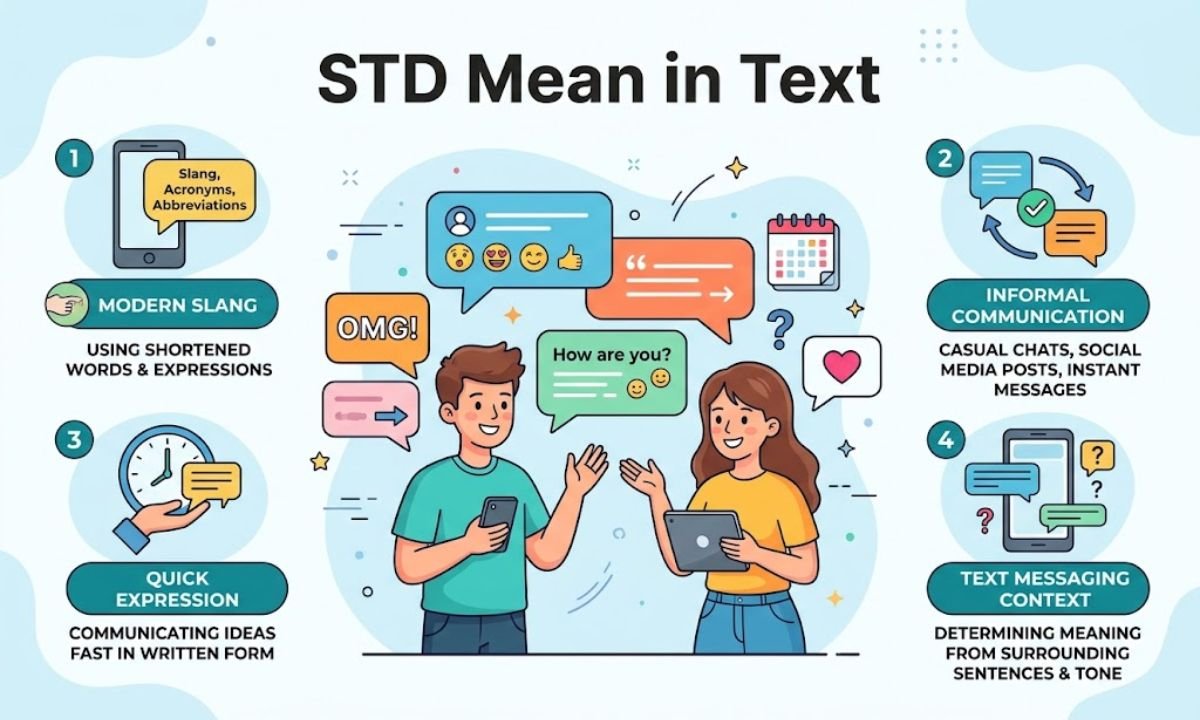

If you are wondering what STD means in a text, the answer is almost always sexually transmitted disease. People type it when they talk about sexual health, testing, or awareness.
That said, STD can mean other things depending on who is typing. A student may mean standard deviation, a traveler may mean scheduled time of departure, and someone in India may mean a phone area code. This guide covers the main meaning, how people use it in chats, and how to reply when someone brings it up.
STD Meaning in Text – Quick Definition
Simple Definition
STD stands for sexually transmitted disease. In a text message, it refers to an infection that spreads mainly through sexual contact. Common examples include chlamydia, gonorrhea, herpes, hepatitis, HIV and HPV.
People say it letter by letter: “S-T-D.” It is a health term, not a joke word, so the tone around it is usually serious.
Example Usage
Here are a few simple ways the term shows up in messages:
- “I booked an STD test for Monday. Just a routine check.”
- “The clinic is offering free STD screening this week.”
- “Our health teacher spent the whole class on STD prevention.”
- “Got my results back. No STD, all clear.”
Origin and Background of the Term STD
Evolution of the Term
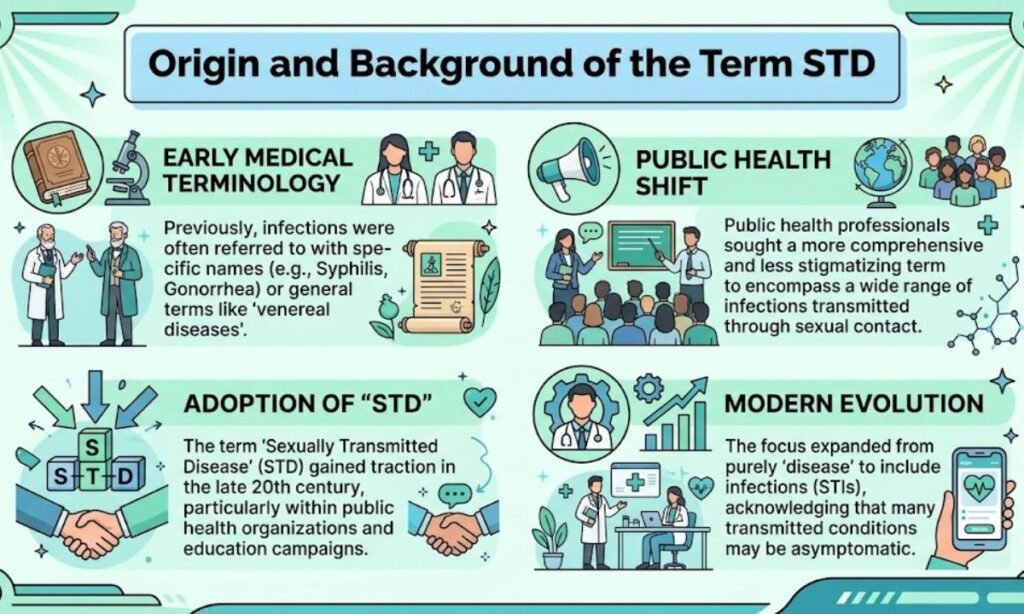
Older medical language used the phrase “venereal disease.” Over time, public health writing moved to “sexually transmitted disease,” which is where the abbreviation STD comes from.
More recently, many doctors and health organizations prefer STI, short for sexually transmitted infection. Their reasoning is that many infections cause no symptoms, so “disease” can sound inaccurate. “Infection” is also seen as less stigmatizing.
Internet Influence
Texting and social media love short forms, and STD is quick to type. It appears in health posts, group chats, school discussions, and DMs about clinic visits.
Online, the same three letters also spread into other fields. Programmers and statisticians type “std” for standard or standard deviation, which is why context matters so much in a chat.
Real-Life Conversations Using STD in Text
The sample chats below show how the term appears in everyday messages.
WhatsApp Conversation
Sara: Can I tell you something personal?
Mina: Of course. What’s up?
Sara: I went for an STD test yesterday. Just a routine checkup.
Mina: Thanks for trusting me with that. Proud of you for getting checked.
Sara: Results come Thursday. A bit nervous.
Mina: That’s normal. Want me to come with you?
Instagram DM Conversation
Zain: Saw your story about the community health day. Do they do STD screening too?
Hira: Yes, it was on the list along with counseling.
Zain: Good to know. I’ll send it to my cousin.
Hira: Nice. Tell him to check the timings first.
Text Message Conversation
Omar: My lab sheet says STD 2.4. Is that bad??
Ali: Relax, that’s standard deviation, not the disease. Stats class, remember?
Omar: Oh, thank goodness. Why would they write it like that?
Ali: Short forms. Always check the context.
Emotional and Psychological Meaning
STD is a small abbreviation that can carry a lot of feeling. A message that uses it might come with worry, embarrassment, relief, or trust.
When someone brings it up in a chat, they are often sharing something private. How you respond can make them feel safe or judged.
Why People Care About the Topic
- Stigma: Many people still feel shame around sexual health, even though these infections are common.
- Uncertainty: Some infections show no symptoms, so people can feel anxious until they get tested.
- Health: Untreated infections can lead to serious problems, so the topic feels important.
- Relationships: Talking about testing involves honesty and trust between partners.
- Privacy: People want to control who knows about their health.
Usage in Different Contexts
Social Media
On public platforms, STD usually appears in awareness posts, health tips, and discussions about education. Memes sometimes use it too, but jokes can land badly with people who have personal experience.
Friends and Relationships
Between close friends or partners, the term often comes up around testing, results, or a clinic visit. These messages tend to be sincere and private, and the best replies are calm and kind.
Work or Professional Settings
At work, the term is rare and usually formal. A health professional may use it in clinical writing. An HR or benefits document may use STD to mean short-term disability, which is a different thing entirely.
Casual vs Serious Tone
Casual use is common in group chats, but the topic is personal for many people. If someone writes in a serious tone, match it. When in doubt, stay respectful and skip the jokes.
Common Misunderstandings
Misunderstanding 1: Assuming It’s Slang
STD is not slang. It is a standard medical abbreviation used by doctors, schools, and health departments. People may use it casually in texts, but the term itself is formal.
Misunderstanding 2: Confusing STD With STI
The two terms are closely linked and often used as if they mean the same thing. Strictly speaking, an STI is the infection, and an STD is what it is called once it causes symptoms or damage. Health bodies such as the CDC use both terms.
Misunderstanding 3: Thinking It Always Means Something Negative
A message with STD in it does not always bring bad news. The sender may be talking about a routine test, a clear result, an awareness event, or a school lesson. In some chats, it is not about health at all.
When It Should Not Be Used
Avoid the term in these situations:
- As a joke or insult aimed at a person
- In public posts or gossip about someone’s health
- In professional emails where another meaning, such as short-term disability, could confuse the reader
- In formal writing without spelling it out the first time
Comparison Table
| Term | Full Form | Where It Appears | Example |
| STD | Sexually transmitted disease | Health chats, clinics, schools | “She booked an STD test.” |
| STI | Sexually transmitted infection | Medical advice, newer health writing | “Regular STI screening is advised.” |
| STD | Standard deviation | Statistics, science, spreadsheets, code | “The STD of this data is 2.4.” |
| STD / Std | Standard | Labels, forms, product sizes | “Std size, no extras.” |
| STD | Scheduled time of departure | Flight schedules, logistics | “STD 14:45, delayed.” |
| STD | Short-term disability | HR, insurance, benefits | “She is on STD leave.” |
| STD | Subscriber Trunk Dialling | Phone codes in India | “Add the STD code before the number.” |
Variations and Related Terms
1. STD Test
A lab test that checks for sexually transmitted infections. It usually involves a urine sample, a blood sample, or a swab, depending on what is being checked.
2. STD Screening
Testing done on people who may not have any symptoms. It helps catch infections early, since many show no signs at first.
3. STD Prevention
Steps that lower the risk of infection, such as using condoms, getting vaccinated where vaccines exist (for example, HPV and hepatitis B), and getting tested regularly.
4. STD Awareness
Campaigns and conversations that help people understand risks, testing, and stigma. Awareness posts are one of the most common reasons the term appears on social media.
5. STD Symptoms
Signs such as sores, itching, burning, or unusual discharge. Many infections cause no symptoms at all, so the absence of symptoms does not confirm a clear result.
6. STD Treatment
Bacterial infections like chlamydia and gonorrhea can usually be cured with antibiotics. Viral ones like herpes and HIV can be managed with medication but not cured. A doctor decides the right treatment.
7. STD Clinic
A place that offers testing, treatment, and counseling. This can be a sexual health clinic, a community health center, or an urgent care center.
8. STD Education
Teaching about how infections spread, how to prevent them, and where to get help. It is often part of school health classes and public health programs.
9. STD Risk
How likely someone is to get an infection. Factors include unprotected sex, new partners, and multiple partners.
10. STD Transmission
How an infection passes between people. Some spread through skin-to-skin contact, while others pass through body fluids such as semen, vaginal fluids, or blood.
How to Respond When Someone Uses STD in Text
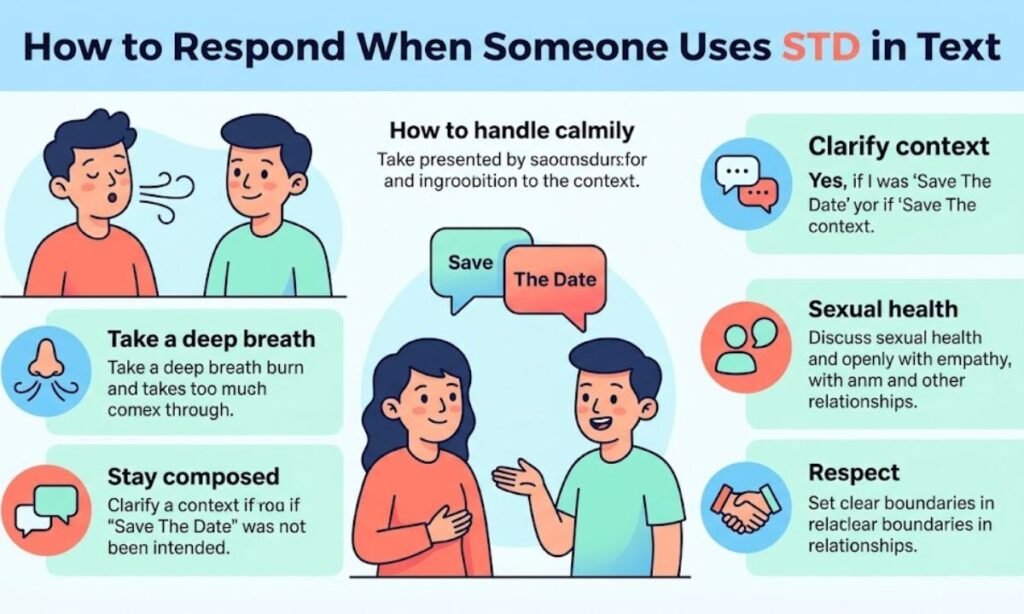
First, work out whether the person is talking about health. If it is unclear, a simple “Do you mean the health kind?” avoids awkward guesses.
Casual Reply
“Thanks for telling me. Hope you’re doing okay.”
Supportive Reply
“That took courage to share. I’m here if you want to talk or need company at the clinic.”
Informative Reply
“Getting tested is a smart step. Many infections have no symptoms, and public health bodies like the CDC recommend regular testing for some sexually active people. A doctor can tell you what fits your situation.”
Private or Respectful Reply
“I appreciate you trusting me. This stays between us.”
Light but Respectful Reply
“Good on you for staying on top of your health. Let me know how it goes, no pressure.”
Regional and Cultural Usage
These are broad patterns, and individuals vary a lot within every culture.
Western Culture
STD is widely known from school health classes and public health campaigns. Medical sources increasingly prefer STI, but both terms are understood. Conversations are relatively open, though the topic still feels personal.
Asian Culture
In many Asian communities, sexual health is discussed more privately, so the term may appear in DMs rather than public posts. In India, STD also has everyday non-medical uses, such as the telephone STD code and “Std” for a school class level.
Middle Eastern Culture
In many families and communities, sexual health is a private subject that people usually handle with a doctor. A text using STD is often treated as serious and personal, so discretion matters.
Global Internet Culture
Online, English abbreviations travel fast across languages and platforms. The same three letters can mean health, math, or travel, so the surrounding context decides the meaning.
what does std mean in text
In most chats, it means sexually transmitted disease. To confirm, check three clues:
- Health words nearby (test, clinic, results) point to the disease.
- Numbers after it (like “STD 2.4” or “STD 14:45”) point to standard deviation or departure time.
- A grade number (like “Std 6”) points to a school class.
what is std mean in text
The phrase is a common way people type the question, and the answer is the same: STD is an abbreviation. It is normally written in capitals and read letter by letter. Lowercase “std” is more common in casual typing and in code.
Std meaning in school teacher
In many Indian schools, “Std” is short for standard, meaning a class or grade. A line like “Std 8 maths teacher” means the teacher handles eighth grade.
In a statistics class, a teacher may use it for standard deviation. In a health class, it may refer to lessons on sexually transmitted diseases.
STD abbreviation Business
In business settings, the meaning depends on the department:
- Standard in terms, rates, or procedures
- Short-term disability in HR and insurance
- Scheduled time of departure in airline and logistics work
- Standard deviation in finance, quality control, and analytics
STD abbreviation in English
In English writing, the disease meaning is written in capitals without periods, with “STDs” as the plural. Style guides generally recommend spelling it out the first time in formal writing, then using the abbreviation after that.
Std abbreviation for standard
“Std” or “std.” is a common short form of standard on forms, product labels, and specifications, such as “std size” or “std delivery.” In C++ programming, “std” is also the name of the standard library namespace.
STD acronym funny
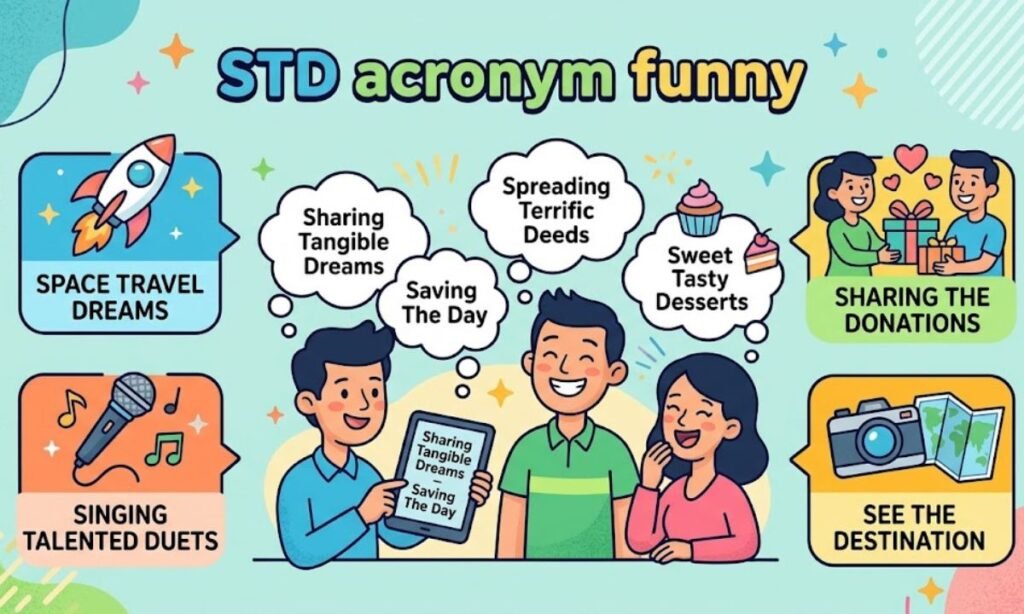
Some people make up playful backronyms for STD as jokes. These are invented on the spot and are not real meanings, so they should not be taken as definitions.
Joking about the term can hurt people who have dealt with it personally. If you share a joke, keep it away from anyone’s actual health.
Conclusion
In a text, STD almost always means sexually transmitted disease. Other meanings, such as standard, standard deviation, or short-term disability, appear in school, work, and travel settings.
Check the context before you reply, and keep your tone kind when the topic is personal. A thoughtful response matters more than the abbreviation itself.
Frequently Asked Questions
What does std mean in text messages?
In text messages, STD usually means sexually transmitted disease. It can also stand for standard deviation or standard, depending on the topic.
What does “STD” mean when someone texts it?
It most likely refers to sexual health, such as a test, a result, or awareness. If the conversation is about school, work, or flights, it may mean something else.
How do popular texting apps define std in chats?
Apps like WhatsApp, Instagram, and Snapchat only deliver messages and do not set an official meaning for STD. The meaning comes from the conversation.
Is STD the same as STI?
Not exactly. An STI is a sexually transmitted infection, while an STD is the disease it can become once it causes symptoms. Many people use them interchangeably.
Can STD mean something other than a disease in a text?
Yes. It can mean standard deviation, standard, short-term disability, or scheduled time of departure, depending on the context.
What does STD mean in math or statistics?
In math and statistics, STD is short for standard deviation, which measures how spread out a set of numbers is.
What does STD code mean on a phone number in India?
It refers to Subscriber Trunk Dialling, the area code you dial before a local number when calling from another city.
What does STD mean on a flight schedule?
On flight boards and airline documents, STD stands for scheduled time of departure, meaning the planned departure time.
Is it okay to bring up STD testing in a text?
It can be, if you keep the tone respectful and private. For sensitive conversations, many people prefer a call or an in-person talk.

I am a dedicated author with 6+ years of experience writing and researching content for name meaning websites. My expertise includes American names, baby names, surnames, name origins, and cultural significance. I focus on creating accurate, well researched, and easy to read articles using trusted sources. My goal is to help readers discover the history, meaning, and uniqueness behind every name with reliable and engaging content.