
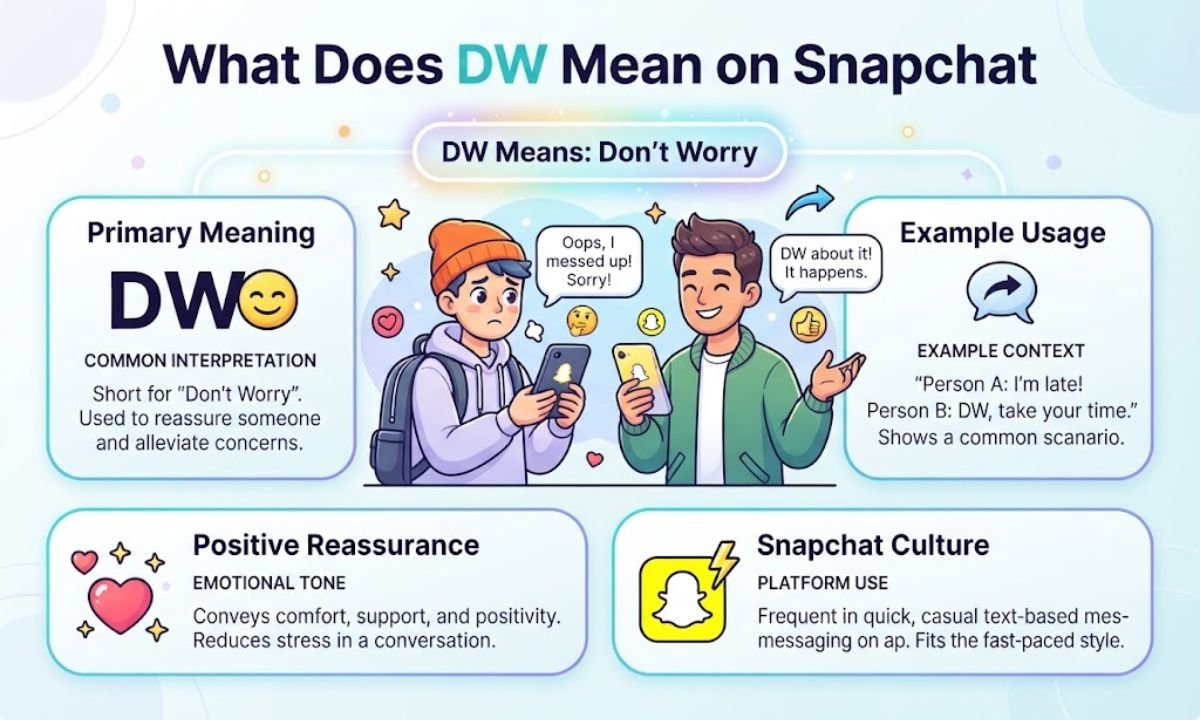

If you’ve been scrolling through Snapchat and someone replied with just “dw,” you’re not alone in wondering what it means.
Texting slang moves fast, and abbreviations like this one show up so often that missing the meaning can make a whole conversation feel confusing.
This guide breaks down everything you need to know about “dw” on Snapchat, from its exact definition to real examples, origin, tone, and when you should — or shouldn’t — use it yourself.
By the end, you’ll be able to spot “dw” in any chat, reply naturally, and understand the small emotional cues hiding behind two simple letters.
What Does DW Mean Snapchat?
“Dw” is one of the most common shorthand terms used across Snapchat, texting, and other messaging apps. It’s short, casual, and carries a reassuring tone that softens a conversation almost instantly.
Quick Definition
DW stands for “don’t worry.” People use it to calm someone down, brush off a small issue, or let a friend know that something isn’t a big deal. It’s almost always lowercase and rarely needs punctuation.
Simple Examples
- “I forgot to bring the charger.” → “dw I have an extra one”
- “Sorry I’m late!” → “dw, we just got here too”
- “Did I say something weird?” → “dw about it lol”
Each example shows the same pattern: someone expresses a small concern, and “dw” instantly diffuses it.
Why People Use DW
Typing full sentences on Snapchat can feel slow, especially in fast-moving group chats or Snap replies. “Dw” gives people a quick way to reassure a friend without breaking the pace of the conversation. It also feels more personal and less formal than typing out “don’t worry about it.”
Snapchat conversations tend to move quickly, with Snaps, replies, and stories all competing for attention at once.
In that environment, a two-letter reassurance keeps things moving without making the sender stop to think about wording. It’s practical as much as it is emotional, which is part of why it has stuck around for so long.
Origin & Background
Slang abbreviations like “dw” didn’t appear overnight. They grew out of decades of shorthand texting culture, then found a second life on visual, fast-paced apps like Snapchat.
Where Did DW Come From?
“Dw” is part of the same texting-abbreviation family as “brb,” “lol,” and “idk.” It became popular during the early SMS era, when character limits and slow typing speeds pushed people to shorten common phrases. As soon as “don’t worry” became a frequent thing to type, condensing it made sense.
The Influence of Internet Culture
Forums, early instant messengers, and chatroom culture all played a role in normalizing letter-based shorthand. Once these abbreviations became familiar across platforms, new apps simply inherited them instead of inventing new slang from scratch.
Social Media’s Role
Platforms like Twitter, Instagram, and Snapchat accelerated the spread of abbreviations because character limits and quick-reply formats rewarded brevity. Snapchat, with its Snap-and-reply structure, made short responses like “dw” even more practical.
How the Meaning Evolved
Originally, “dw” was a literal stand-in for “don’t worry.” Over time, it picked up a broader emotional role — used not just to calm someone down, but also to sound friendly, relaxed, or non-confrontational in everyday chats.
Today, “dw” often works as a small social cushion. It can close out an awkward moment, smooth over a minor mix-up, or simply signal that the sender isn’t taking something too seriously.
That flexibility is a big reason it has outlasted many other texting abbreviations from the same era.
Real-Life Conversations
Seeing “dw” used in different chat formats makes its meaning click faster than any definition alone.
WhatsApp Conversation
Sara: hey I think I left your umbrella at the cafe Jay: dw it’s an old one anyway
Instagram DM Conversation
Mia: omg I liked your old photo by accident 😭 Leo: haha dw everyone does that
TikTok Comment Section
User1: wait did I say the wrong lyrics in my duet 😅 User2: dw no one even noticed
Text Message Conversation
Mom: I might be 10 minutes late picking you up You: dw take your time
Emotional & Psychological Meaning
Beyond its literal definition, “dw” carries emotional weight that shapes how a conversation feels.
What Emotion Does DW Express?
At its core, “dw” expresses reassurance and calm. It signals that the listener isn’t upset, annoyed, or bothered by whatever was just said. In many cases, it also carries a quiet sense of warmth, letting the other person know the small moment won’t affect how they’re seen or treated.
Why People Use It
People reach for “dw” because it’s efficient at managing small social tension. Instead of over-explaining that something is fine, a short reply closes the topic quickly and keeps the conversation light.
What It Reveals About Modern Communication
The popularity of “dw” reflects how digital communication favors speed and emotional shorthand. Instead of long reassurances, people rely on compact phrases that still carry warmth and empathy.
It shows how much emotional nuance can be packed into just a few characters when the context is already understood between two people.
Personal-Style Scenario
Imagine texting a friend after accidentally missing their Snap streak. A simple “dw, streaks aren’t that deep” instantly resets the mood, showing that brief responses can still feel genuinely comforting.
Or picture sending an awkward Snap by mistake to the wrong group chat. A quick “dw lol happens all the time” from a friend can turn a small embarrassment into a shared laugh instead of a lingering worry. These tiny moments are exactly where “dw” earns its keep.
Usage in Different Contexts
“Dw” isn’t a one-size-fits-all phrase. Its tone shifts slightly depending on where and with whom it’s used.
Social Media
On platforms like Snapchat, Instagram, and TikTok, “dw” is used casually and constantly, especially in comment replies, captions, and direct messages.
Friends & Relationships
Among friends or partners, “dw” often carries warmth and closeness. It can soften disagreements or simply reinforce that everything between two people is okay.
Work or Professional Settings
In workplace chats, “dw” is far less common and generally best avoided in formal emails, though it sometimes appears in casual internal messaging apps like Slack among close teammates who already share an informal rapport.
Casual vs Serious Tone
“Dw” works best in low-stakes situations. For serious emotional conversations, it can come across as dismissive if used without enough context or empathy.
A good rule of thumb: if the topic is small enough to forget by tomorrow, “dw” usually fits. If it’s something that needs a real conversation, a fuller reply almost always lands better.
When NOT to Use It
While “dw” is handy, there are situations where it can backfire or seem inappropriate.
Professional Communication
Formal emails, client messages, or workplace documentation should avoid slang entirely, since it can look unprofessional or careless.
Sensitive Situations
If someone shares a genuine worry, grief, or serious problem, replying with just “dw” can feel dismissive rather than comforting. A fuller response usually works better here, since it shows the sender took time to actually acknowledge what was said rather than brushing past it.
Cultural Differences
Not everyone is familiar with texting shorthand, especially across generations or regions where English abbreviations aren’t part of everyday digital culture. Using “dw” with someone unfamiliar with slang may cause confusion.
Potential Misunderstandings
Without tone or emojis, “dw” can sometimes come across as short or curt, even if that isn’t the intention. Context matters more than the abbreviation itself.
Common Misunderstandings
A few small mix-ups happen often when people first encounter “dw” in chats.
Thinking DW Means Something Negative
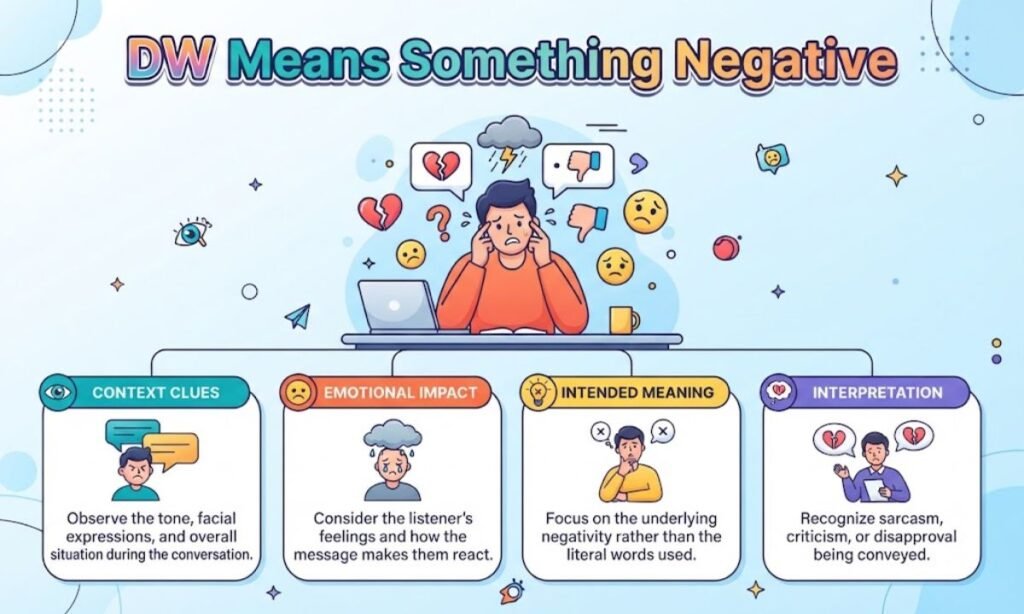
Some new users mistake “dw” for something dismissive or rude, when it’s usually meant to be comforting rather than negative.
Assuming It Is Sarcastic
Without emojis or punctuation, “dw” can occasionally be misread as sarcastic. Most of the time, though, it’s simply casual and sincere.
Literal vs Emotional Meaning
While “dw” literally means “don’t worry,” its emotional meaning often carries more weight — signaling reassurance, friendliness, or a desire to keep things drama-free.
Understanding this distinction helps avoid overreading a short reply. Most of the time, “dw” is exactly what it looks like on the surface: a quick, low-effort way to say everything is fine.
Comparison Table
Here’s how “dw” compares to a few other common texting abbreviations people often confuse with it.
| Abbreviation | Meaning | Typical Tone | Common Use Case |
| DW | Don’t worry | Reassuring, casual | Calming a friend down |
| NP | No problem | Friendly, neutral | Responding to thanks |
| IDC | I don’t care | Neutral to blunt | Expressing indifference |
| MB | My bad | Apologetic | Owning a small mistake |
| IKR | I know, right | Agreeable | Reacting to a statement |
Key Insight
While these abbreviations sometimes overlap in casual chats, “dw” stands out because its main purpose is emotional reassurance rather than agreement, apology, or indifference.
Knowing the difference helps you pick the right response instead of defaulting to whichever abbreviation comes to mind first.
Variations / Types
“Dw” shows up in several slightly different forms depending on the platform, group of friends, or personal texting style.
DW
The standard, most widely recognized version, used exactly as “don’t worry.”
DWW
A playful, exaggerated version some users type for emphasis, often used jokingly among close friends.
DW
Sometimes typed in all caps — “DW” — for stronger emphasis, especially when reassuring someone who seems genuinely anxious.
DW Bro
A casual variation common among male friend groups, adding a friendly, laid-back tone.
DW Mate
A regional variation popular in the UK and Australia, often paired with “mate” for added friendliness.
DW About It
A slightly longer version that softens the message further and feels a bit more conversational.
DW I’ll Handle It
Used when someone is taking responsibility for fixing a problem, reassuring the other person that no action is needed from them.
DW We Got This
A team-oriented variation, often used in group projects or plans to express shared confidence.
DW Everything’s Fine
A more detailed reassurance, typically used when someone senses the other person needs a bit more comfort than usual.
DW You’re Good
A common phrase used to let someone know they haven’t done anything wrong, often after an apology.
How to Respond When Someone Uses It
Knowing how to reply to “dw” keeps the conversation flowing naturally.
Casual Replies
- “okay, thanks!”
- “appreciate it”
- “cool, np”
Funny Replies
- “you’re the real MVP”
- “dw yourself lol”
- “noted, boss”
Mature Replies
- “thanks for understanding”
- “I appreciate you saying that”
- “good to know, thank you”
Respectful Replies
- “thank you for being so understanding”
- “that means a lot, thanks”
- “I appreciate the reassurance”
Regional & Cultural Usage
The way “dw” is used can shift slightly depending on where you are in the world.
Western Culture
In the US, UK, Canada, and Australia, “dw” is extremely common across texting apps and social media, especially among teens and young adults.
Asian Culture
In many parts of Asia, English texting slang like “dw” is popular among younger, English-speaking or bilingual social media users, especially on Snapchat and Instagram.
Middle Eastern Culture
Younger users in the Middle East frequently mix English abbreviations like “dw” into Arabic or other native-language conversations, especially in casual chats among friends.
Global Internet Usage
Because English is the dominant language of internet slang, “dw” has spread globally through memes, comment sections, and cross-cultural online communities.
Generational Differences
Gen Z and younger millennials use “dw” the most, while older generations may recognize it but use it less frequently in daily conversation. Older millennials and Gen X users may still prefer full phrases, even in casual texts, simply out of habit.
Is It Safe for Kids?
“Dw” itself is harmless and simply means “don’t worry,” making it one of the more innocent pieces of texting slang.
Understanding the Context
Parents don’t need to worry about the abbreviation itself, but it’s always a good idea to stay aware of the overall context of a conversation, since tone and intent matter more than any single acronym. Learning common shorthand like “dw” can also make it easier for parents to follow along with their kids’ conversations without feeling lost in translation.
DW in Gen Z Slang
Among Gen Z, “dw” is used constantly and often paired with other slang terms like “fr,” “lowkey,” or “no cap” to build a relaxed, conversational tone. It’s less about formality and more about keeping messages quick, warm, and low-pressure.
This layering of slang terms is a defining feature of Gen Z texting style. A message like “dw fr, it’s not that deep” packs reassurance, emphasis, and casual tone into a single short line, which is exactly the kind of efficient communication this generation tends to favor.
What Does DW Mean From a Girl
When a girl uses “dw” in a chat, it almost always carries the same core meaning — reassurance. Depending on the context, it can also signal that she’s comfortable enough with the conversation to keep things casual rather than overly formal.
MB Meaning in Chat
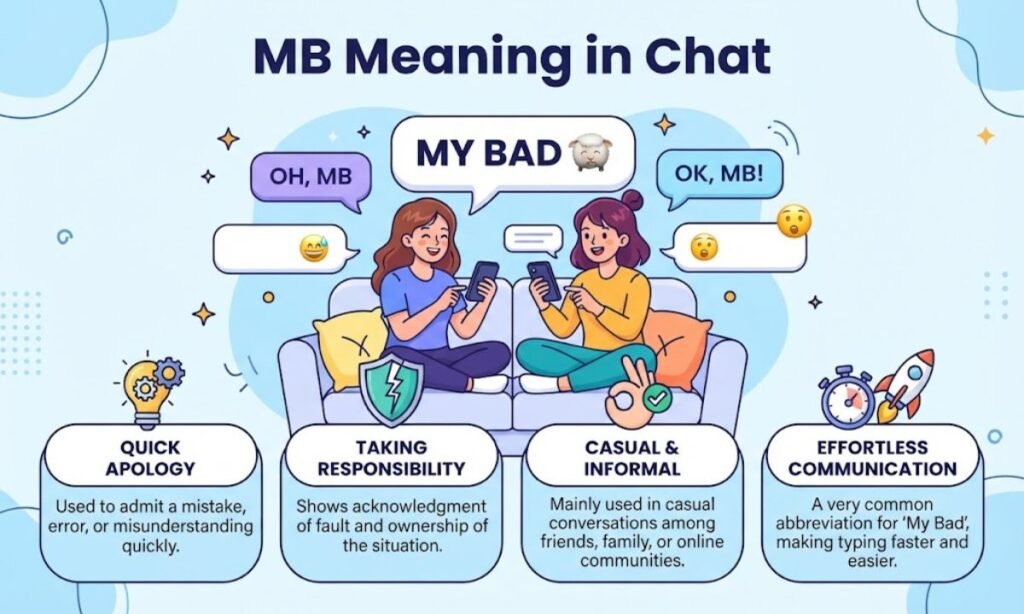
“MB” stands for “my bad,” a short way of admitting a small mistake. It’s often used right before or after someone replies with “dw,” creating a quick apology-and-reassurance exchange.
What Does DW Mean in Text From a Guy
Just like with any sender, “dw” from a guy typically means “don’t worry” and reflects a relaxed, friendly tone. It’s rarely meant to carry hidden meaning and is usually just a quick way to ease tension in the conversation.
Conclusion
“Dw” is one of the simplest yet most useful pieces of texting slang on Snapchat today. It means “don’t worry,” and its main job is to keep conversations light, reassuring, and free of unnecessary stress.
Once you know the meaning, spotting it in chats becomes second nature. Whether a friend types it after a small mistake or you use it yourself to calm a conversation down, “dw” remains a small phrase with a genuinely comforting purpose.
At the end of the day, “dw” works because it’s simple, quick, and easy to understand. It fits naturally into fast-paced Snapchat chats without losing any warmth. Once you start noticing it, you’ll see just how often it quietly keeps conversations feeling relaxed.
Frequently Asked Questions
What does “dw” mean in Snapchat chats?
“Dw” stands for “don’t worry” and is used to reassure someone or downplay a small issue in a Snapchat conversation.
How to interpret “dw” in Snapchat conversations?
Read it as a friendly, low-stakes reassurance rather than anything negative — it usually means the sender isn’t bothered or upset.
What is the meaning of “dw” in social media messaging apps?
Across platforms like Instagram, TikTok, and WhatsApp, “dw” carries the same meaning as on Snapchat: “don’t worry,” used to keep the tone casual and calm.
Is “dw” an acronym used on Snapchat and what does it stand for?
Yes, “dw” is a common Snapchat acronym that stands for “don’t worry,” typically used to comfort or reassure the other person in a chat.

I am a dedicated author with 6+ years of experience writing and researching content for name meaning websites. My expertise includes American names, baby names, surnames, name origins, and cultural significance. I focus on creating accurate, well researched, and easy to read articles using trusted sources. My goal is to help readers discover the history, meaning, and uniqueness behind every name with reliable and engaging content.